RSS Feed

Tag Archives: fall

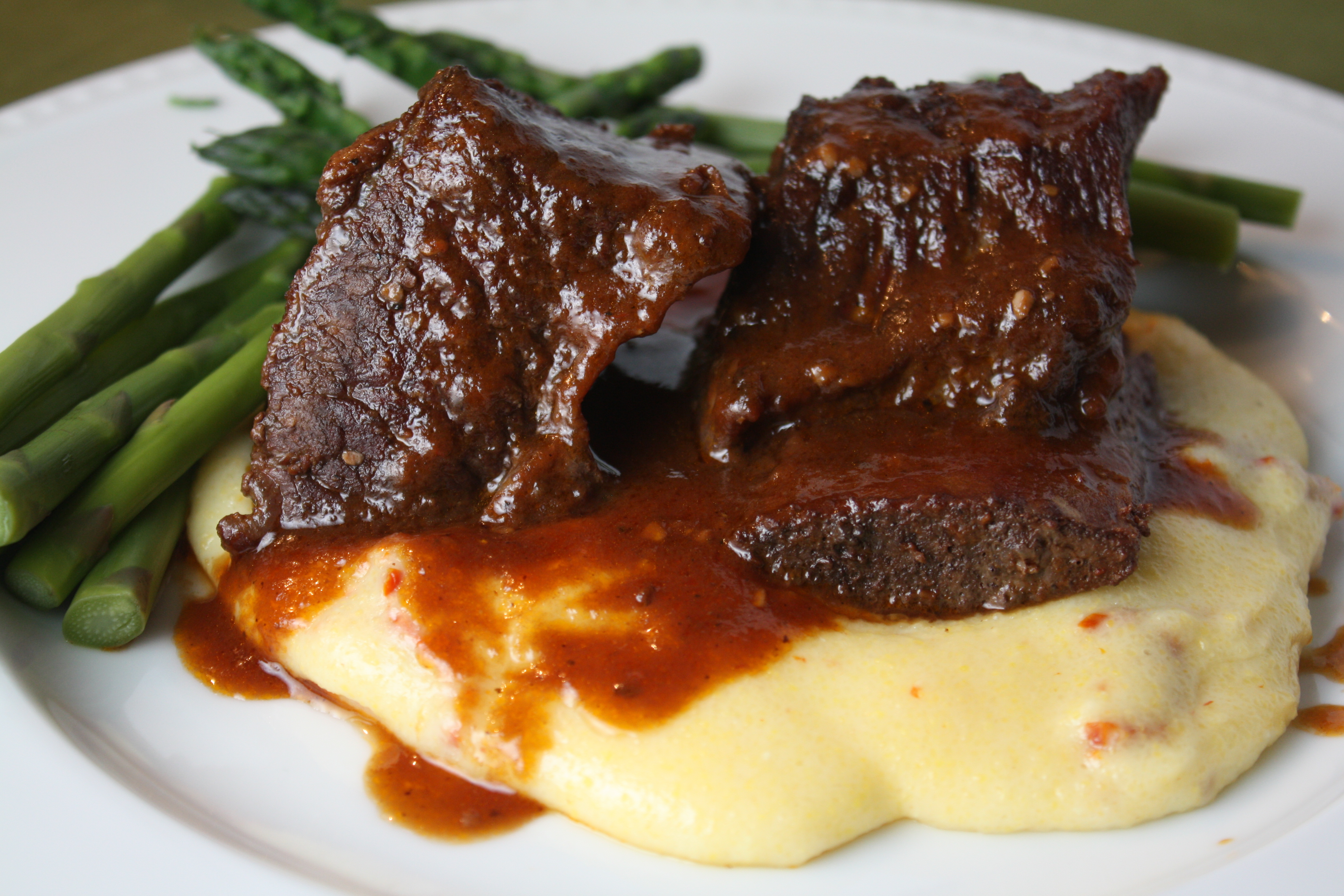
Braised Short Ribs with Creamy Parmesan and Sun-Dried Tomato Polenta

Last weekend, I received a recipe request from my uncle. We were seated around a table at the Venus Restaurant, a little diner where my grandmother has breakfast each and every morning. Each day, my grandmother is joined by at least one, and sometimes many, of my aunts, uncles, and cousins. Whenever my family travels to Long Island, we’ve made it a routine to join the group at breakfast before we hit the road for home. I get the corned beef hash and eggs every time; eggs cooked over-hard, rye toast, and fries.
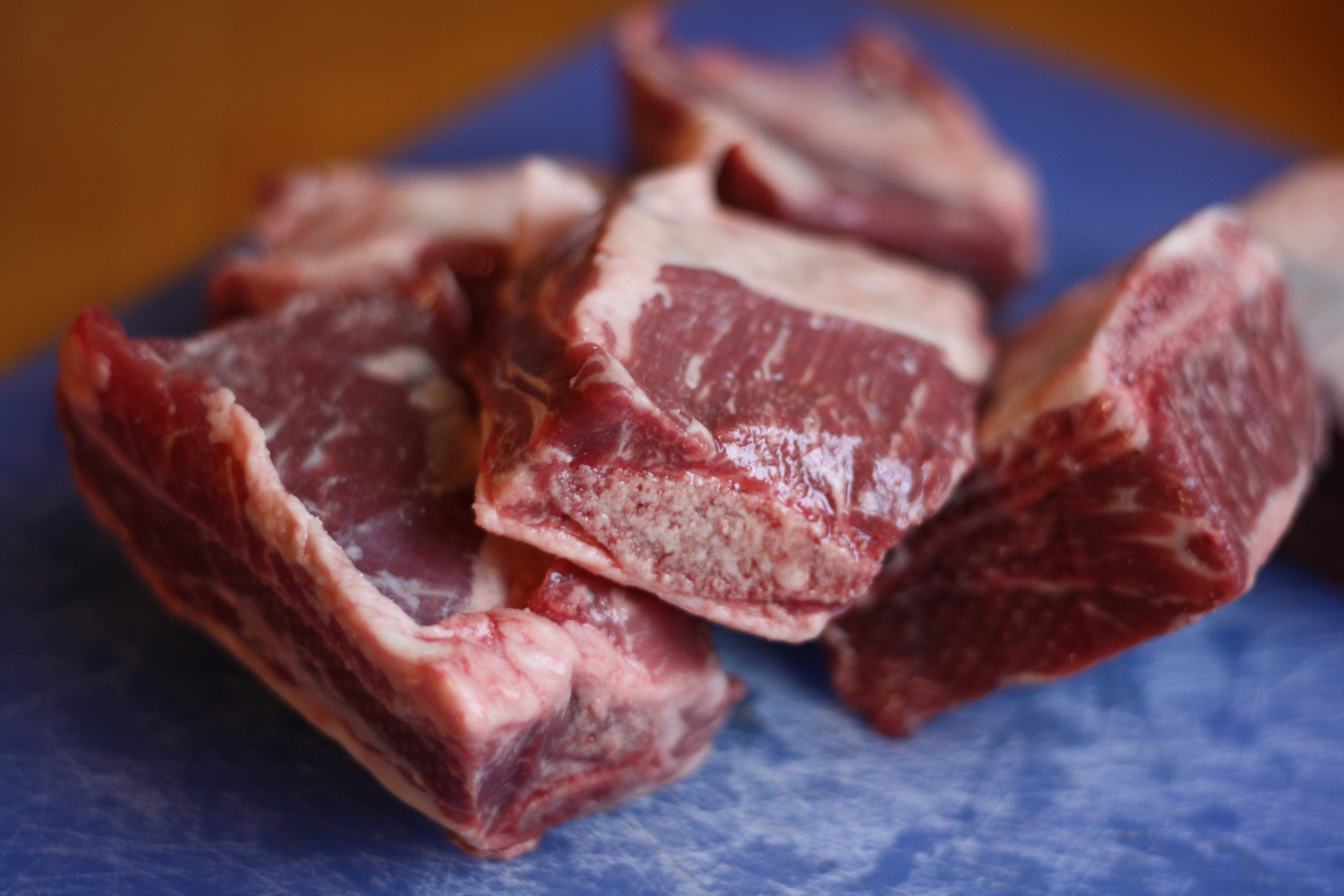
Well, this past weekend, as I was eating my corned beef  hash and eggs, my family was discussing some of their favorite recipes from this very blog. It thrills me to know that the people I love are enjoying my little work of culinary joy. We talked of gravies, soups, and macaroni and cheese. And then my Uncle Gene asked if I take requests. I absolutely take requests!! In fact, I love requests. His request was clear and precise; braised short ribs with polenta. My mouth watered at the thought. It didn’t take me more than a minute to formulate a plan.
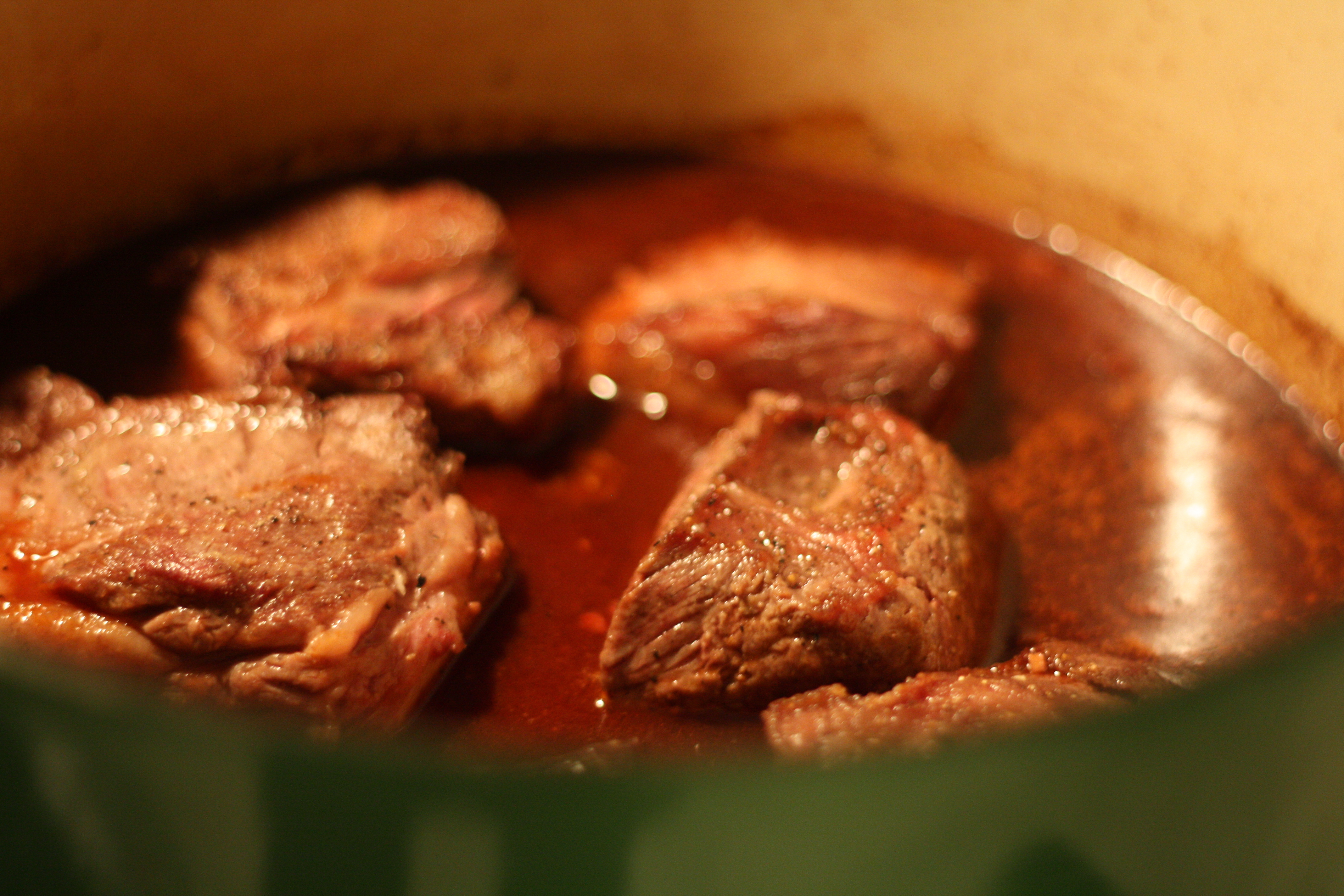
Braising is a wonderfully simple technique which produces extraordinary results. During braising, meat is typically seared over high heat and then cooked slowly in a bit of liquid at a lower temperature. The slow cooking process breaks down the connective tissues of tougher cuts of meat, resulting in a very tender and flavorful result. As the meat cooks, the braising liquid reduces and thickens into a ready made sauce for your completed dish. Combine whatever liquids and seasonings strike your fancy. For the braising liquid in this dish, I chose to use a simple combination of beef stock and red wine, combined with accents of tomato paste, garlic, and onion. Perfection in simplicity.

My uncle requested polenta to accompany the braised short ribs. Polenta is, quite simply, boiled cornmeal. A basic polenta is made from yellow cornmeal, simmered in boiling water or stock until it’s smooth and thickened. To add a bit of rich creaminess to our polenta, I incorporated butter and cream at the end. The addition of parmesan cheese and sun-dried tomatoes makes this polenta the perfect partner to our tomato accented short rib sauce.
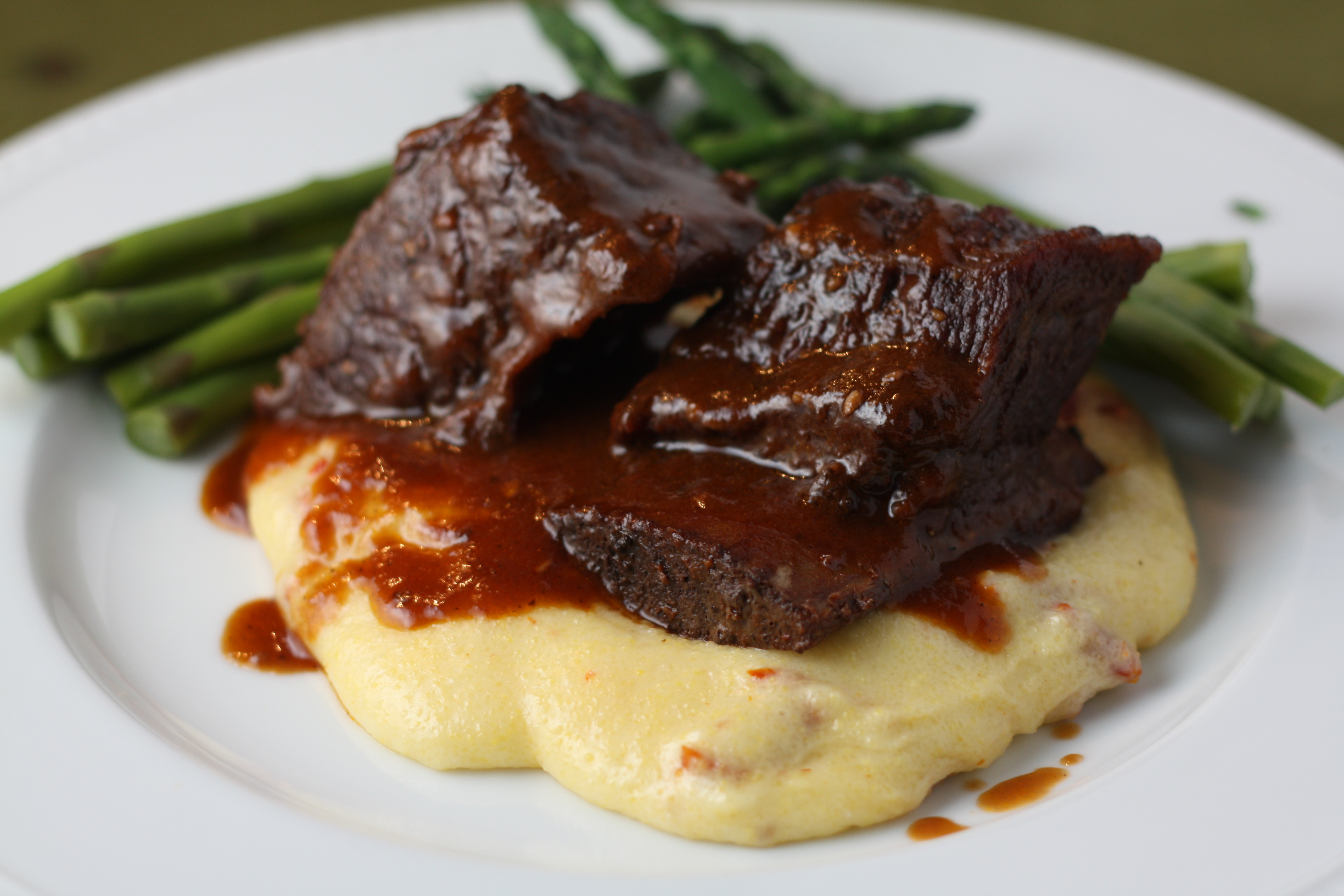
Braised Beef Short Ribs

Ingredients

  • 6 Beef Short Ribs
  • 3 Tbsp Olive Oil
  • 3 cloves Garlic, minced
  • 1/2 Onion, finely diced
  • 2 cups Beef Stock
  • 1 cup Red Wine
  • 1/4 cup Tomato Paste
  • Salt and Pepper

Directions

Preheat oven to 350 degrees. Heat olive oil in a large oven-safe pan over medium/medium-high heat. Season the short ribs with salt and pepper. Add the short ribs to the pan and cook for a minute or two on each side until nicely browned. Remove the short ribs from the pan and set aside. Reduce the heat to medium. Add the onion and garlic. Cook for 3-4 minutes until the onion is soft and golden. Add the red wine, beef stock and tomato paste. Whisk to combine. Bring to a simmer and allow the mixture cook for about 3-5 minutes. Place the short ribs in the liquid. (They will not be fully submerged.) Cover the pan and place it in the oven. Cook for about 2 hours.

After two hours, remove the pan from the oven. The meat will have pulled away from the bones. Remove the short ribs from the liquid and set aside. Discard any bones which have fallen away from the meat. Strain the sauce. Allow the sauce to sit for a couple minutes so that the excess fat will rise to the surface. Skim the excess fat off of the sauce. Taste and season with salt and pepper. If you desire a thicker sauce, pour the sauce into an uncovered saucepan and simmer until the sauce has reduced to your desired consistency.

Serves 2-3

Creamy Parmesan and Sun-Dried Tomato Polenta

Ingredients

  • 2 cups Water, divided
  • 1/2 cup Coarse-Ground Yellow Corn Meal
  • 1/4 tsp Salt
  • 2 Tbsp Butter
  • 1/3 cup Pecorino Romano or Parmigiano Reggiano Cheese, grated
  • 1/4 cup Light Cream
  • 1/3 cup sun-dried tomatoes, diced
  • Salt and Pepper

Directions

Bring 1 1/2 cups water to a boil. Meanwhile, in a small bowl, combine the remaining water, corn meal, and salt. Once the water is simmering, slowly stir in the cornmeal mixture until smooth. Continue stirring and cooking over low heat for a couple minutes until the mixture thickens. Cover and allow to cook over low heat for 5 more minutes. Stir in the butter, cheese, sun-dried tomatoes, and cream. Taste and adjust seasoning with salt and pepper.

Serves 2-4

Roasted Vegetable Pasta Primavera

Roasted vegetables are winter’s answer to grilled vegetables. In some parts of the country, the flowers are blooming and flip-flops are still appropriate footwear. But up here, we awoke to a world coated in white. Winter has arrived. And when the weather gets cold and the grill has been packed away for the season, it’s time to fire up the oven for some sweet roasted vegetables. The best part about roasting veggies is that it has the ability to coax some fantastic flavor out of some normally lackluster winter produce.

I love roasted vegetables on ciabatta bread with fresh mozzarella and pesto, toasted in the oven. Yum! It’s one of my favorite sandwiches in the world. But today we’re adding our delicious roasted veggies to a pesto pasta dish for a cold weather version of Pasta Primavera.

Roasted Vegetable Pasta Primavera

Ingredients

  • 1 Squash, cut in half lengthwise and sliced into half-moons
  • 1 Red Bell Pepper, cut in half, seeds and ribs removed
  • 1 1/2 cups Grape Tomatoes, rinsed
  • 1 1/2 cups small Mushrooms, rinsed
  • 2-3 Tablespoons Olive Oil
  • Salt and Pepper
  • 1 pound Pasta

For the Pesto:

  • 1 big bunch of basil
  • 1/4 cup pine nuts
  • 1 Tbsp lemon juice
  • 1/4 cup parmesan (or parmesan cheese blend)
  • 1 Tbsp minced garlic
  • 6 Tbps+ olive oil
  • Salt and Pepper

Directions

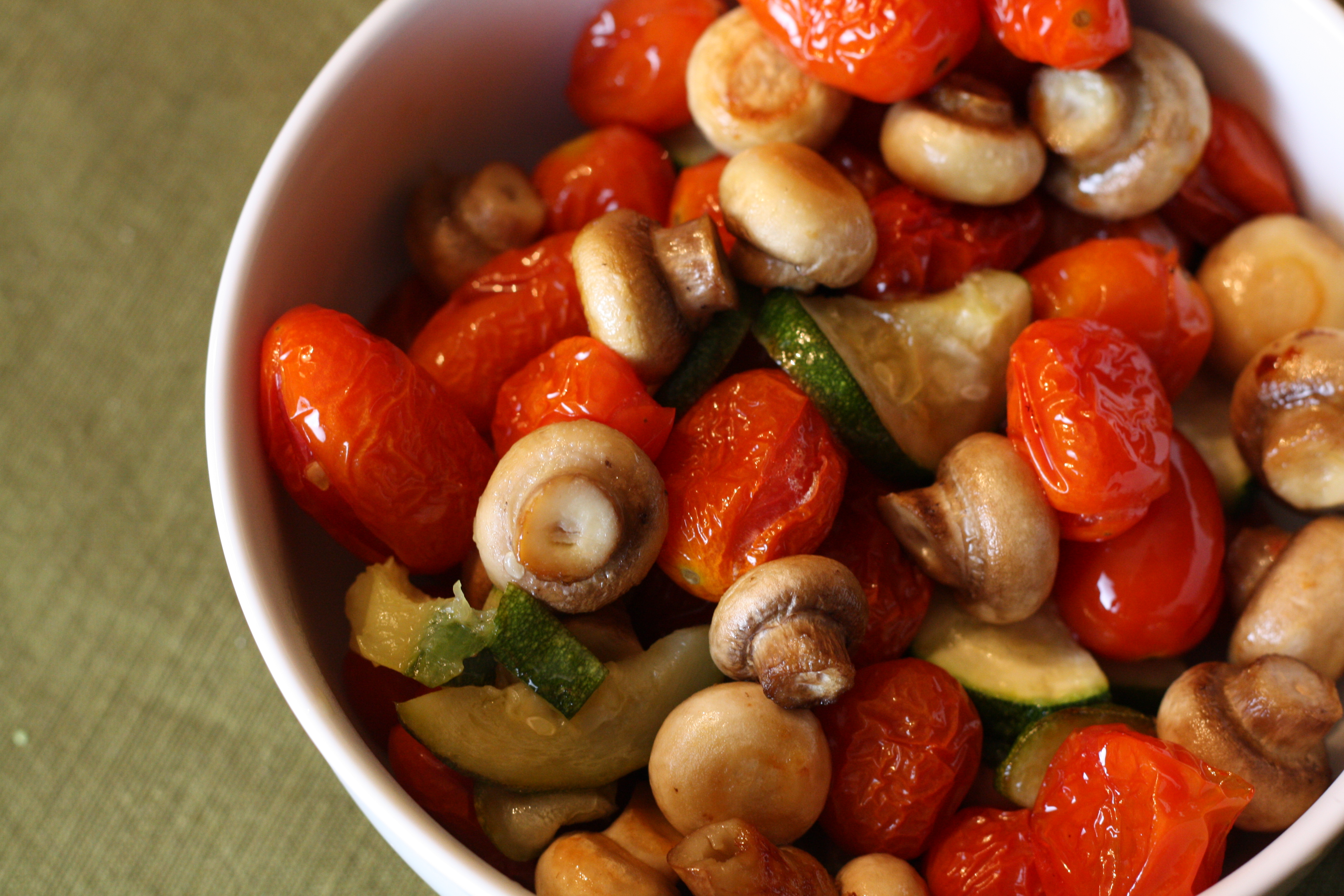
Preheat oven to 400 degrees. Toss the vegetables in olive oil and arrange on a baking sheet. Place the pepper halves cut side down. Cook for 20-35 minutes. The squash will probably be ready in about 20-25 minutes. The remaining veggies will take longer. Remove the veggies from the oven. Place the pepper halves in a ziploc bag to help the skin to pucker as it cools. Season the remaining veggies in a bit of salt and pepper. When the pepper has cooled, remove from the ziploc and peel away the skin. Cut the pepper into small pieces.

Cook the pasta according the package directions. While the pasta is cooking, prepare the pesto. Pull the basil leaves off of the stem.  Place in a food processor and pulse slightly, giving the leaves a course chop. Add all other ingredients, except the oil, and mix until well blended. Gradually incorporate the oil until you reach your desired consistency. Taste and adjust seasonings.

When the pasta has finished cooking, strain and return to the pot. Toss the pasta with some of the pesto and the roasted veggies. Serve hot with grated parmesan cheese.

Serves about 6


Four Variations on Thanksgiving Leftovers

Preparing a Thanksgiving feast for a crowd can be both exhilarating and utterly exhausting. At the end of the day, your kitchen looks like a tornado has whipped through it and you probably feel as if you’ve completed a triathlon. But, your belly is full, your guests have been well fed, and if you’re lucky, your fridge is filled with leftovers. Those are all things to be most thankful for.

Is there anything better than Thanksgiving leftovers?? I think not. Perhaps the most joyous part of a fridge full of Thanksgiving leftovers is being able to put your feet up for a few days, recover from the cooking marathon, and live off of the ready-made meals in your fridge. While it would be perfectly delicious to just reheat a plate of Thanksgiving dinner each night, it’s nice to add a little variety to leftovers; make it feel like a fresh meal every night. With that in mind, I offer you four simple variations on Thanksgiving leftovers.

Thanksgiving Leftover Variation #1 – Turkey Soup

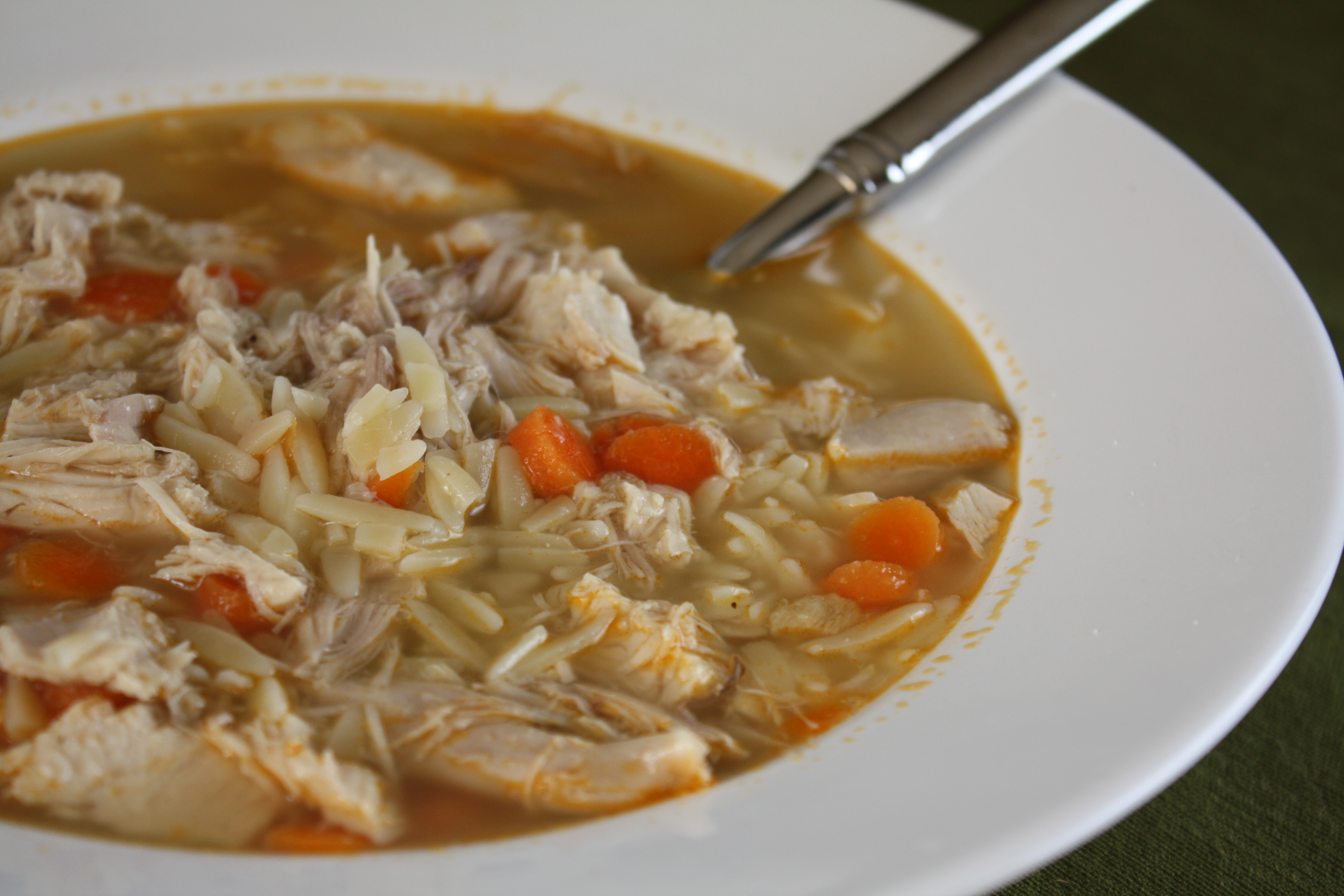
Don’t let that turkey carcass go to waste! There’s so much flavor waiting to be extracted from those bones. Get the broth started right after dinner. Simply throw the whole turkey carcass into a large pot, cover with water, and simmer (partly covered) for 3-4 hours. Don’t worry if there’s still some meat or turkey skin hanging on the turkey! Just throw the whole thing in the pot and let it start working while you sit down to enjoy some pumpkin pie. Once it’s simmered, strain the broth and refrigerate overnight. The next day, you can finish making the soup. Click here for my step-by-step guide to making a basic chicken soup. You can follow the same process for turkey soup.
Thanksgiving Leftover Variation #2 – Open-faced Thanksgiving Sandwich

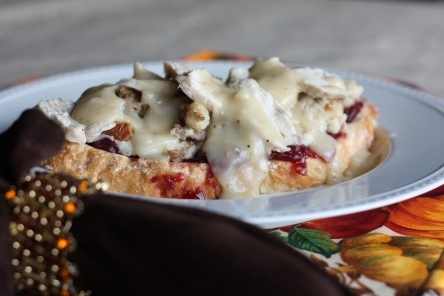
In my opinion, this is the best way to use leftovers on the day after Thanksgiving, when you’ve still got a bit of everything in the fridge. Simply reheat some leftover turkey, stuffing, and mashed potatoes. Spread some cranberry sauce on a lightly toasted slice of thick, doughy bread. Then, top the cranberry sauce with the hot turkey, stuffing and mashed potatoes. Drizzle hot gravy over the entire thing and enjoy. This is a knife and fork kind of sandwich; simple, hearty, and satisfying.

Click here for more details on making an open-faced turkey sandwich any time of year.

Thanksgiving Leftover Variation #3 – Roast Turkey, Brie, and Homemade Apple Butter Melts

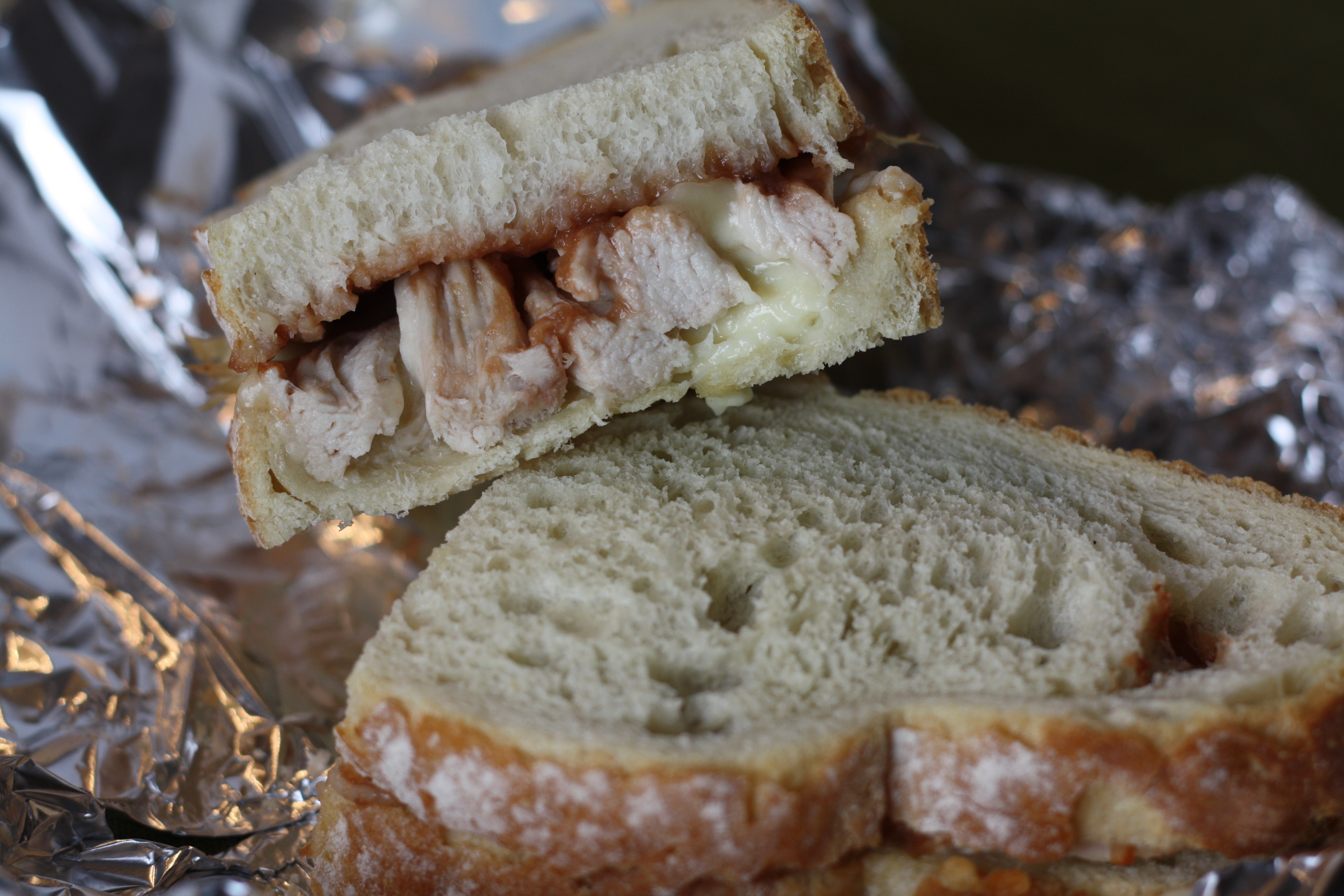
This is my new personal favorite. Such a perfect combination of flavors. I happen to love apple butter; always have and probably always will. You can find it in most grocery stores, usually near the  jams and jellies. Look for one which doesn’t contain a lot of unnecessary added sugar or corn syrup. Apple butter really doesn’t need anything other than apples and a bit of apple cider or apple juice. Apple butter is a cinch to make at home. So, if you can’t find any at your store, follow my simple recipe to make your own. And, if apple butter just isn’t your thing, substitute some leftover cranberry sauce on these sandwiches. It will pair beautifully with the brie.

For the sandwiches, thinly slice brie and spread it onto a sturdy piece of bread. I prefer to use ciabatta or pain de campagne, but any doughy, crusty bread should work. Spread apple butter (or cranberry sauce) onto another piece of bread. Place a few slices of roasted turkey breast between the bread slices. Loosely wrap the sandwich in foil and bake for about 20-25 minutes in a 350 degrees oven, until the cheese has melted, the bread feels slightly toasted, and the turkey is warm.

Homemade Apple Butter

Ingredients

  • 5-6 Apples, peeled, cores removed, and coarse chopped
  • 1 1/2 cups Apple Cider
  • Cinnamon Stick (optional)

Directions

Preheat oven to 250 degrees. Simmer the apple pieces in the apple cider for about 20 minutes. If desired, add a cinnamon stick to simmer with the mixture. Then, puree the apples until smooth. Pour the puree into an oven-safe covered pan and place in the oven for about 5 hours. The apple butter will darken to a rich brown as it cooks.

Thanksgiving Leftover Variation #4 – Turkey Salad Sandwiches

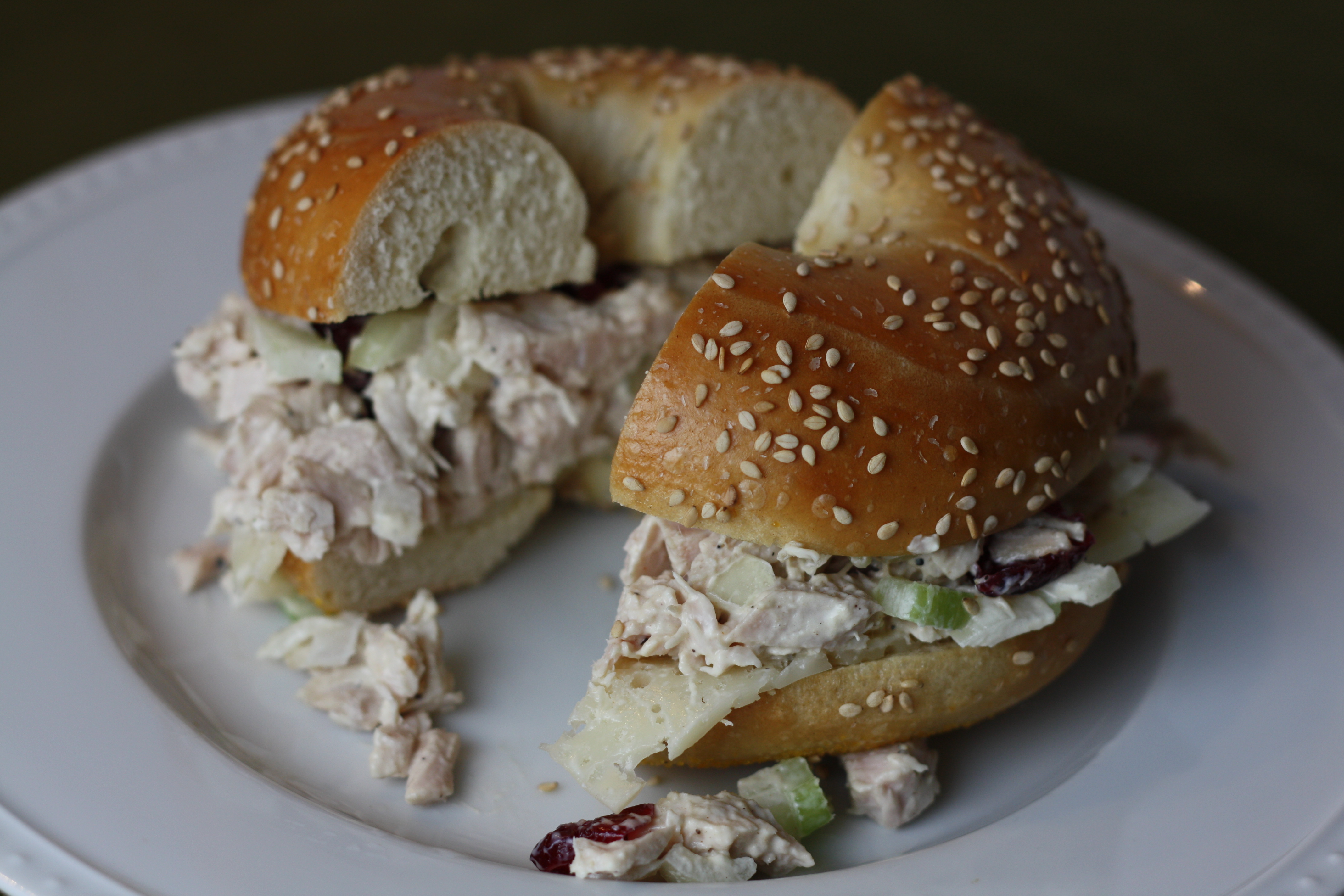
Turkey Salad is a simple and delicious way to breathe new life into the remainder of your turkey leftovers. I love it on a lightly toasted bagel with a slice of swiss cheese. To make a basic turkey salad, simply chop or tear your leftover turkey into small pieces. Add some finely diced onion and celery. Combine with just enough mayonnaise and mustard to bind the salad. Season with salt and pepper, as desired. Stir in some dried cranberries for an extra tasty touch!

Hot Doughy Buns with Cheesy Cheddar Soup

During the past week, we worked our way through a full Thanksgiving meal. The kids and I are still diligently working on finishing the leftover pies. Let’s take a quick look at the Thanksgiving menu we covered…

Herb-Roasted Turkey Breast with Pan Gravy

Sausage, Apple, and Leek Stuffing

Cranberry Orange Sauce

Spiced Sweet Potato Puree with Pecan Streusel

Shaved Apple-Fennel Salad

Roasted Garlic Smashed Potatoes

Green Beans Almondine

Roasted Brussel Sprouts with Bacon and Walnuts

Sweet Honey Cornbread

Fresh Pumpkin Coconut Pie

Chocolate Pecan Pie

Sounds like a pretty spectacular meal to me! But, I promised you one more thing; homemade hot, doughy rolls. Recently, I was glancing through the current Thanksgiving-themed edition of Food Network magazine and I ran across the most mouthwatering, step-by-step guide for soft, doughy dinner rolls. They looked even better than my husband’s favorite Thanksgiving rolls, which we usually buy pre-made from our grocery store. I had to give this recipe a try.

I made one small adaptation to the recipe as published in Food Network magazine. The original recipe calls for mixing the dough using a stand mixer. While this is a convenient option, I’m hesitant to share recipes which require special equipment, since I recognize that not everyone has access to a stand mixer. So, I tested the dough out by hand. And it worked perfectly! If you have a stand mixer, go ahead and use it, but if you don’t, rest assured that it’s totally possible to make these delicious rolls by hand.

And, are you ready for the best part about these rolls?? The dough can be completely prepared ahead of time and frozen until ready to use, which makes this a totally doable addition to your Thanksgiving table. The recipe produces a huge batch of twenty-four rolls. I baked eight last night for our dinner and threw the remaining sixteen in the freezer for Thanksgiving!

Hot, Doughy Dinner Rolls

Adapted from the Food Network Magazine recipe for Parker House Rolls by Alex Guarnaschelli

Ingredients

  • 1 packet Dry Active Yeast
  • 1/2 cup Warm Water (110-115 degrees)
  • 1/2 cup Sugar
  • 1 cup Flour
  • 1 1/2 sticks Butter, melted and cooled
  • 2 cups Whole Milk (at room temperature)
  • 2 Eggs (at room temperature)
  • 1 Tablespoon Salt
  • 6 1/2 cups Flour
  • Butter for Brushing

Directions

Sprinkle the yeast in the bottom of a large bowl. Stir in the warm water and sugar. Wait a minute. Then, mix in the 1 cup of flour until well combined. Set aside.

In a large bowl, stir together the melted butter and milk. Whisk in the eggs. Stir in the yeast mixture. Gradually stir in the flour and the salt, a cup or so at a time, until a ball of dough forms. Towards the end of mixing, you may find it easier to use your hands to knead the remaining flour into the dough. Add up to 1/2 cup additional flour if the dough seems too sticky.

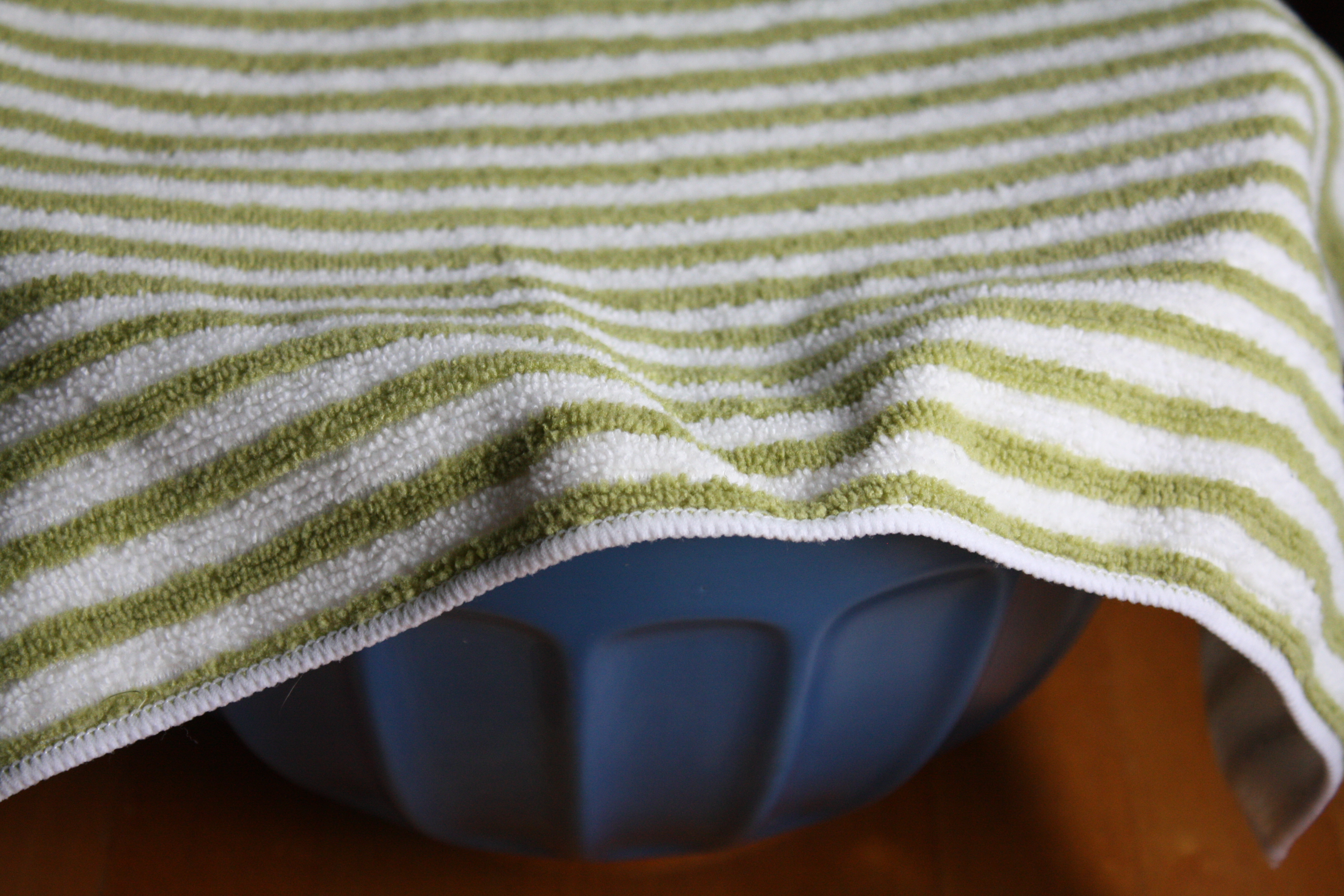
Place the ball of dough into a large bowl which has been brushed with melted butter. Loosely cover with a towel and allow to rest at room temperature for about 2 1/2 hours. The dough should double in size.

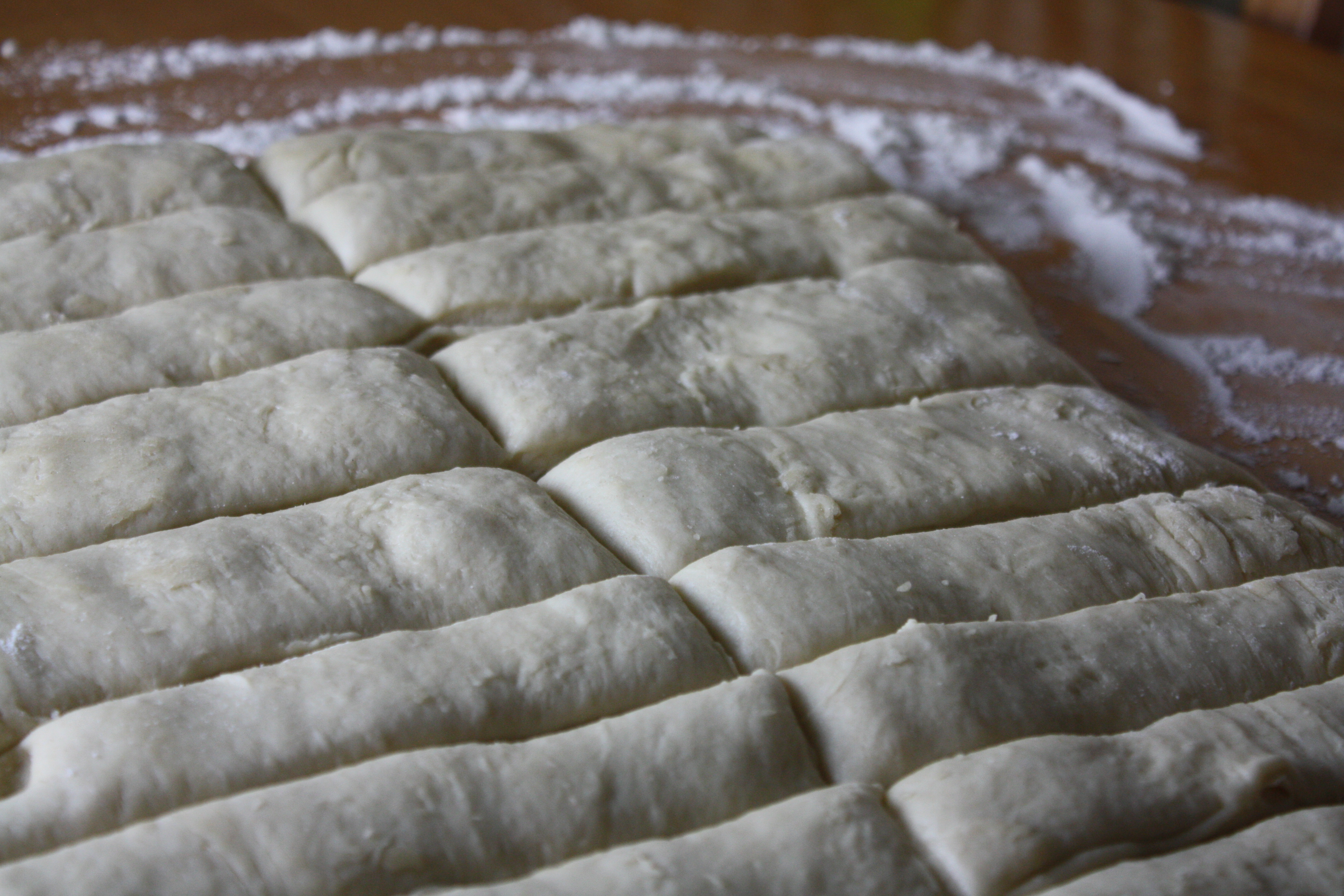
Once the dough has risen, place the dough onto a well-floured work surface. Using your hands to press and pull the dough, form a rectangle, about 18 inches long by 8 inches wide. It should be about 1/2 inch thick.

Using a knife, cut the dough in half lengthwise. Then, cut the dough crosswise into 12 strips. You should have 24 total dough strips.

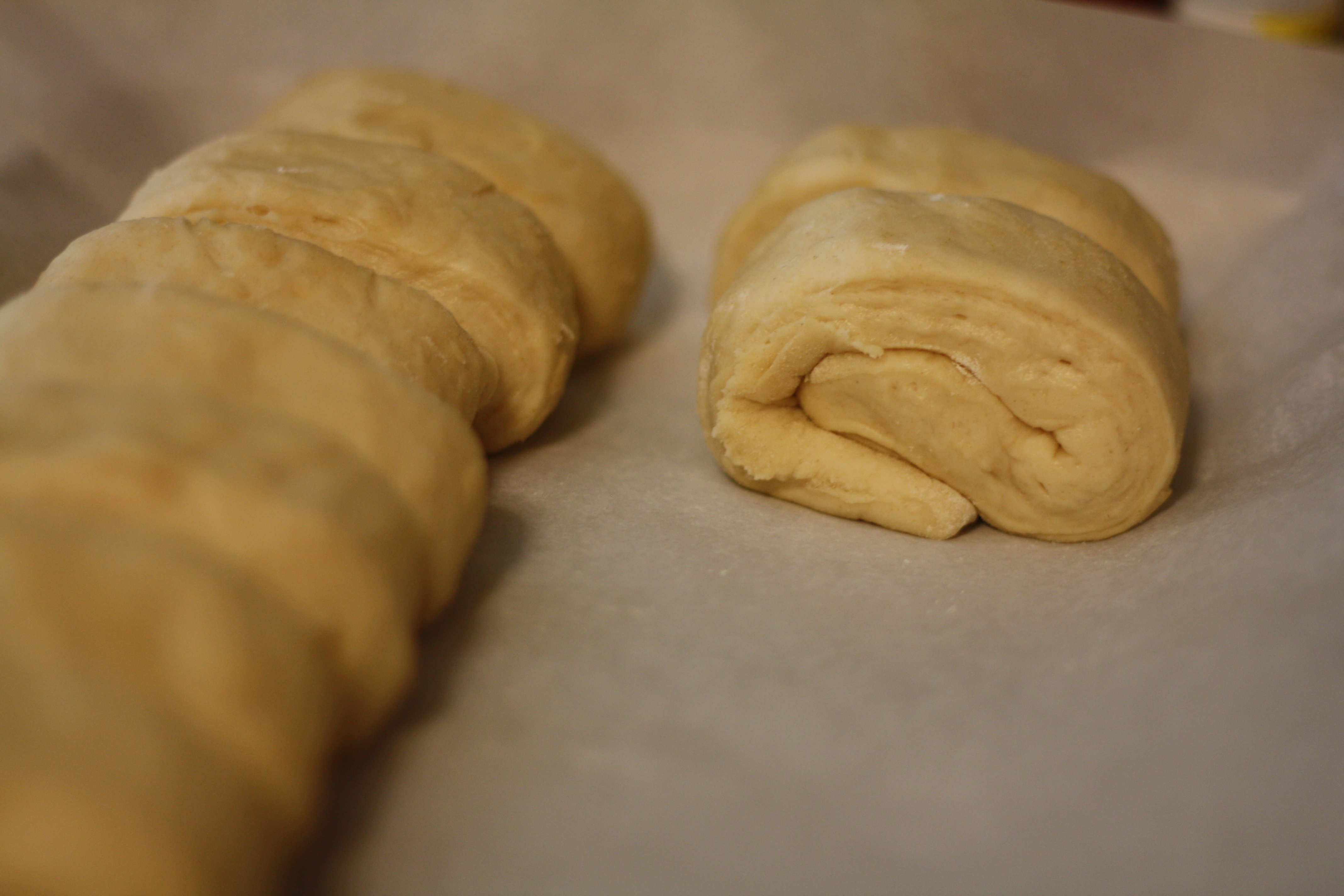
Form each strip into a little roll, by folding part of the strip under, so that a small section of the top overhangs the bottom. Then tuck the overhanging piece underneath. Place the formed rolls, seam-side down, onto a parchment-lined baking sheet, close to each other, forming 3 loaves of 8 rolls each. (The rolls can be wrapped and frozen at this point, if desired.)

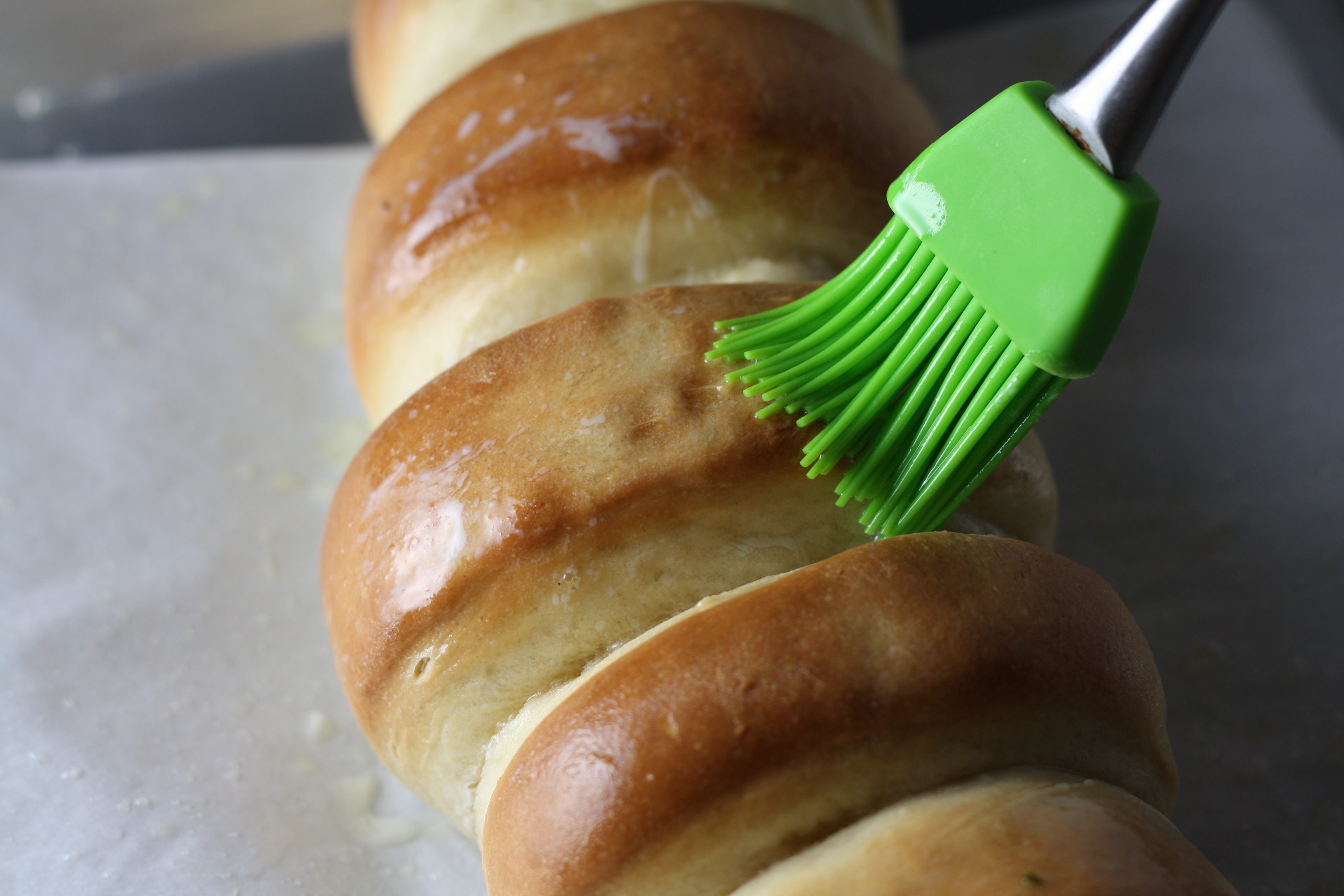
If baking immediately, bake at 375 degrees for 18-20 minutes. If baking from frozen, bake for 25 minutes at 325 degrees, then an additional 10 minutes at 375 degrees. Brush the rolls with melted butter prior to serving.

Makes 24 buns

**The original Food Network Magazine recipe and photo guide can be found by clicking here.

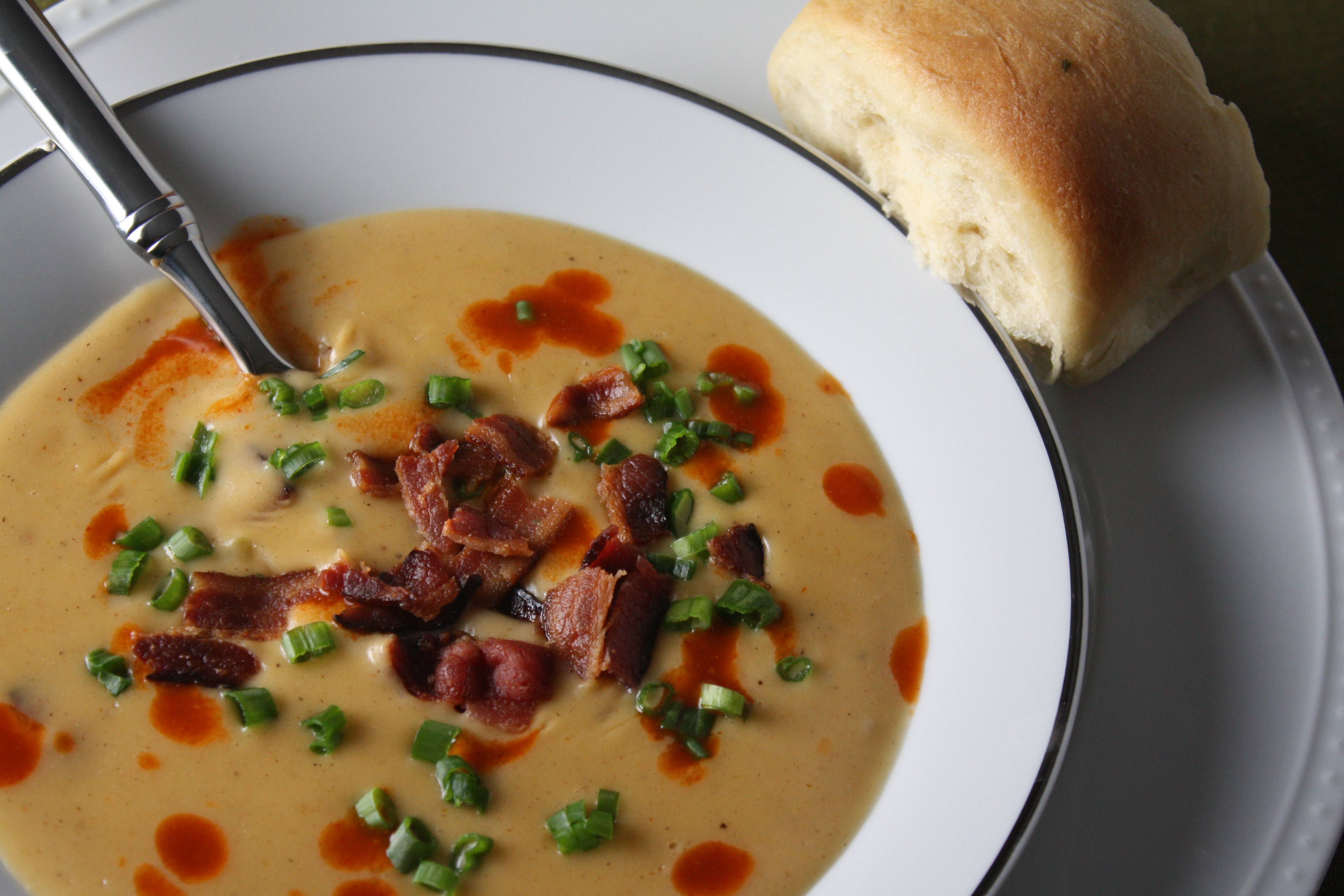
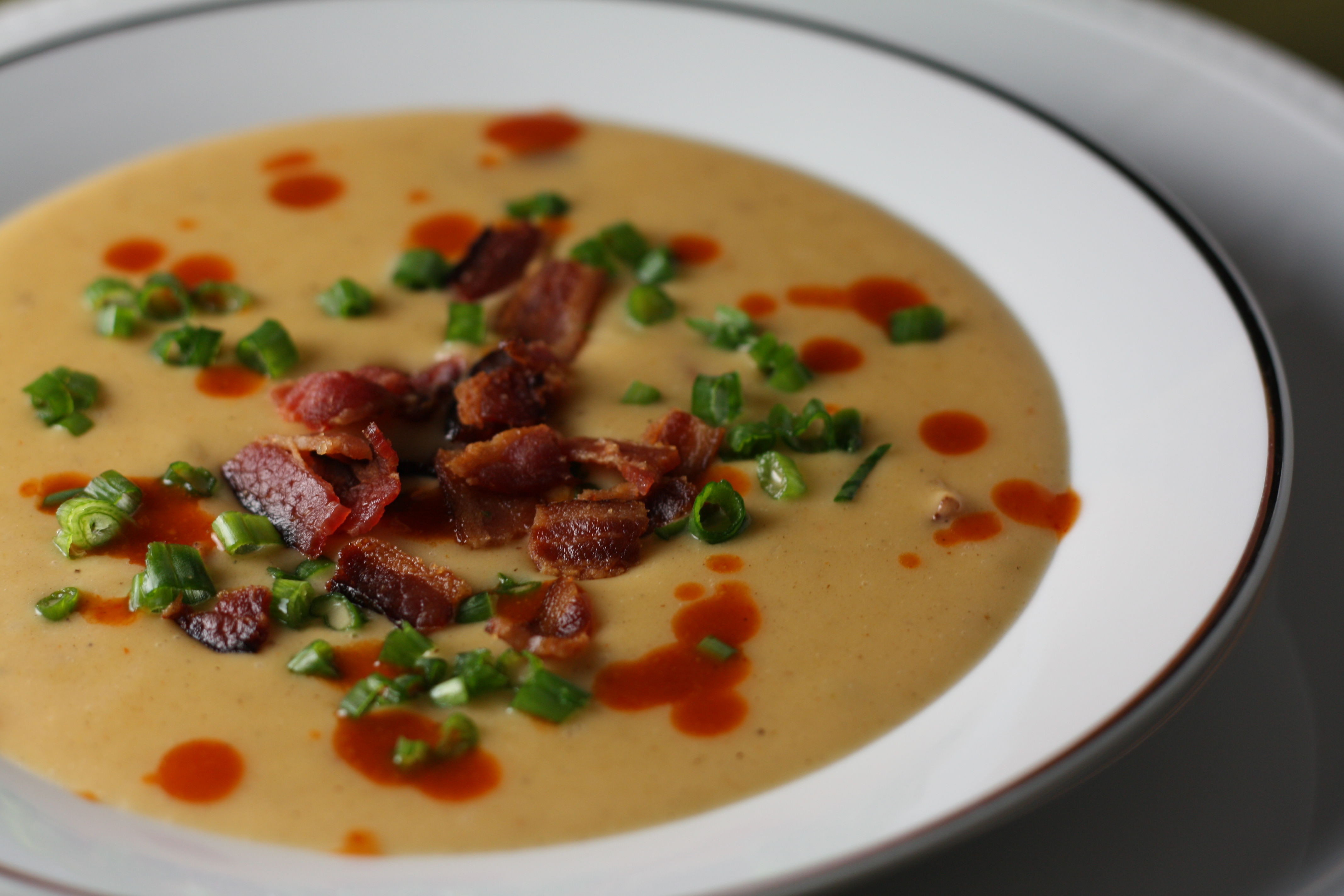
We needed a little something to go along with our buns, so I turned to my Delicious Disney cookbook for a really fantastic Cheddar Soup straight from Disney’s Le Cellier restaurant. This soup is thick, satisfying, and a cinch to throw together. The recipe, as follows, produces a huge ten-serving batch. It can easily be halved for smaller crowds.

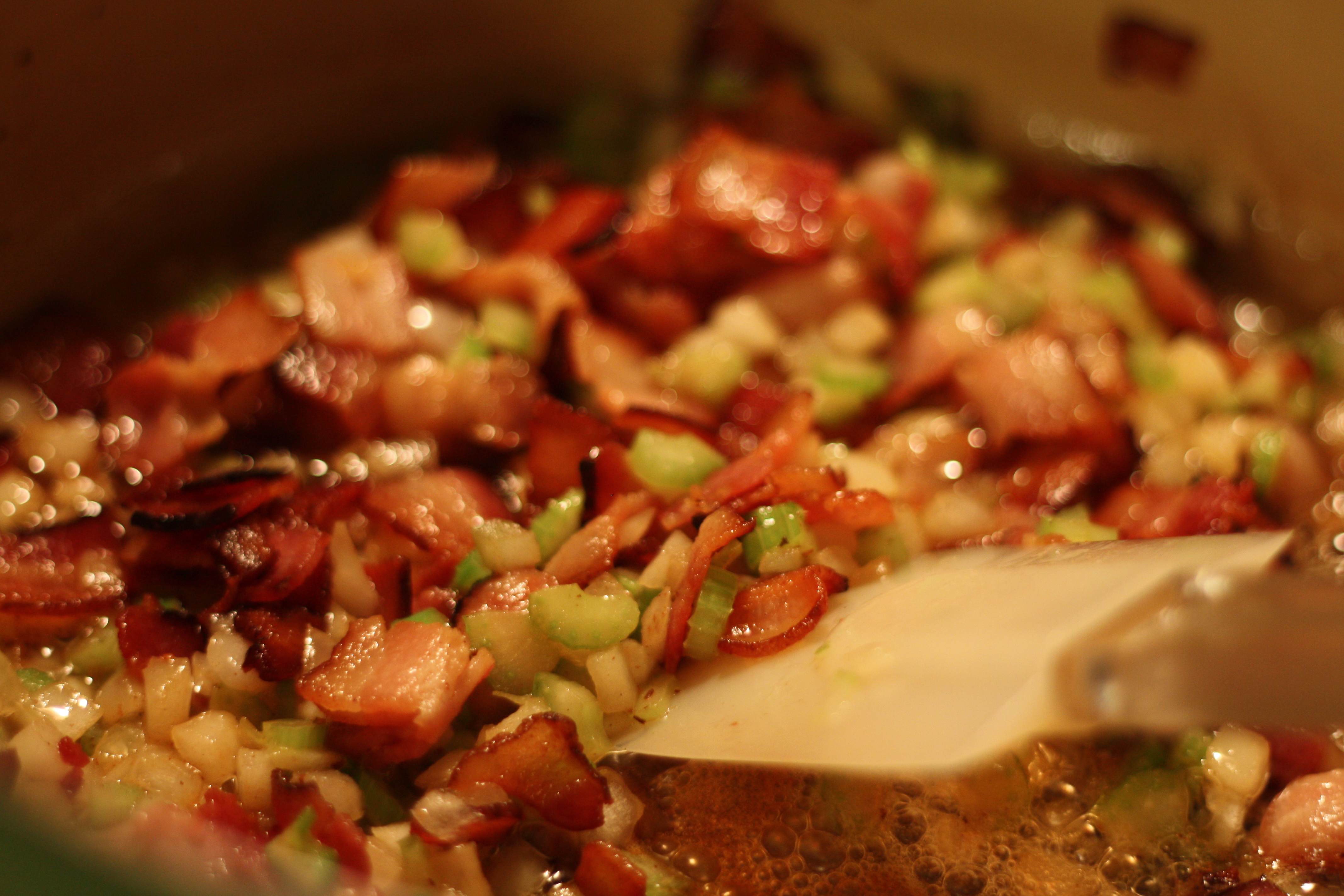
Start by cooking about a half pound of chopped Bacon in a large stockpot or dutch oven pan over medium heat, until fully-cooked and slightly crispy. Throw in four tablespoons of Butter, one finely diced medium Onion and about 1/2 cup finely diced Celery. Cook for about 5 minutes.

Stir in a cup of Flour. The mixture will be very thick. Cook over medium heat for a few minutes. Then, whisk in 3 cups of Chicken Stock. Continue whisking until smooth. Bring to a simmer and cook for about 10 minutes. The mixture will be quite thick. Pour in 4 cups of Milk. (Skim milk would be perfect.) Bring to a gentle simmer (not a boil) and cook for 10 more minutes. Turn down the heat and stir in a pound (16 ounces) of Shredded Cheddar. Stir until the cheddar melts into the soup. If the soup is too thick, add a bit more milk. Stir in about a tablespoon of Worchestershire Sauce and a tablespoon (or more) of Tabasco Sauce. If desired, add 1/2 cup of warm Beer. Season with salt and pepper, as desired.

Garnish with chopped bacon and chopped green onions.


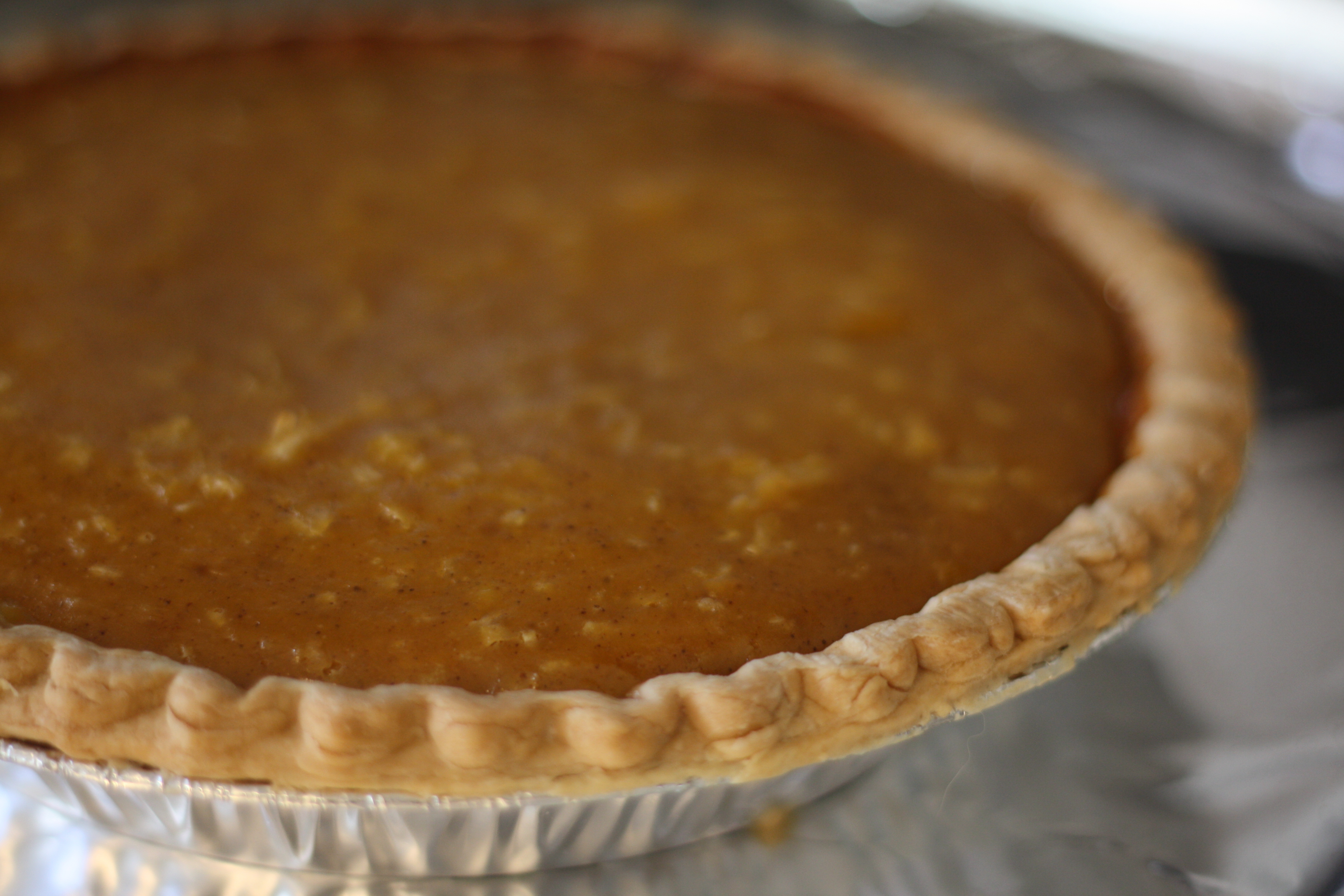
Fresh Pumpkin Coconut Pie

Yesterday, we hacked our way into a pumpkin to prepare fresh pumpkin puree, with the promise of a fresh pumpkin coconut pie. Today, we eat pie. This is my mom’s recipe for fresh pumpkin pie. It is the pumpkin pie I grew up with. It is the pumpkin pie to which I compare all other pumpkin pies. That’s just how things are when you’ve grown up with them, sort of how I’m a loyal Crest toothpaste girl and shiver at the thought of any mayonnaise other than Hellman’s.

To me, this is pumpkin pie the way is should be. It’s light, fresh, and sweet. My mom always uses fresh pumpkin, but I wouldn’t fault you for substituting canned. It will still be quite delicious. The recipe works well with or without the coconut. I’m a coconut girl, through and through. It gives the pie a sort of half pumpkin, half coconut custard sort of feel. Spectacular!

And now, the pumpkin pie recipe you’ve been waiting for…

Fresh Pumpkin Coconut Pie

Ingredients

  • 2 cups Pumpkin Puree (fresh or canned)*
  • 1 1/2 cup Evaporated Milk (1 12-ounce can)
  • 1/4 cup Brown Sugar
  • 1/2 cup White Sugar**
  • 1 tsp Cinnamon
  • 1/2 tsp Salt
  • 1/2 tsp Ginger
  • 1/4 tsp Nutmeg
  • 1/8 tsp Ground Cloves
  • 2 Eggs, lightly beaten
  • 1/2 cup Shredded, Sweetened Coconut (optional)
  • 1 9″ Deep-Dish Pie Shell (homemade or frozen)

* Click here for my photo guide on preparing fresh pumpkin puree.

**My mom’s recipe calls for 1 cup sugar, which produces an extremely sweet pie. I cut the white sugar to 1/2 cup, which still produces a deliciously sweetened pie.

Directions

Preheat oven to 425 degrees. In a bowl, whisk together all ingredients until well combined. Stir in the coconut, if desired. Place the pie shell on a foil lined baking sheet, to prevent oven spill-over. Pour the mixture into the pie shell.*  Bake for 15 minutes at 425 degrees. Lower the heat to 350 degrees. Continue cooking for 45-55 minutes, until the tip of a knife, inserted about an inch from the edge, comes out mostly clean. Allow to cool for about an hour. Then refrigerate to completely cool. Serve with whipped cream.

*You will probably have some leftover filling. Use it in individual pie shells to make mini pies or simply pour it in a ramekin or small baking dish and bake, for a little crustless pie.

How to Prepare Fresh Pumpkin Puree

When it comes to Thanksgiving desserts, does it get any more classic than pumpkin pie?? Pumpkin is the bright orange star of autumn produce. They play a leading role in Halloween celebrations and an even tastier role at Thanksgiving. As far as I’m concerned, serve whatever other desserts you’d like on Thanksgiving, as long as there’s at least one pumpkin pie. So, in honor of our Thanksgiving Week here at The Gourmand Mom, we’ll be making a pumpkin pie, using my mom’s tasty recipe for Fresh Pumpkin Coconut Pie.

Like many families, we purchased several pumpkins to adorn our front steps throughout October. They lasted out there for a month, until one afternoon, we opened the door to find the remnants of what used to be the Frankenstein pumpkin. We were all a bit flummoxed upon finding the remains. The boys were devastated. What horrific event could have caused the brutal destruction of our little pumpkin; so thoroughly ravaged on our front steps. We all felt a bit violated. But, my husband dutifully cleaned up the remains and we did our best to put the past behind us. And then, the very next day, the vicious pumpkin villian returned.

Let’s just call him Squirrely. Squirrely stood there on our front steps, staring at me with his beady little eyes, looking all cute with his fluffy tail. And then he strutted himself over to the next largest pumpkin, and shamelessly went to work. So strong was his passion for pumpkin, that he worked diligently at his task for at least an hour, as we all stood staring in awe. Squirrely was clearly a master of pumpkin. To his credit, he waited a month before devouring our decor.

Clearly, I wouldn’t be using any of those pumpkins to make my pumpkin pie. Luckily, our grocery store is well-stocked with pumpkins. For the purpose of making pumpkin puree for pies or other pumpkin desserts, your best bet is to pick up a Pie Pumpkin or Sugar Pumpkin. They are smaller and will produce a less watery, more flavorful result. When my mom prepares the pumpkin for her pies, she typically prepares the puree in a similar fashion to mashed potatoes. She cuts the pumpkin into chunks, removes the skin, boils, then mashes. It’s a technique which has always worked well for her. However, an easier alternative to chopping a hard pumpkin into pieces and removing all of the skin is to roast the pumpkins. Once roasted, the tender insides will scoop out with ease. Here is a step by step guide on how to prepare fresh pumpkin puree by roasting.

1. Thoroughly rinse the pumpkins.

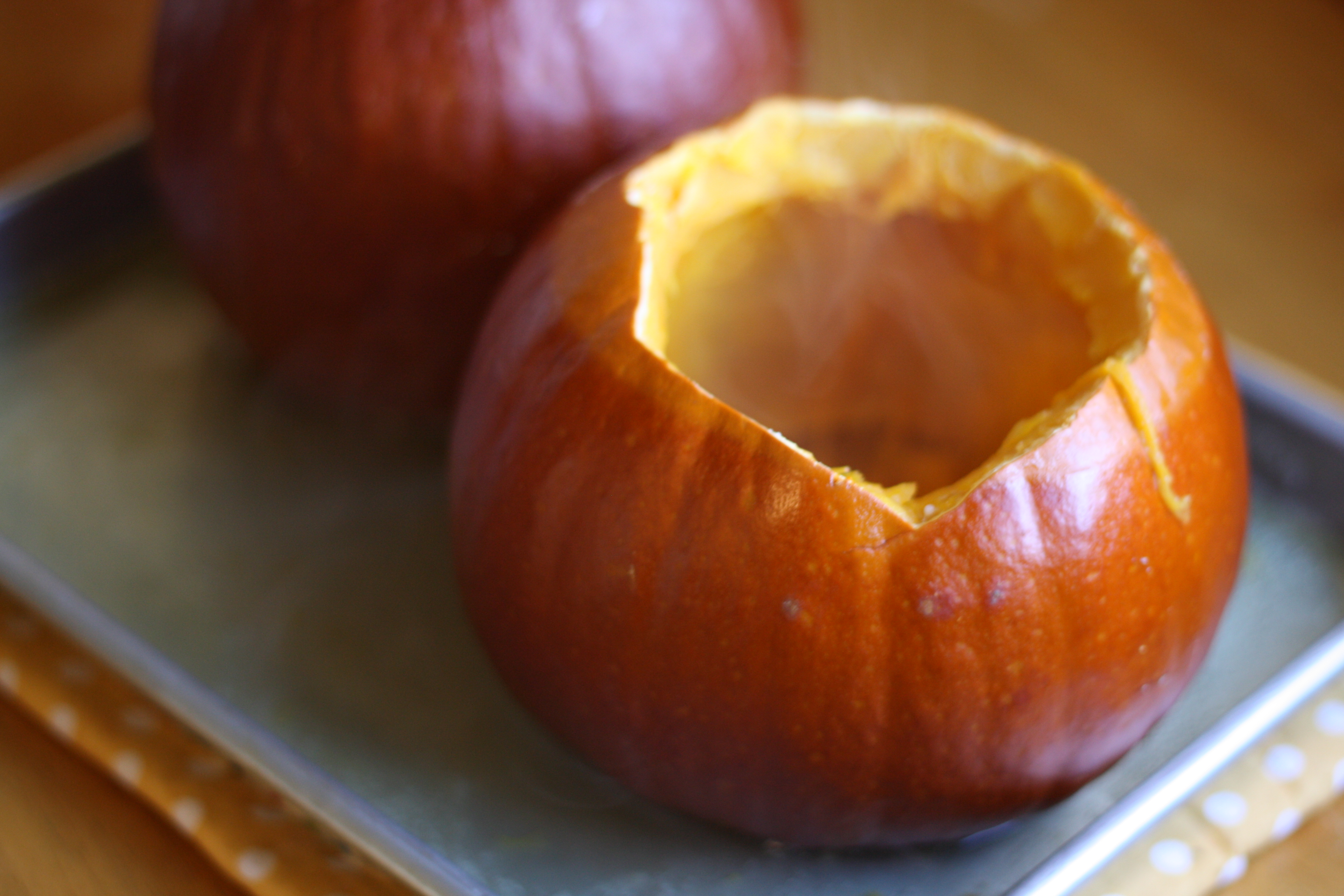
2. Ideally, cut the pumpkins in half, from the stem to the base. However, if you happened to purchase the world’s hardest pumpkins or perhaps left your pumpkins in the freezing car overnight, you may have to settle for simply sawing and prying off the top. After trying every one of my very sharp knives on my stubborn pumpkins, I considered inviting Squirrely inside to help. (He clearly knows how to get inside a pumpkin.) Seriously, a hacksaw wouldn’t have cut through my pumpkins. But, eventually I managed to wrestle the tops off. Don’t worry, if you can not manage to cut your pumpkins in half, rest assured that the  pumpkins will roast just as well with only the tops removed.

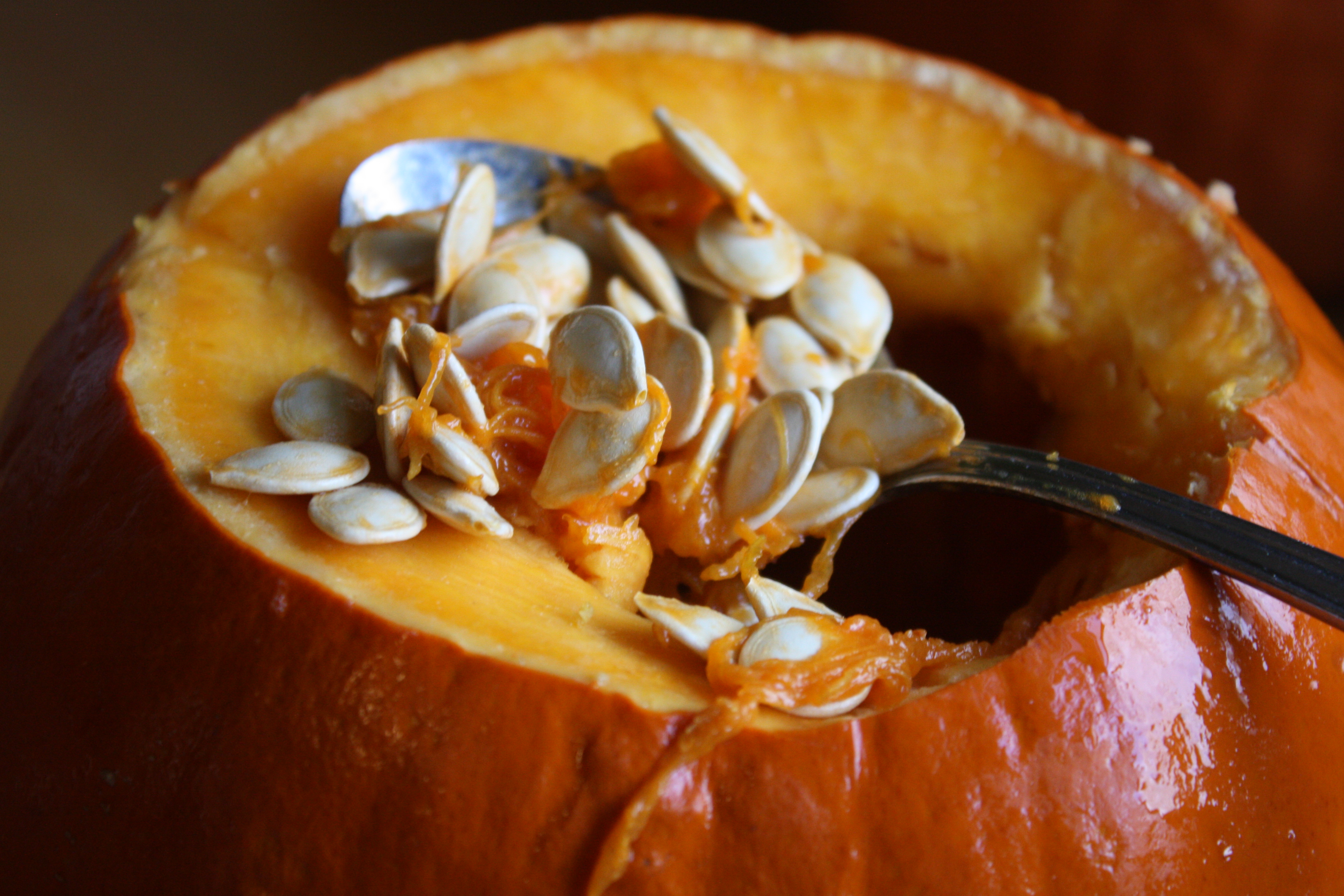
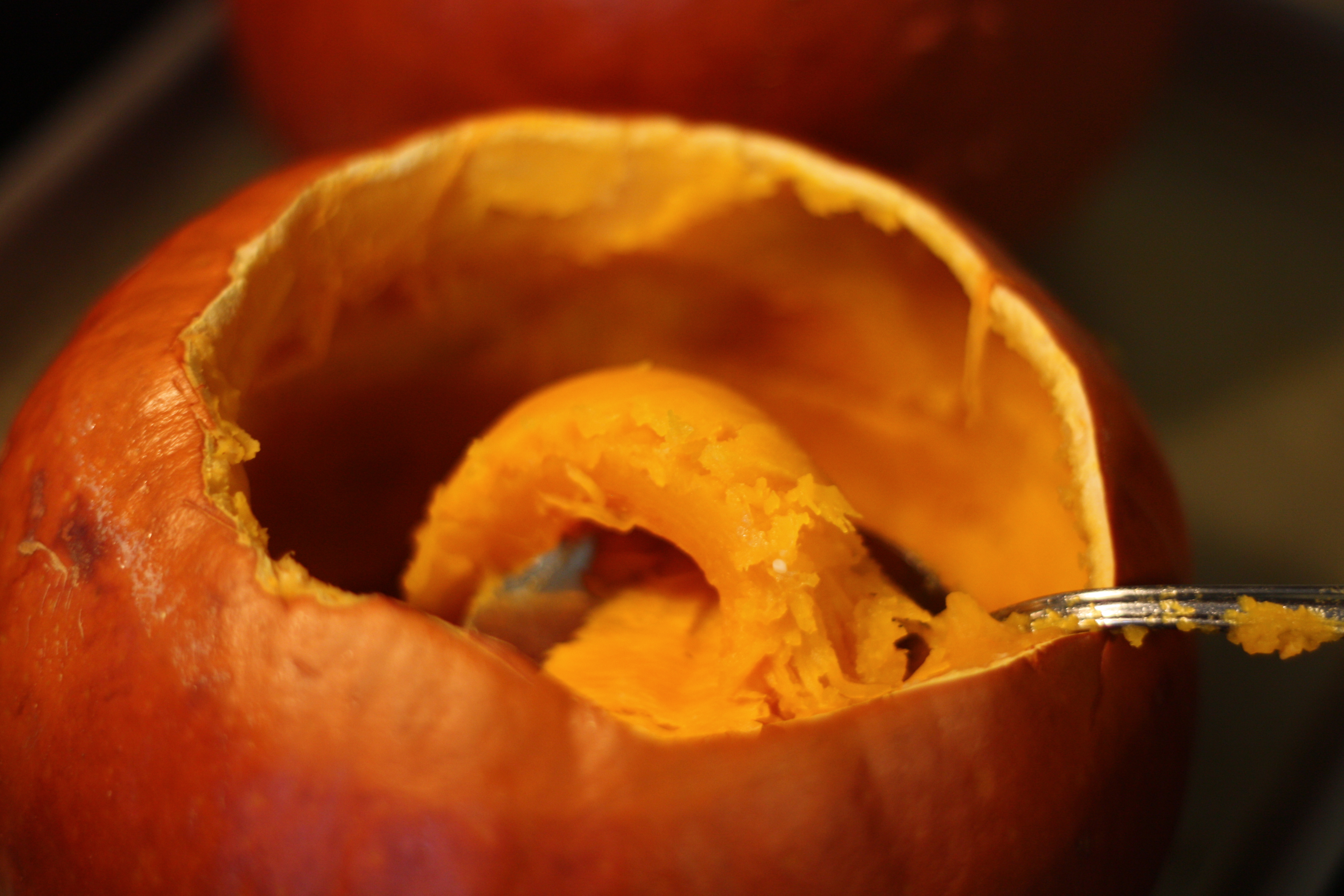
3. Use a spoon or ice cream scoop to remove all of the seeds and stringy parts from the pumpkin. Save the seeds for roasting.

4. Place the pumpkin upside down on a baking sheet (cut sides down, if you were able to cut your pumpkin in half). Fill the bottom of the baking sheet with a thin (1/4 inch) layer of water.

5. Roast at 375 degrees for about 90 minutes. Test by inserting a fork into the inside of the pumpkin. It should be quite tender. Allow to cool.

6. Scoop out the tender insides.

7. Use a blender, food processor, or immersion blender to puree until smooth. Refrigerate until ready to use.

** Two small Pie Pumpkins should produce about 3-4 cups pumpkin puree.

If you’re preparing fresh pumpkin puree, be sure to roast the seeds separately for a tasty snack. I seriously ate so many pumpkin seeds yesterday that I’m beginning to suspect I may be sprouting a pumpkin in my belly. They are a delicious and highly nutritious snack.

To roast the pumpkin seeds: Rinse the seeds and separate from the stringy pumpkin pieces. Discard the stringy pieces. Lay the pumpkin seeds in a single layer on a paper towel to dry. Spread the seeds onto a baking sheet. Toss with a bit of olive oil. Sprinkle with sea salt and pepper. Bake in a 375 degrees oven for about 20 minutes. Enjoy!

Stay tuned for the recipe for Fresh Pumpkin Coconut Pie, coming up next!

Cranberry Orange Sauce, Super Stuffing, and Other Thanksgiving Sides

It’s Thanksgiving Week here at The Gourmand Mom. Yesterday we started talking about the side dishes; my personal favorite part of the Thanksgiving feast. Today, we’re going to continue looking at a few easy and delicious dishes to complete any Turkey Day buffet. We’ll start with a fresh cranberry sauce, accented with freshly squeezed orange juice and zest. Then, we’ll take a look at my favorite Sausage, Apple, and Leek Stuffing recipe. After that, we’ll take a glance back at several other previously-posted Gourmand Mom recipes which would work beautifully for this occasion. Pick and choose what works for you.

As a child, I was a jellied cranberry sauce girl, through and through. I can not tell a lie; I still love the stuff. But, over the years, I’ve also learned to love fresh, whole berry cranberry sauce. It’s delicious paired with a bite of turkey or spread on leftover turkey sandwiches. I’ve even used it to make cranberry linzer-style cookies and baked it with brie wrapped in puff pastry. Spread some on top of a cheesecake for a seasonal touch!

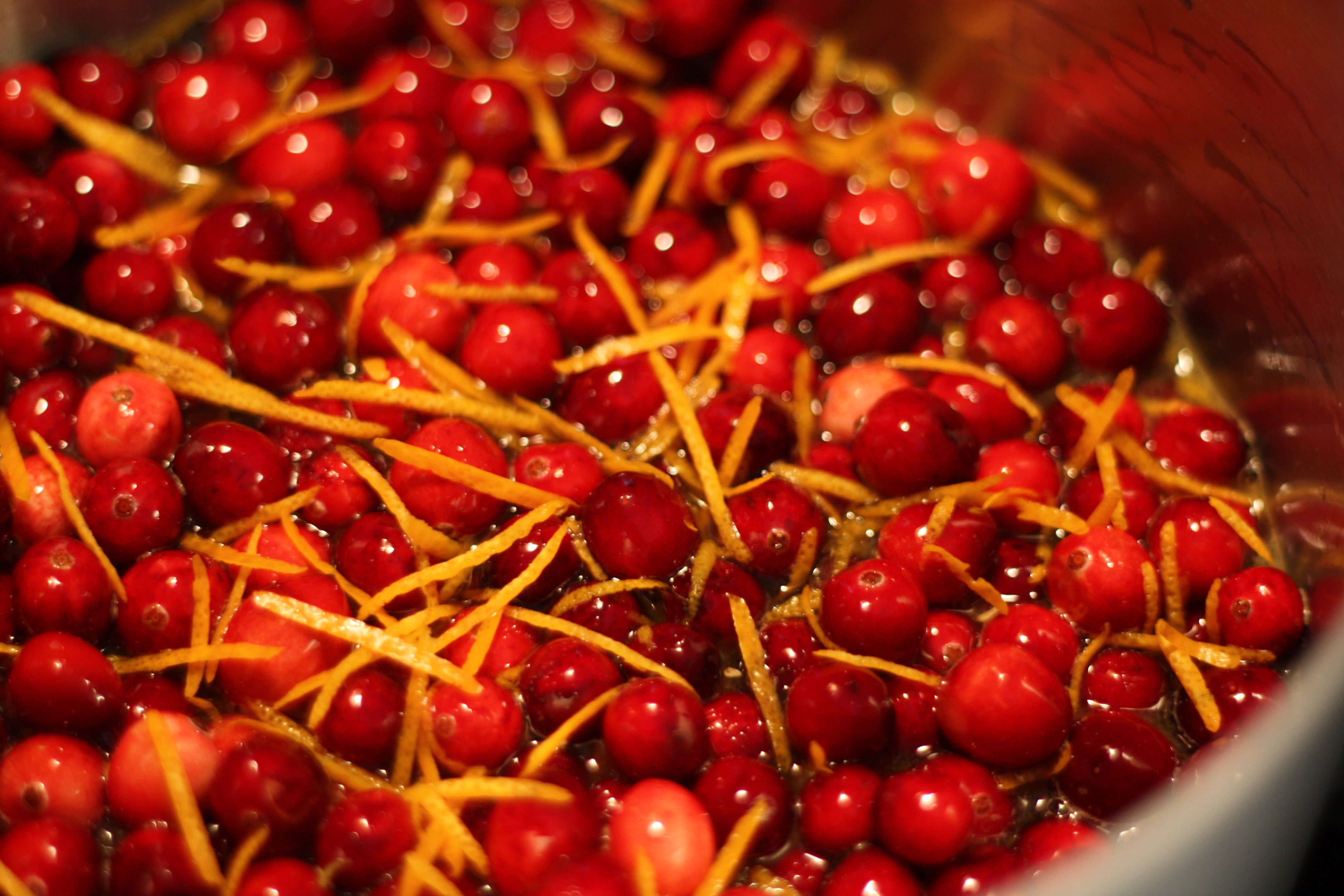
Fresh cranberry sauce can be as simple as simmering cranberries in water with a bit of sugar or you can get creative incorporating other flavors. Most commonly, other fruit flavors are added, though I once made a cranberry sauce which featured caramelized onions. And I’ve got to admit that it was pretty spectacular. But, a cranberry-onion sauce might not be up everyone’s alley, so today we’re sticking with a basic Cranberry Orange Sauce. We’re replacing part of the water with fresh squeezed orange juice, then mixing in the zest of the orange skin. Simple and delicious.

Cranberry Orange Sauce

Ingredients

  • 1 12-ounce bag Fresh Cranberries
  • 3/4 cup Sugar
  • Juice from 2 Oranges (about 1/2 cup)*
  • 1/2 cup Water*
  • Zest from 1 Orange

*Use 1 cup of liquid total.

Directions

Rinse cranberries and carefully examine for any stems or overly mushy berries. Combine all ingredients in a saucepan over medium heat. Bring to a simmer. Lower heat and continue simmering for 10-12 minutes, stirring occasionally, until all cranberries have popped and the mixture has thickened. Remove from the heat and cool completely before serving.

The Stuffing

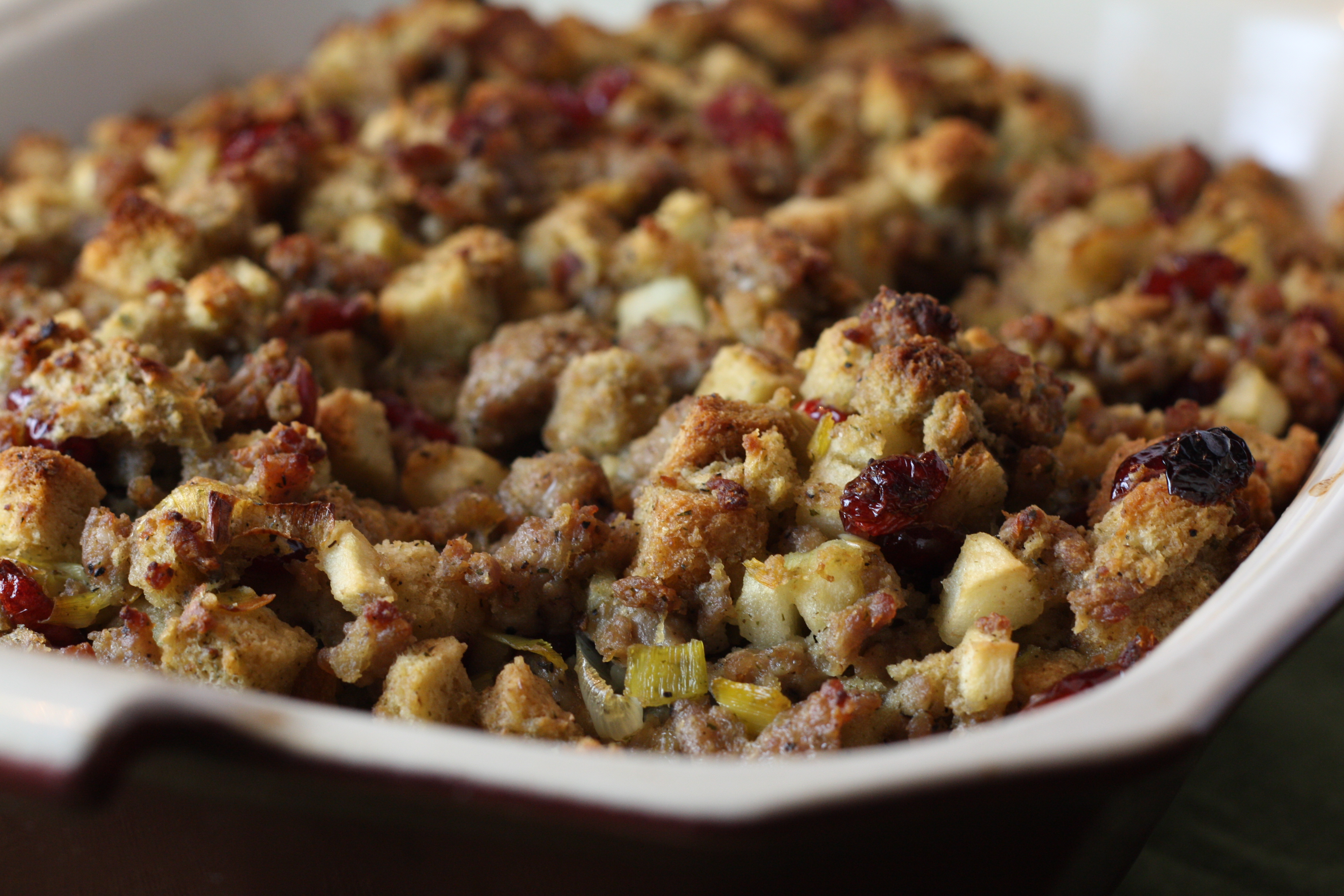
A few months ago, we celebrated Thanksgiving in June; a prelude to Christmas in July. For our summertime Thanksgiving meal, we enjoyed an open-faced turkey sandwich. On that sandwich, we piled on my favorite Thanksgiving stuffing. The secret is the sausage. My mom’s traditional stuffing incorporates the turkey giblets. You know, that pouch of organs which comes stuffed inside the turkey. The thought of it makes my skin crawl. Though, to be completely honest, I really enjoyed the texture which those giblets added to the stuffing. Regardless, I just can’t bring myself to use the giblets. For me, the perfect stuffing addition is ground sausage. The sausage adds such an incredible flavor and that great texture I was so fond of as a child. To the sausage, we add some mild leeks, sweet apples, and a generous handful of dried cranberries. Herb-seasoned bread cubes and chicken stock complete the mix. You won’t need more than a little salt and pepper after that.

The original idea for this stuffing comes from the Food Network recipe, found here. Over the years, I’ve adapted and simplified the recipe to suit our tastes. The recipe can easily be doubled, tripled, or stretched by adding more bread cubes and stock. Add the stock gradually until it reaches the right consistency. The mixture should be moist, but not mushy.

Sausage, Apple, and Leek Stuffing

Ingredients

  • 1 pound Bulk Breakfast Sausage
  • 2 Tablespoons Butter
  • 2 Granny Smith Apples, peeled and diced
  • 1 1/2 cup Leeks, finely sliced (about 1 large leek)*
  • 6 cups Herb-Seasoned Bread Cubes
  • 2 1/2 cups Chicken Stock (approximately)
  • 1/3 cup Dried Cranberries
  • Salt and Pepper, if desired

*To see my photo guide on leeks, click here.

Directions

Preheat oven to 375 degrees. In a pan, cook the sausage until fully cooked, about 8-10 minutes. As it cooks, use a spoon to break up the sausage into small pieces. Remove the cooked sausage and place it in a large bowl. In the same pan (no need to clean it out) melt the butter over medium heat. Add the apples and leeks. Cook for 3-4 minutes until softened. Add the apples and leeks to the bowl with the sausage. Add bread cubes and dried cranberries. Stir to combine. Slowly add the chicken stock, stirring between additions to give the bread a chance to absorb the stock. Continue adding stock until the stuffing is moistened but not mushy. Most of the bread cubes should still appear as cubes. (2 1/2 cups of stock should be about right, but add a little less or a little more, as needed, to get the right consistency.) Place the stuffing in a baking dish and bake for about 30 minutes, until heated through and the top feels firm.

Serves 8-10

*The stuffing can be fully prepared ahead of time, refrigerated and then baked before serving.

A Few More Thanksgiving Side Dish Ideas

Over the past few months, I’ve shared a few recipes which would work wonderfully for a Thanksgiving feast. Here’s a round-up of a few Gourmand Mom Thanksgiving side dish ideas.

Roasted Brussel Sprouts with Bacon and Walnuts


Bacon-Stuffed Mushrooms

Green Beans Almondine

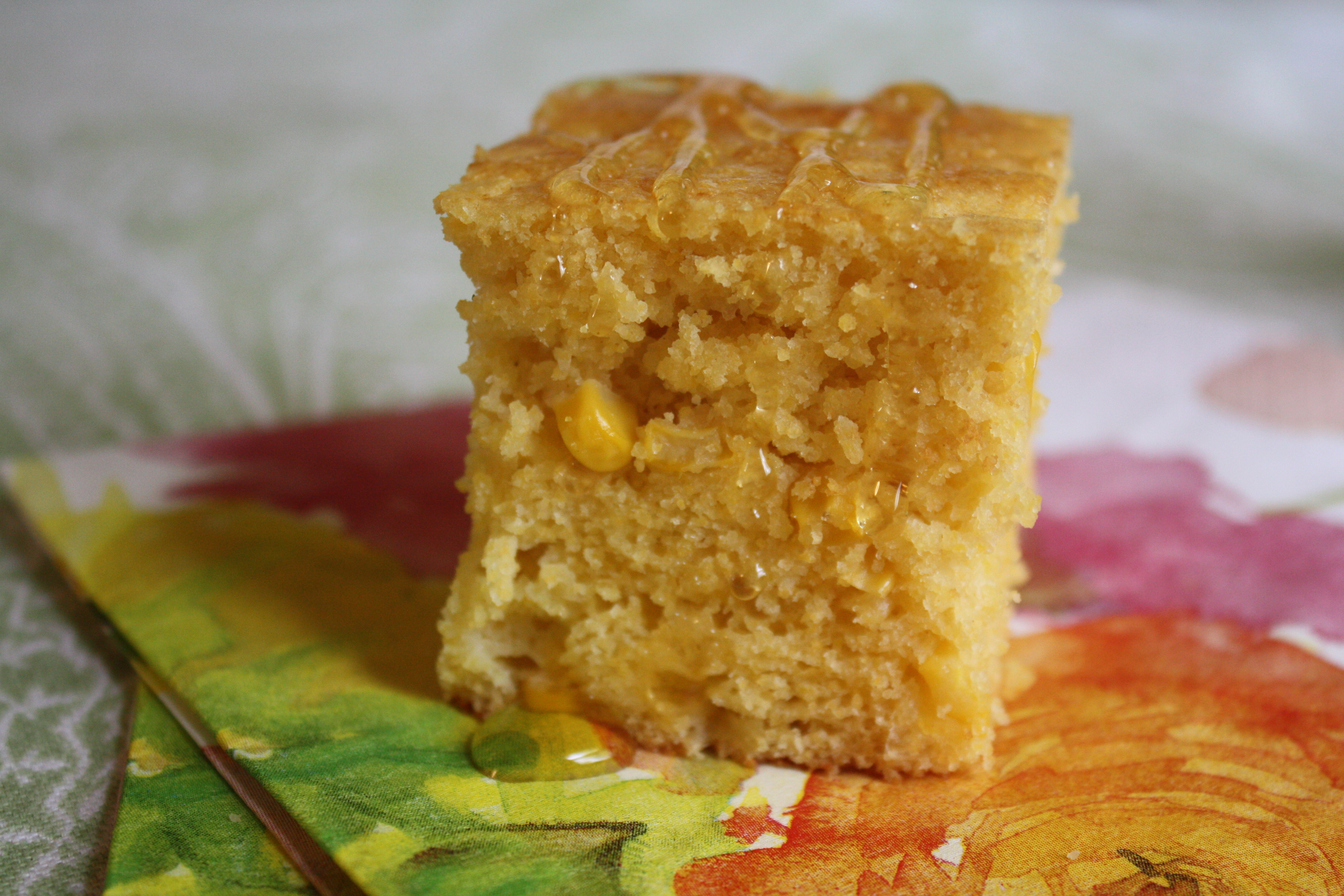
Sweet Honey Cornbread


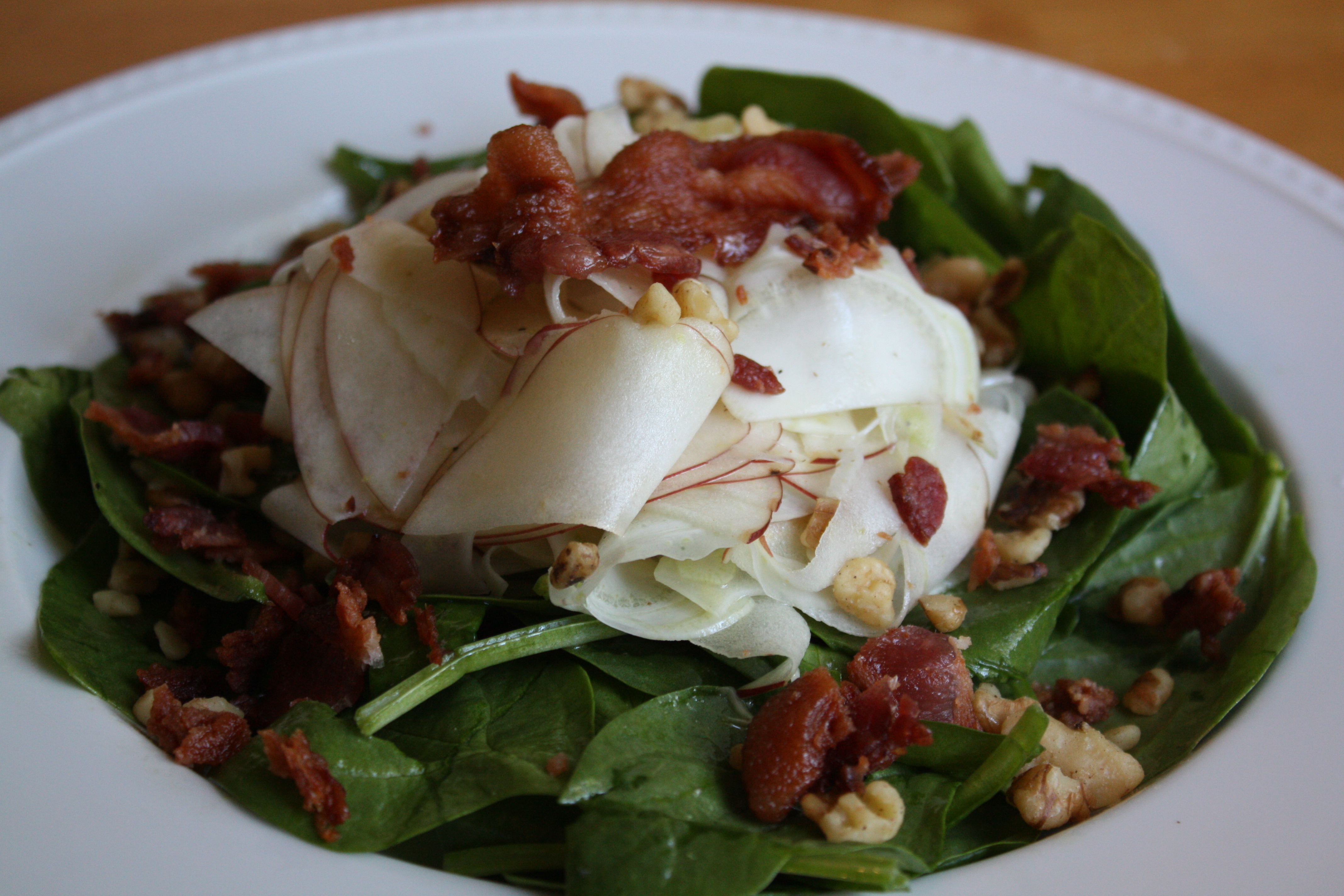
Shaved Apple-Fennel Salad


Autumn Harvest Salad
Roasted Garlic Smashed Potatoes

Tomorrow, we’re moving on to the desserts! Yummy, yum, yum!

It’s Thanksgiving Week! Herb Roasted Turkey Breast with Pan Gravy

You didn’t think I’d leave ya hanging for Thanksgiving, did ya? I’d never do a thing like that! I figured it wouldn’t do you very much good if I waited until the day after Thanksgiving to share all of the delicious things I ate, so I’ve decided to officially declare this Thanksgiving Week on The Gourmand Mom.

We’ll start with the basics; turkey and gravy; and go from there. We’ll work our way through a fantastic Spiced Sweet Potato Puree with Pecan Streusel. Our mouths will water over some homemade Cranberry Orange Sauce. Then we’ll take a look back at my favorite stuffing recipe and a few other previously posted dishes which would make perfect additions to any Thanksgiving table. After that, we’ll try out a new doughy dinner rolls recipe I’ve got my eyes on. Finally, we’ll move on to the desserts; my mom’s Pumpkin Coconut Pie and my favorite Chocolate Pecan Pie. After that, well, we’ll just have to see where it goes from there.

Today, we’re starting with the turkey. I’ll let you in on my dirty little secret. I haven’t roasted a whole turkey in years. For the past fews years, I’ve been roasting a bone-in whole turkey breast separate from the drumsticks. Some people may claim that this is Thanksgiving culinary sacrilege. I claim that it produces the best end result. Here’s the deal… when you cook the turkey whole, you’re forced to continue cooking that big ole turkey until the slowest cooking parts come up to a safe temperature. In the mean time, this often results in overcooking and drying out the faster cooking breast. And who likes dried out turkey breast?? Not me!

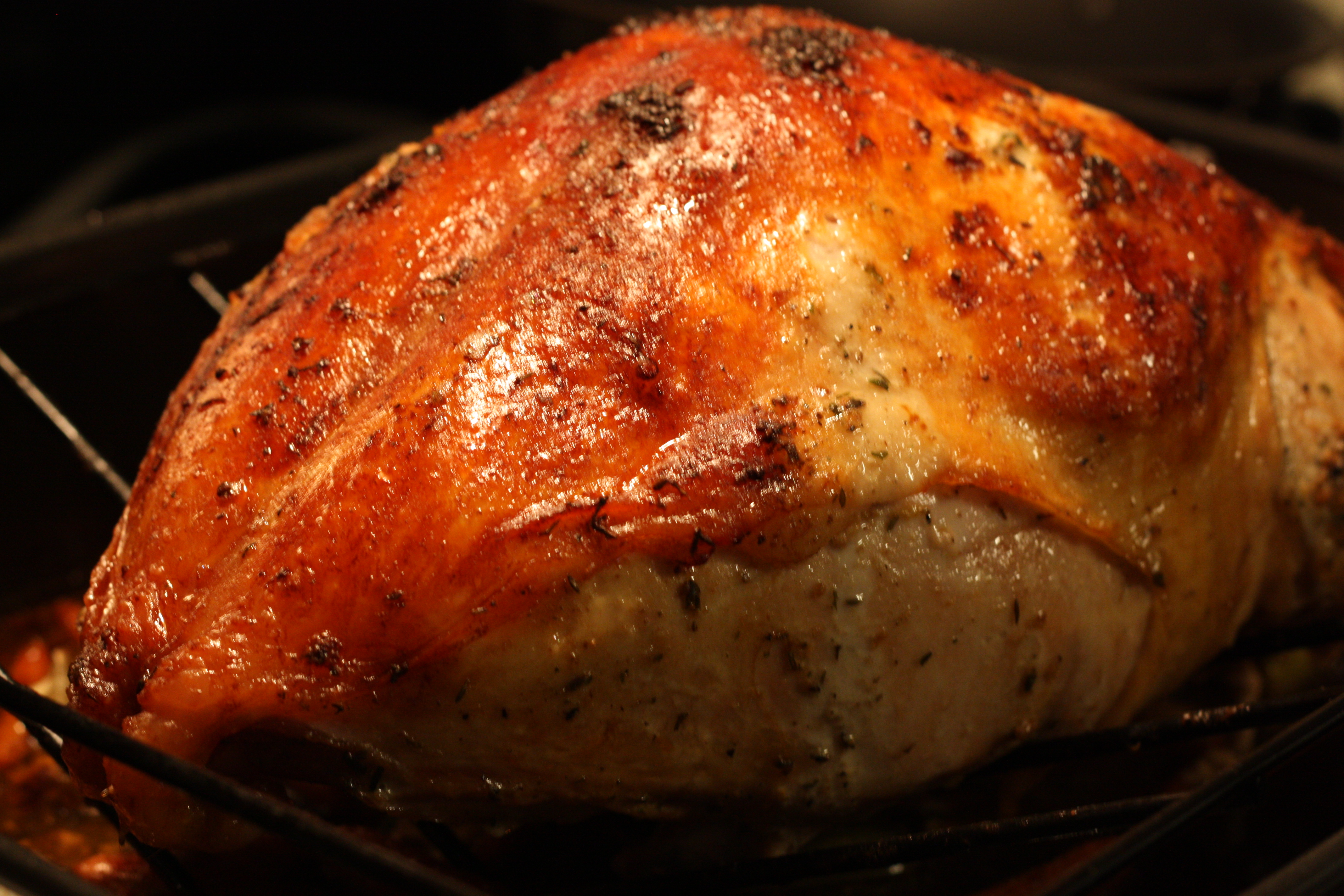
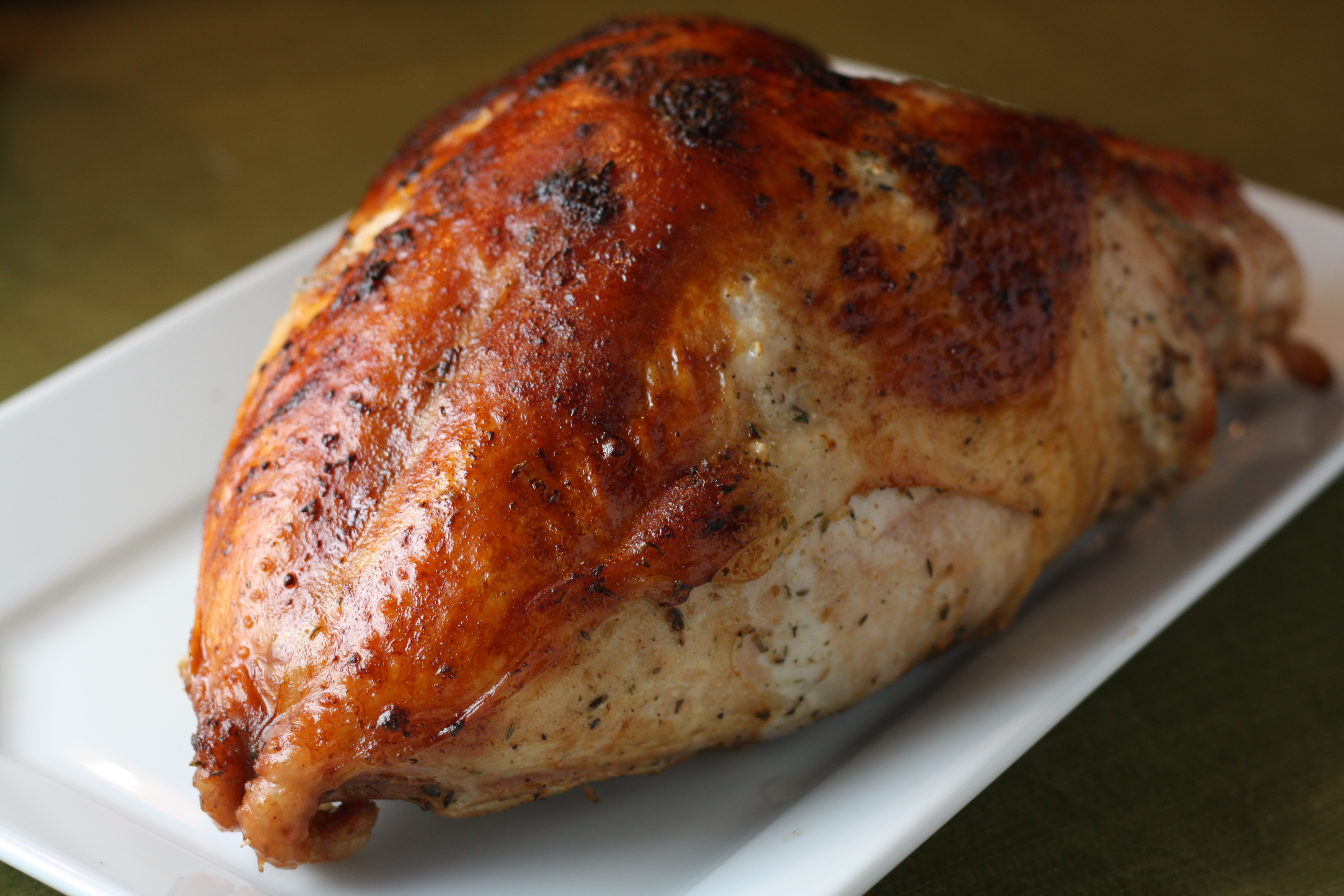
By cooking the turkey breast separate from the drumsticks, you can cook each part to perfection. The roasted turkey breast continues to make a stunning presentation on the Thanksgiving table.  Serve it with roasted drumsticks on the side and you’ll hardly notice the difference. Besides, how long does everyone really sit and gaze at the whole turkey before it gets carved and served anyway? The roasted turkey breast is big, golden brown, and perfectly moist. Your guests will have nothing to complain about.

Because the turkey breast is smaller, it will require less cooking time. Furthermore, the smaller size is easier to handle overall. So, my recommendation is to cook a large turkey breast separate from the drumsticks. My grocery store carries whole turkey breasts right alongside the whole turkeys. One large turkey breast should serve at least 6-8 people with some leftovers. If you’re serving a large crowd, buy two. For dark meat lovers, grab a couple drumsticks. Go crazy. Buy more than two. Then roast (or braise) the drumsticks separately and serve with your perfectly roasted turkey breast.

There are many creative recipes out there for turkey. Food Network is consistently a wonderful source for turkey recipes and other Thanksgiving menu ideas. Today, we’re sticking with a basic herb-roasted preparation. We’ll rub the turkey with an herbed butter, then begin by roasting at a high temperature to achieve a nice brown color on the skin while searing the exterior to lock in the juices. Then, we’ll lower the heat and let the turkey finish cooking to perfection. As the turkey cooks, delicious juices will collect on the bottom of the roasting pan. We’ll enrich the flavor of those juices by placing a few aromatics, in the form of celery, carrots, and onions, in the bottom of the roasting pan. While the turkey is resting, we’ll be able to turn those juices and a bit of chicken stock into a simple and delicious pan-gravy.

Herb Roasted Turkey Breast with Pan Gravy

Ingredients

  • 1 6-7 pound Turkey Breast (bone in)
  • 1/2 stick Butter, softened
  • 1 Tablespoon Dijon Mustard
  • 1 teaspoon Garlic, minced
  • 1/2 teaspoon Salt
  • 1/2 teaspoon Pepper
  • 1 teaspoon Thyme
  • 1 teaspoon Rosemary
  • 3/4 cup Carrots, coarse chopped
  • 1 Onion, quartered
  • 3/4 cup Celery, coarse chopped
  • 2 cups Chicken Stock

Directions

The night before, remove the turkey breast from it’s packaging. Place on a rack in a roasting pan and sit, uncovered in the refrigerator.

Preheat oven to 475 degrees. In a small bowl, combine the butter, mustard, garlic, salt, pepper, thyme, and rosemary. Rub the herbed butter all over the turkey. Working from the edges, try to loosen the skin and rub some of the butter directly onto the turkey breast. In the bottom of the roasting pan, scatter the carrots, celery, and onion. Add the chicken stock to the bottom of the pan. Place the pan on the middle rack of the oven and roast for 25 minutes. The skin should take on a nice golden browned color. Baste the turkey with the pan juices. Then, lower the heat to 325 degrees. Periodically, baste the turkey with the juices from the bottom of the pan. (If the bottom of the pan becomes too dry during cooking, add a little more stock.) Continue cooking until the internal temperature reaches 165 degrees. Use an instant read meat thermometer, inserted into a deep part of the breast, to check the temperature. A 7 pound turkey will take approximately 2 hours at 325 degrees, after the initial 25 minutes at 475 degrees. When the turkey is cooked, remove the pan from the oven. Loosely cover the turkey with foil and allow it to rest for about 20 minutes. Meanwhile, prepare the gravy and side dishes.

Serves about 6-8, generously

Turkey Pan Gravy

Ingredients

  • 3 Tablespoons Butter
  • 3 Tablespoons Flour
  • Drippings from Turkey
  • 1 1/2 cups Chicken Stock (approximately)

Directions

Pour out the turkey juices from the roasting pan. Strain to remove the vegetables. Allow the juices to sit for a few minutes. The fat will rise to the top. Pour off the fat and reserve the remaining juices. Add chicken stock to the juices to make a total of 2 cups liquid. In a saucepan, combine the butter and flour over medium heat, whisking continuously. Cook for a minute or two. Then, whisk in the turkey juice/chicken stock. Bring to a simmer.Cook for 2-3 minutes until the gravy begins to thicken. Taste and adjust seasoning with salt and pepper, as desired.

Makes 2 cups

Now, if you’ve just got to create that beautiful, Norman Rockwell style, picture-perfect bird, here are a few tips for handling that whole turkey:

  • Do not stuff your turkey. Stuffing your turkey presents a food safety and moist turkey challenge. Since the stuffing is in contact with the raw turkey, it will need to reach a temperature of 165 degrees to be safe. In order to reach this safe temperature, you’ll often end up cooking the turkey longer than necessary. Instead, bake your stuffing separately and throw a few herbs and aromatics into the turkey cavity; celery, onions, carrots, garlic, thyme, rosemary, etc.
  • Allow your turkey to sit uncovered in the fridge overnight before roasting. This will help to produce a crispier skin.
  • Start your turkey at a high temperature (475 – 500 degrees) for the first 20-30 minutes, then reduce heat to 325 or 350 degrees to finish cooking.
  • Don’t bother with that flipping the turkey technique you may have seen. In my opinion, it’s more trouble than it’s worth.
  • To brine or not to brine? Brining your turkey in a solution of salt, water, and other seasonings is said to produce a juicier and more flavorful turkey. There are people who swear by brining to produce the best turkey. I’m not one of those people. I’ve brined and I’ve not brined. In my opinion, the difference is minimal. But if you’ve got the time  and space to do it, go for it. Click here for a useful resource on brining.
  • Loosely tenting the turkey with foil during cooking can help to prevent over-browning and keep the turkey moist. Be sure to remove the foil during the last 45 minutes to achieve a nicely browned skin.
  • To be safe, all parts of your turkey should register 165 degrees on an instant read thermometer. Some resources list 180 degrees as the minimal temperature. The USDA recommends 165 degrees as measured in the  innermost part of the thigh and wing and the deepest part of the breast.
  • Let your turkey rest for at least 20-30 minutes before carving. This is a good time to make the gravy and finish reheating your side dishes.
  • After dinner, throw the whole turkey carcass into a large pit of simmering water. Follow my procedure for chicken soup to make a tasty turkey soup. Click here for my chicken soup procedure.

A few excellent resources for turkey info:

FDA – Let’s Talk Turkey

Food Network – Top Ten Turkey Tips

Food Network – Turkey Recipes and Turkey Calculator

Sweet Potato Bisque with Pan-Seared Scallops and Bacon

Confession: I’m a digger. Give me a pint of cookie dough ice cream and I will inadvertently eat the entire container as I dig and search for those luscious little bits of cookie dough. Just one more bite always uncovers the hint of another piece. So, I dig and eat and work with the patience of an archeologist at an excavation site, gently removing each glorious piece of cookie dough. I get lost in my work, until suddenly I’m holding an empty container. I feel both ashamed and proud simultaneously. I’m a digger.

So, you may imagine the little problem I had with those brownies I recently shared with you; the ones I so cleverly filled with bits of halloween candy; those bits of halloween candy which taunted me into consuming bite after bite after bite of chewy, fudgey brownies. I would have stopped. Really, I would have. But then I’d catch a glimpse of something; a piece of Twix, perhaps. One more bite. But wait…what’s that? Gooey, melted Reese’s Peanut Butter Cup, behind which hid a few caramel-coated peanuts; remnants of a chunk of Snickers. And that’s how the brownies disappeared, one focused bite at a time.The baby in my belly is most thankful for the sweet treat.

But this post isn’t about my small digging problem. Though it is about sweets; sweet, sweet, sweet potatoes. With Thanksgiving fast approaching, I’ve got sweet potatoes on the brain. And my brain was convinced that it was the perfect time for a spicy sweet potato bisque. I know. You’re probably thinking that this girl sure makes a lot of soups for someone who claims to be largely indifferent to soups. Perhaps I enjoy soup even more than I realize.

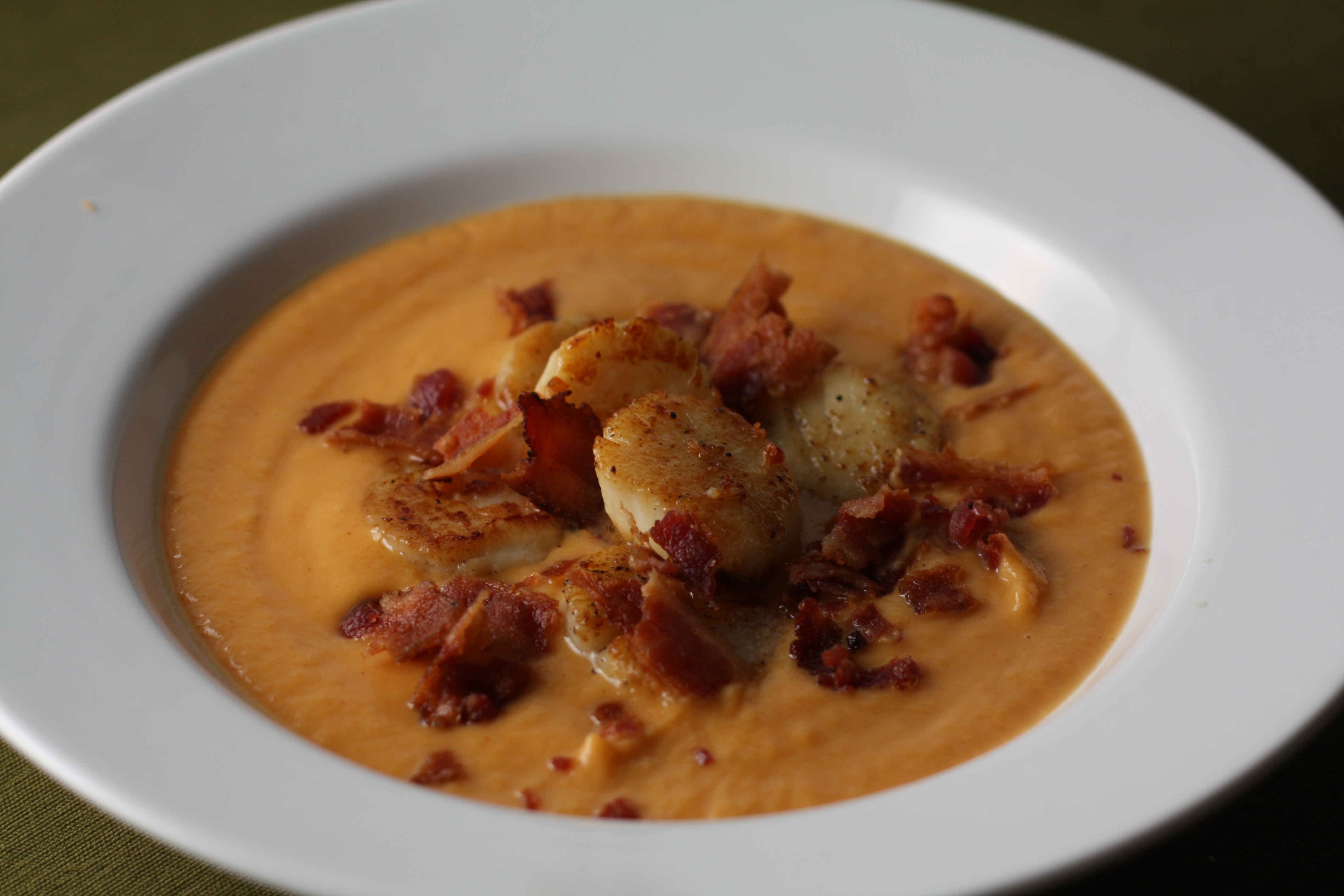
When it comes to creamy, bisque-style soups, I’ve got a little weakness for serving them with a bit of fresh seafood showcased in the center. (See my recipe for Chilled Avocado Soup and Crab Cake with Chipotle Remoulade.) A bit of crunch in the form of crispy bacon, croutons, seeds or nuts never hurts too. These little touches of flavor and texture turn a simple bisque into a simply elegant meal. I’m pairing my sweet potato bisque with a few seared sea scallops and some crispy applewood-smoked bacon for a fantastic autumn meal.

Spiced Sweet Potato Bisque

Ingredients

  • 4 large Sweet Potatoes
  • 1 medium Onion, chopped
  • 1 teaspoon Garlic, minced
  • 5-6 slices Bacon*
  • 3 cups Chicken Broth
  • 1 cup Half and Half
  • 1 teaspoon Salt
  • 1/2 teaspoon Cinnamon
  • 1/8 teaspoon Ginger
  • Dash of Nutmeg
  • Dash (or two) of Cayenne

*If available, I recommend using applewood smoked bacon. It’s nitrate free and the flavor is fantastic.

Directions

Preheat oven to 375 degrees. Wash the sweet potatoes and pierce the skin several times with a fork. Place the sweet potatoes on a baking sheet and bake for about 90 minutes until fork-tender. Remove from the oven and allow to cool.

In a large wide-bottomed saucepan or stockpot, cook the bacon over medium heat until crispy. Remove the bacon and set aside for garnishing the soup. Pour off all but about 2 tablespoons of the bacon grease. Add the onion and garlic to the bacon grease and cook for about 5 minutes until the onions are tender and slightly translucent. When the potatoes are cool enough to handle, scoop out the sweet potato and add it to the pan. Discard the skins. Add the chicken broth. Simmer the sweet potatoes in the broth for a few minutes. Then, allow the mixture to cool slightly. Blend the mixture until completely smooth. (An immersion blender is the most convenient tool for the job, but a regular blender or food processor will work fine. Just be careful when transferring the warm mixture to a blender or food processor.) Return the blended mixture to the saucepan. Add the half and half and stir until well blended. Add the salt and seasonings. Taste and adjust seasoning as desired. Serve warm.

Note: Depending on the size of the sweet potatoes and your desired soup consistency, you may need to add more or less chicken broth and half and half.

For the Pan-Seared Scallops: To cook the scallops, heat 2-3 tablespoons of olive oil in a pan over medium to medium-high heat. Pat the scallops dry and season with a little salt. (About a pound of scallops will serve four people.) Place the scallops in the pan. Let them cook for about 2-3 minutes, without disturbing. Once they’ve formed a golden-brown crust, turn the scallops over. Cook for another 2-3 minutes on the other side, or until fully cooked through. Cooking time will vary depending on the size of the scallops.

To Serve: Pour some of the warm soup into a wide bowl. It shouldn’t be too deep. Place several seared scallops in the center of the soup. Top with the crispy bacon reserved from the soup.

**Top Secret Family Recipe**

There’s something special about secret family recipes. I’d be willing to bet that every family has got at least one. They are the recipes which are passed on from one generation to the next, the recipes which are prepared on special occasions, the recipes which make you think of home. Perhaps it’s a certain cookie recipe which is baked every Christmas; the one all of your friends and neighbors look forward to. Maybe it’s a special blend of spices which makes your chili stand out. Or it might be a Strawberry-Rhubard Pie which won your Great Aunt Ethel the grand prize at a state fair back in 1920. Whatever it is, these family recipes hold a special worth. They evoke memories and a family pride, which contribute an immeasurable level of value to an otherwise ordinary recipe.

Some families guard their secret recipes with their lives, much like Colonel Sanders guards his secret blend of herbs and spices or Spongebob protects the secret crabby-patty ingredient. Try asking for the recipe and they evade your request, changing topics or vaguely agreeing to send it to you at some unspecified future time. Or perhaps they agree to share the recipe, but it’s done in a whisper, as if Great-Great-Grandma Jones is going to rise from her grave at any moment. Secret family recipes are a special sort of recipe.

As you may expect, my family has its own share of secret recipes. The one which I most strongly associate with home is my dad’s recipe for Connecticut Supper. It’s been my dad’s signature recipe for as long as I can remember. Even now, when we go home for a visit, my dad eagerly prepares Connecticut Supper or he retrieves a tin from the freezer, saved for that very occasion. Either way, it’s almost always waiting for us. It feels like home.

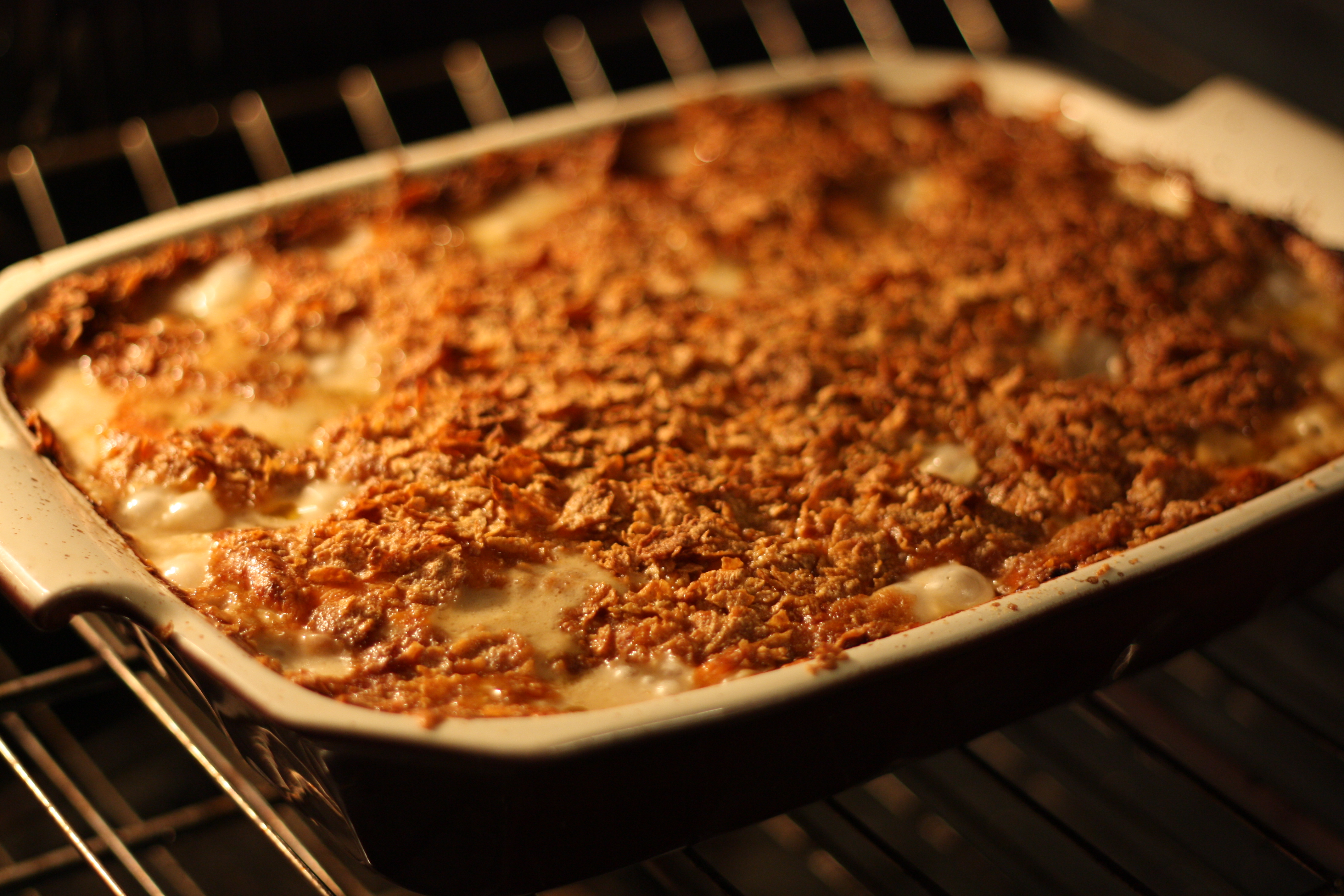
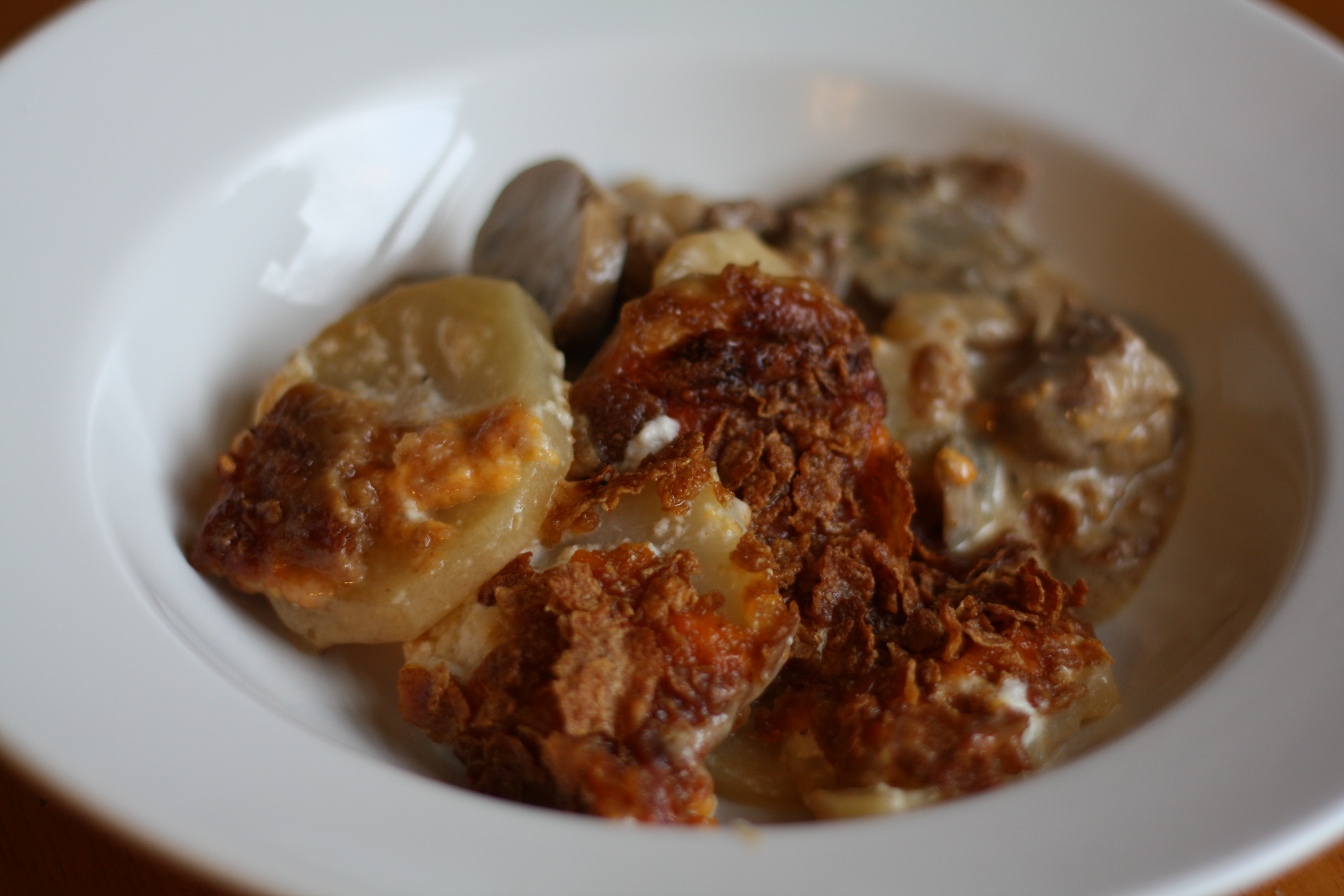
My dad can’t recall the exact origin of the recipe, though he’s pretty sure it was originally found in an old Betty Crocker cookbook circa 1970’s, or something of the like. As far as the name, there is no explanation for that either. It is what it is; Connecticut Supper. And Connecticut Supper is a beefy, cheesy, potato-laden casserole which is pure cold-weather comfort food. This is a Sunday dinner type of meal; a one-dish meal, bubbly hot out of the oven and perfect for a crowd.

Now, we’re all friends here, so I’m going to trust you with my family secret. This is just between us. Shhhh…

**CONFIDENTIAL**

Connecticut Supper

Ingredients

  • 2 large Onions, chopped
  • 2 Tbsp Vegetable Oil
  • 2 pounds Stew Beef, cut into 1″ cubes
  • 1 cup Water
  • 2 cups Mushrooms, sliced*
  • 2-3 Potatoes, peeled and sliced
  • 1 cup Sour Cream
  • 1 can Cream of Mushroom Soup
  • 3/4 cup Milk
  • Salt and Pepper
  • 10 ounce bar of Sharp Cheddar, grated
  • 1 – 1 1/2 cup Wheaties, crushed

*My dad recommends finding your mushrooms at the grocery store, not from your lawn.

Directions

Heat oil in a large saucepan or dutch oven over medium heat. Add the onions and cook for 5-7 minutes until the onions are tender and lightly browned. Season the beef with salt and pepper. Add the beef to the onions. Cook for a few minutes, until the beef is lightly browned. Pour the water over the mixture. Cover and gently simmer for about 50 minutes.

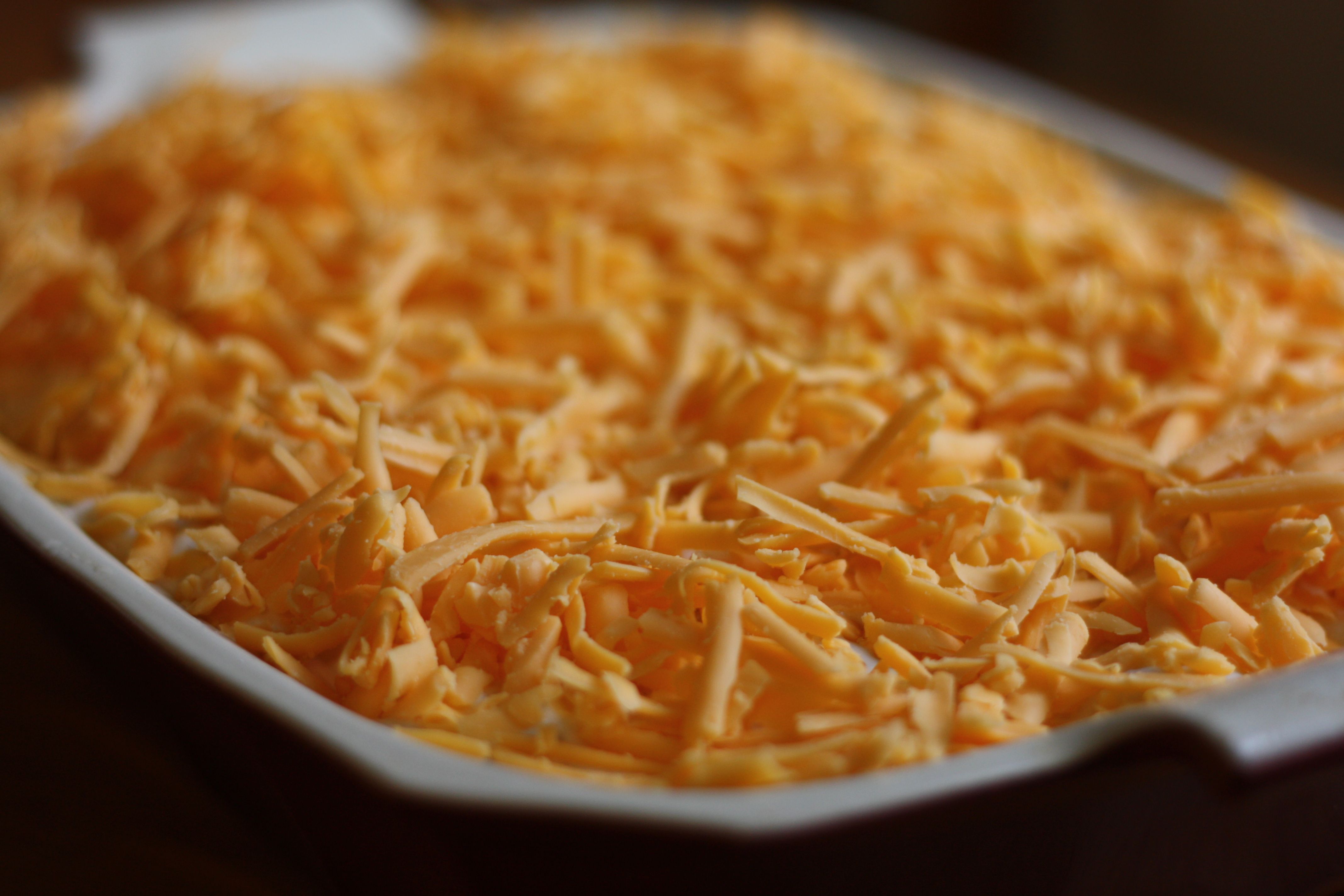
Preheat oven to 350 degrees. Pour the beef, onions, and cooking liquid into a large (13×9) baking dish. Arrange the mushroom slices in an even layer over the beef. Arrange the potatoes in an even layer over the mushrooms. In a small bowl, combine the sour cream, cream of mushroom soup, and milk. Season with salt and pepper, to taste. Spread the mixture over the potatoes. Top with cheddar cheese, then crushed Wheaties. Bake for 1 1/2 – 2 hours. Allow to cool for about 15 minutes before serving.

**CONFIDENTIAL**

This blog post will self-destruct upon reading.


What’s your family’s secret recipe? Will you share it with me?

The Gourmand Mom

Good food, seasoned with a dash of life