RSS Feed

Tag Archives: culinary technique

Sweet and Spicy Pork over Smashed Sweet Potatoes

Posted on

Anyone else inherit the same paranoia about undercooked pork that I did? Do you find yourself perpetually overcooking your pork until it practically crumbles and barely resembles meat? You’re not alone. Overcooking pork is a common practice, stemming from the fear instilled in us by our well-intentioned elders, who warned us never to mess around with undercooked pork. Fearing for our lives and horrified at the thought of contracting some miserable illness, we did as we were told and cooked that pork to a dry 170 degrees.

Turns out that nowadays, Trichinella (the parasite of concern in pork) is not so much a problem as it once was. Improved sanitation standards and pig diets have resulted in a much safer pork quality. Furthermore, trichinella is actually killed at a temperature which is much lower than 170 degrees. There’s really no reason to cook your pork to death.

Wouldn’t you rather enjoy a juicy pork chop instead of something akin to cardboard? Well, you’re in luck! Recently, the USDA officially lowered it’s recommended minimum temperature for pork. You can now rest at ease with cooking your pork to a minimum temperature of 145 degrees. Add a recommended three minute rest time for a little carryover cooking and to let the juices redistribute and you’ll have yourself a delicious, juicy piece of pork. (Click here for more information on the USDA’s revised recommendations.)

It’s now easier than ever to remember the safe cooking temperatures for all types of meat. Just three numbers to remember for safe, delicious meat! Pork, beef, lamb, and other whole cuts of meat all have a minimum recommended temperature of 145 degrees. The recommendation for poultry remains unchanged at a minimum cooked temperature of 165 degrees. Ground meats maintain a minimum recommended cooked temperature of 160 degrees. (See my summertime safety note below the recipe.)

The best way to measure the temperature of any meat is with an instant-read meat thermometer, inserted into the thickest part of the meat. If you don’t already own a good thermometer, get yourself one. It is, without a doubt, one of the most useful kitchen tools you’ll own.
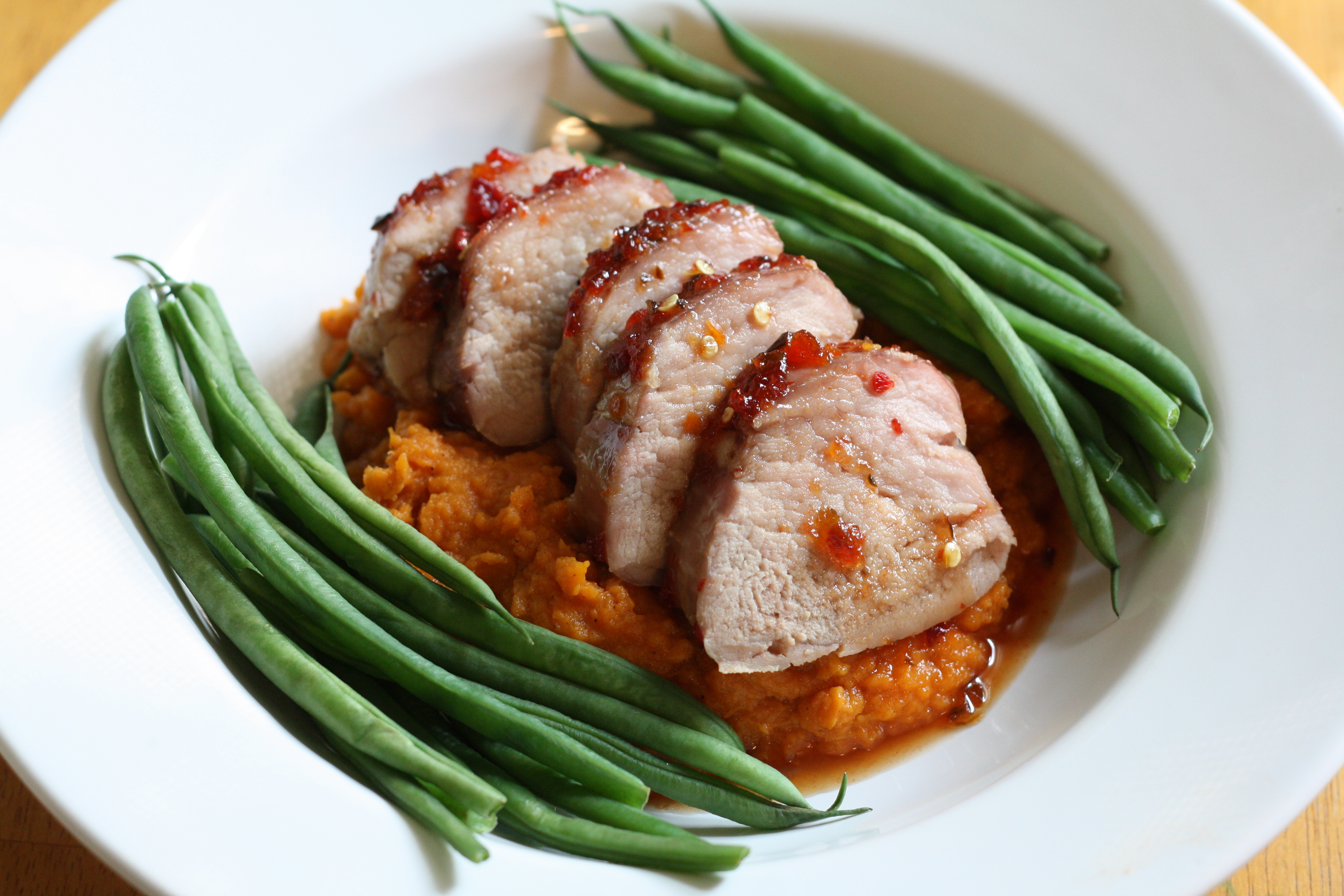
I’ve got just the thing to celebrate the new, lowered safe temperature recommendation for cooked pork; a lean pork tenderloin glazed with a sweet and spicy sauce made of honey and sambal oelek (ground chili paste). Check in the international section of your grocery store for the sambal oelek. If you’re unable to find it, a ground chipotle pepper (from a can of chipotles in adobo) would make a good substitute. Our perfectly cooked tenderloin will be served atop a mound of lightly spiced, smashed sweet potatoes and drizzled with a bit of the honey sauce.

Sweet and Spicy Pork Tenderloin

Ingredients

  • 1 1-pound pork tenderloin
  • 1/4 cup honey
  • 2 tablespoons sambal oelek
  • Salt

Directions

Preheat oven to 375 degrees.

Remove any excess fat or silver skin from the pork tenderloin. Place the tenderloin on a baking dish. Season with salt.

In a bowl, combine the honey and sambal oelek until well blended. Pour about half of the mixture over the tenderloin. Place the tenderloin in the oven and cook for about 25 minutes, until it has reached an internal temperature of at least 145 degrees. Halfway through the cooking time, pour the remainder of the honey mixture over the tenderloin. Allow to rest for 3 minutes before slicing.

Serve over smashed sweet potatoes. Drizzle with excess honey sauce from the baking dish.

Serves 2-4

For the sweet potatoes: Place 2 large sweet potatoes on a baking sheet. Bake in a 375 degrees oven for about an hour, until very tender. Split the potatoes in half and scoop out the tender insides. Smash the potato with 3 tablespoons of butter and about 1/2 teaspoon of cinnamon, until as smooth as desired.

**Semi-unrelated Summertime Safety Note**

The recommended minimum temperature of 160 degrees for ground meats includes burgers, despite some people’s preferences for a more rare-cooked burger. The higher recommended temperature for ground meat (as compared to whole cuts of meat) is due to the nature of the product. Whereas bacteria exists mainly on the surface of whole meats, which enables it to be fully killed during the cooking process, bacteria in ground meat has the potential to be spread throughout the entire product. If you prefer your burgers on the rare side, your best bet is to purchase the highest quality meat from a trusted source and grind it in your own, impeccably clean meat grinder.  Irradiated beef, which has been exposed to radiation in order to kill bacteria and parasites is another option for rare-cooked burgers, though personally, the idea of irradiated meat doesn’t sit well with me. I’d much rather just cook my burgers to the recommended safe temperature. Using a ground beef with a higher fat content (80/20) is the best way to maintain a well-cooked, juicy burger.

Braised Short Ribs with Creamy Parmesan and Sun-Dried Tomato Polenta

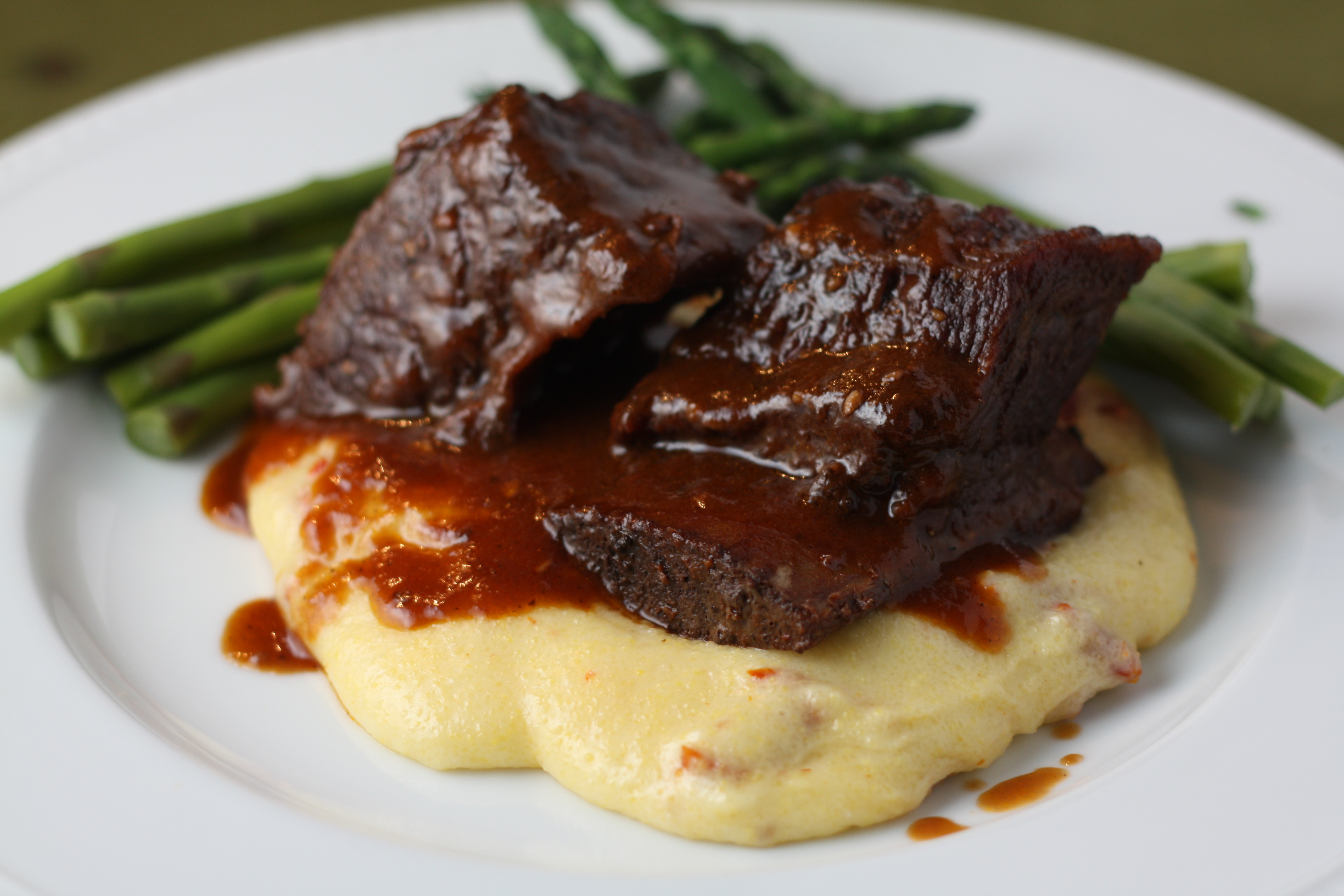
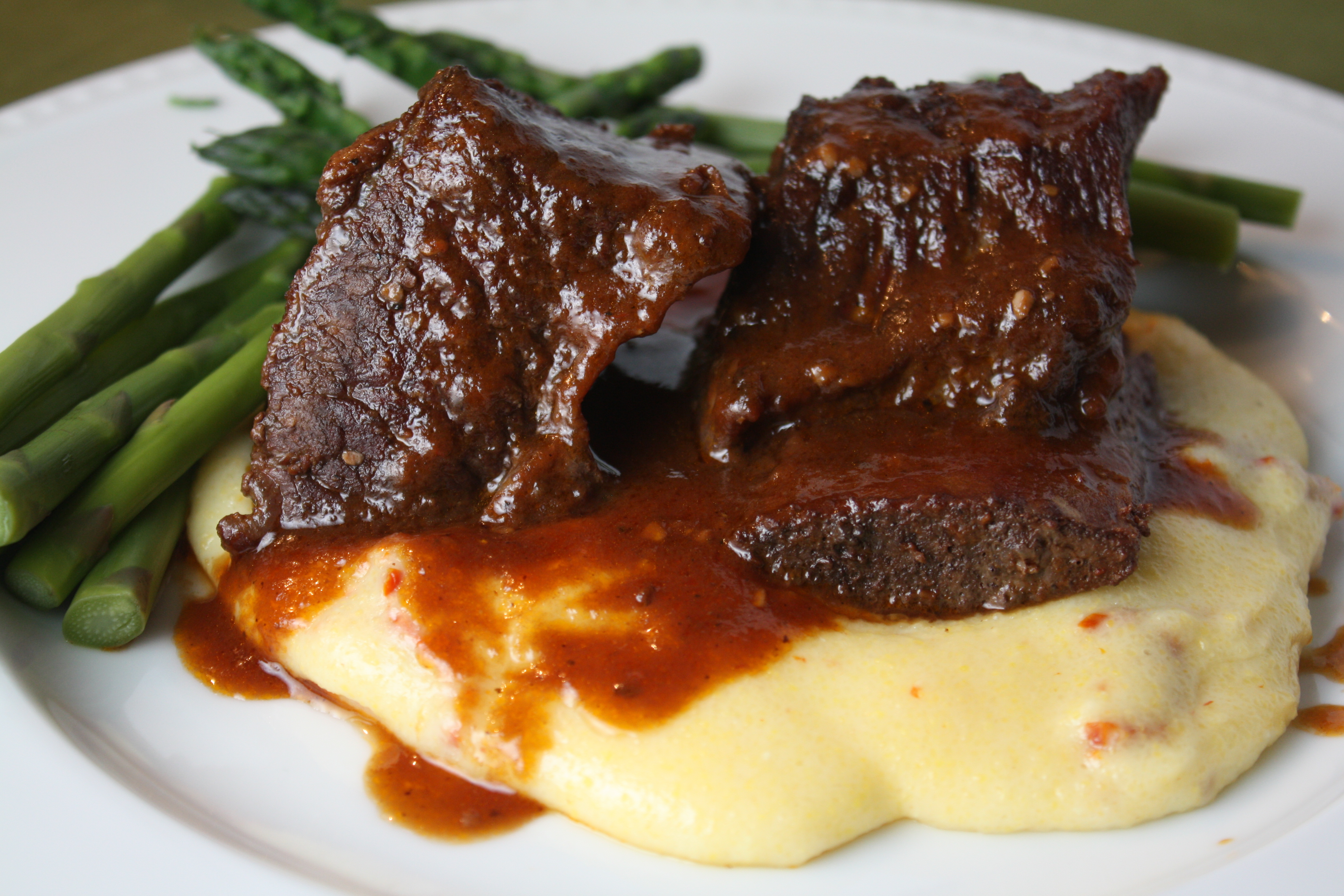
Last weekend, I received a recipe request from my uncle. We were seated around a table at the Venus Restaurant, a little diner where my grandmother has breakfast each and every morning. Each day, my grandmother is joined by at least one, and sometimes many, of my aunts, uncles, and cousins. Whenever my family travels to Long Island, we’ve made it a routine to join the group at breakfast before we hit the road for home. I get the corned beef hash and eggs every time; eggs cooked over-hard, rye toast, and fries.

Well, this past weekend, as I was eating my corned beef  hash and eggs, my family was discussing some of their favorite recipes from this very blog. It thrills me to know that the people I love are enjoying my little work of culinary joy. We talked of gravies, soups, and macaroni and cheese. And then my Uncle Gene asked if I take requests. I absolutely take requests!! In fact, I love requests. His request was clear and precise; braised short ribs with polenta. My mouth watered at the thought. It didn’t take me more than a minute to formulate a plan.

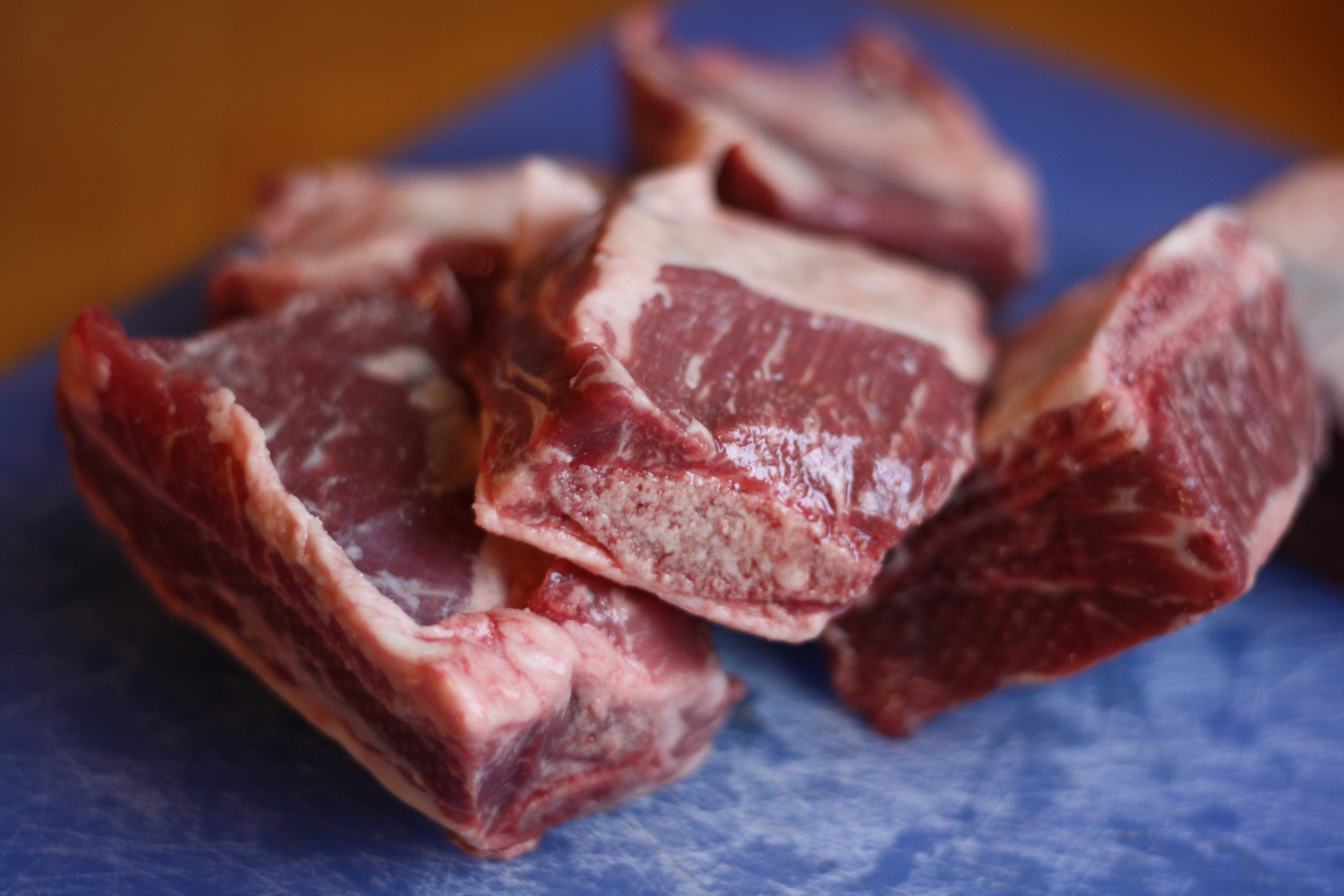
Braising is a wonderfully simple technique which produces extraordinary results. During braising, meat is typically seared over high heat and then cooked slowly in a bit of liquid at a lower temperature. The slow cooking process breaks down the connective tissues of tougher cuts of meat, resulting in a very tender and flavorful result. As the meat cooks, the braising liquid reduces and thickens into a ready made sauce for your completed dish. Combine whatever liquids and seasonings strike your fancy. For the braising liquid in this dish, I chose to use a simple combination of beef stock and red wine, combined with accents of tomato paste, garlic, and onion. Perfection in simplicity.

My uncle requested polenta to accompany the braised short ribs. Polenta is, quite simply, boiled cornmeal. A basic polenta is made from yellow cornmeal, simmered in boiling water or stock until it’s smooth and thickened. To add a bit of rich creaminess to our polenta, I incorporated butter and cream at the end. The addition of parmesan cheese and sun-dried tomatoes makes this polenta the perfect partner to our tomato accented short rib sauce.

Braised Beef Short Ribs

Ingredients

  • 6 Beef Short Ribs
  • 3 Tbsp Olive Oil
  • 3 cloves Garlic, minced
  • 1/2 Onion, finely diced
  • 2 cups Beef Stock
  • 1 cup Red Wine
  • 1/4 cup Tomato Paste
  • Salt and Pepper

Directions

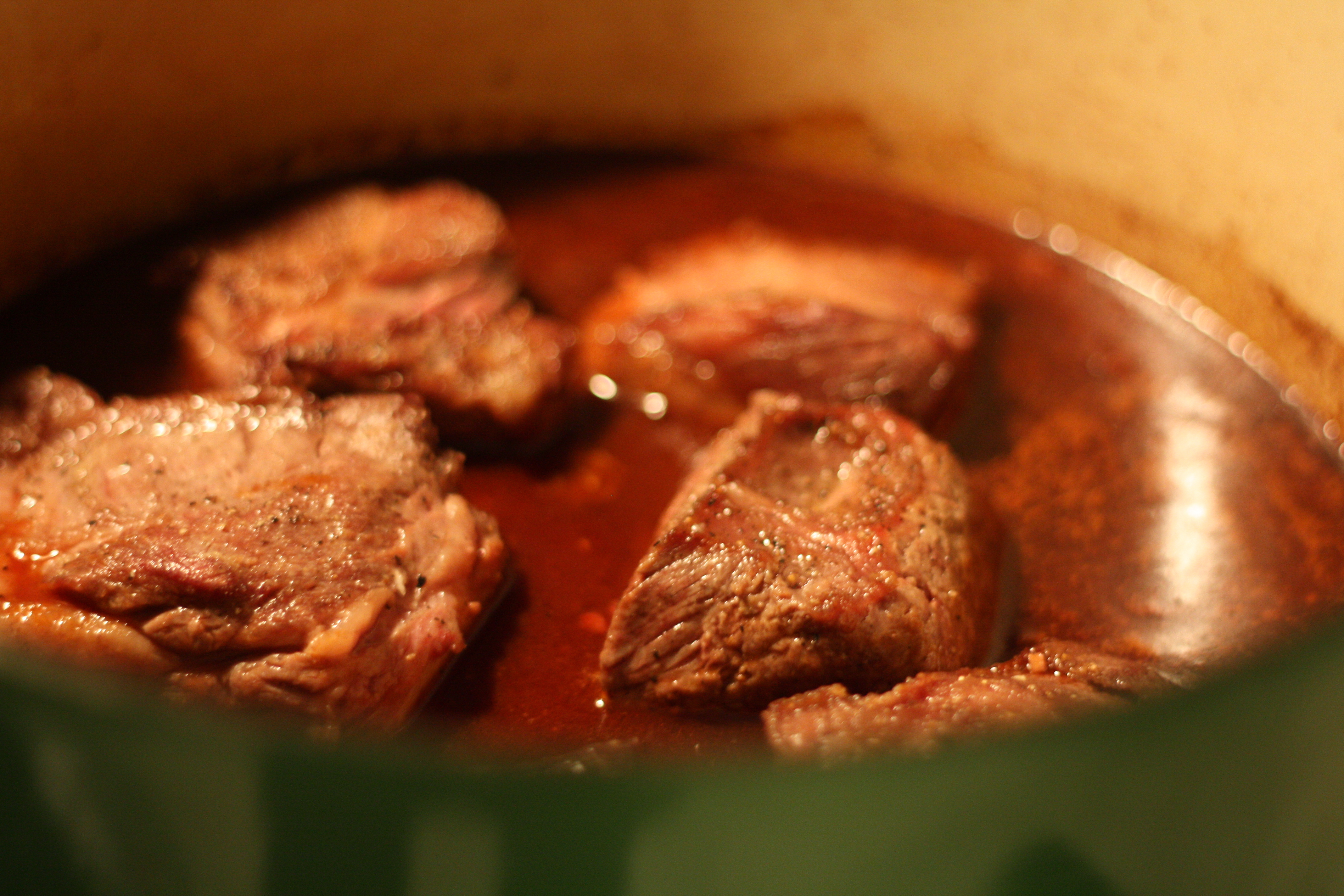
Preheat oven to 350 degrees. Heat olive oil in a large oven-safe pan over medium/medium-high heat. Season the short ribs with salt and pepper. Add the short ribs to the pan and cook for a minute or two on each side until nicely browned. Remove the short ribs from the pan and set aside. Reduce the heat to medium. Add the onion and garlic. Cook for 3-4 minutes until the onion is soft and golden. Add the red wine, beef stock and tomato paste. Whisk to combine. Bring to a simmer and allow the mixture cook for about 3-5 minutes. Place the short ribs in the liquid. (They will not be fully submerged.) Cover the pan and place it in the oven. Cook for about 2 hours.
After two hours, remove the pan from the oven. The meat will have pulled away from the bones. Remove the short ribs from the liquid and set aside. Discard any bones which have fallen away from the meat. Strain the sauce. Allow the sauce to sit for a couple minutes so that the excess fat will rise to the surface. Skim the excess fat off of the sauce. Taste and season with salt and pepper. If you desire a thicker sauce, pour the sauce into an uncovered saucepan and simmer until the sauce has reduced to your desired consistency.
Serves 2-3


Creamy Parmesan and Sun-Dried Tomato Polenta

Ingredients

  • 2 cups Water, divided
  • 1/2 cup Coarse-Ground Yellow Corn Meal
  • 1/4 tsp Salt
  • 2 Tbsp Butter
  • 1/3 cup Pecorino Romano or Parmigiano Reggiano Cheese, grated
  • 1/4 cup Light Cream
  • 1/3 cup sun-dried tomatoes, diced
  • Salt and Pepper

Directions

Bring 1 1/2 cups water to a boil. Meanwhile, in a small bowl, combine the remaining water, corn meal, and salt. Once the water is simmering, slowly stir in the cornmeal mixture until smooth. Continue stirring and cooking over low heat for a couple minutes until the mixture thickens. Cover and allow to cook over low heat for 5 more minutes. Stir in the butter, cheese, sun-dried tomatoes, and cream. Taste and adjust seasoning with salt and pepper.

Serves 2-4

How to Prepare Fresh Pumpkin Puree

When it comes to Thanksgiving desserts, does it get any more classic than pumpkin pie?? Pumpkin is the bright orange star of autumn produce. They play a leading role in Halloween celebrations and an even tastier role at Thanksgiving. As far as I’m concerned, serve whatever other desserts you’d like on Thanksgiving, as long as there’s at least one pumpkin pie. So, in honor of our Thanksgiving Week here at The Gourmand Mom, we’ll be making a pumpkin pie, using my mom’s tasty recipe for Fresh Pumpkin Coconut Pie.

Like many families, we purchased several pumpkins to adorn our front steps throughout October. They lasted out there for a month, until one afternoon, we opened the door to find the remnants of what used to be the Frankenstein pumpkin. We were all a bit flummoxed upon finding the remains. The boys were devastated. What horrific event could have caused the brutal destruction of our little pumpkin; so thoroughly ravaged on our front steps. We all felt a bit violated. But, my husband dutifully cleaned up the remains and we did our best to put the past behind us. And then, the very next day, the vicious pumpkin villian returned.

Let’s just call him Squirrely. Squirrely stood there on our front steps, staring at me with his beady little eyes, looking all cute with his fluffy tail. And then he strutted himself over to the next largest pumpkin, and shamelessly went to work. So strong was his passion for pumpkin, that he worked diligently at his task for at least an hour, as we all stood staring in awe. Squirrely was clearly a master of pumpkin. To his credit, he waited a month before devouring our decor.

Clearly, I wouldn’t be using any of those pumpkins to make my pumpkin pie. Luckily, our grocery store is well-stocked with pumpkins. For the purpose of making pumpkin puree for pies or other pumpkin desserts, your best bet is to pick up a Pie Pumpkin or Sugar Pumpkin. They are smaller and will produce a less watery, more flavorful result. When my mom prepares the pumpkin for her pies, she typically prepares the puree in a similar fashion to mashed potatoes. She cuts the pumpkin into chunks, removes the skin, boils, then mashes. It’s a technique which has always worked well for her. However, an easier alternative to chopping a hard pumpkin into pieces and removing all of the skin is to roast the pumpkins. Once roasted, the tender insides will scoop out with ease. Here is a step by step guide on how to prepare fresh pumpkin puree by roasting.

1. Thoroughly rinse the pumpkins.

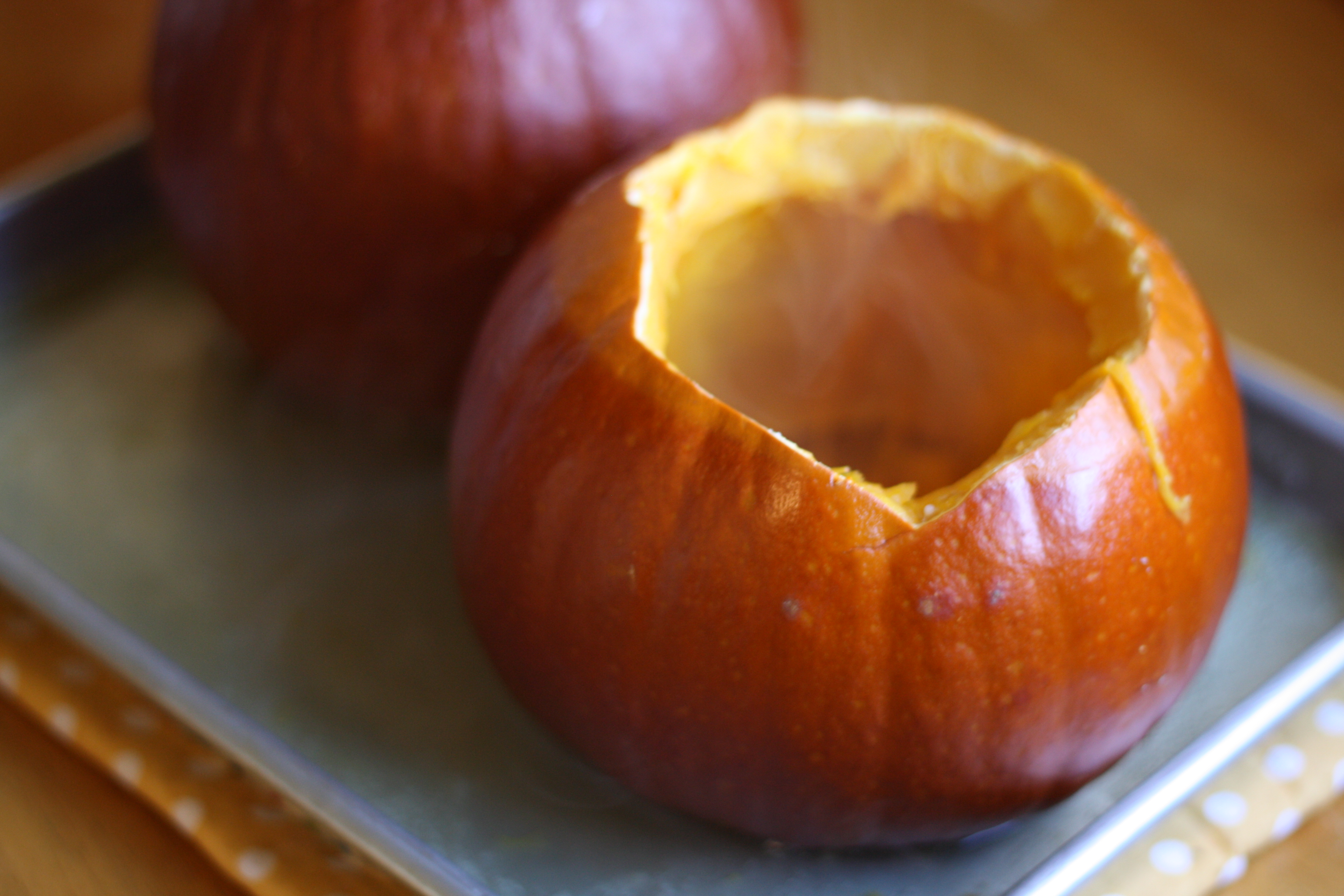
2. Ideally, cut the pumpkins in half, from the stem to the base. However, if you happened to purchase the world’s hardest pumpkins or perhaps left your pumpkins in the freezing car overnight, you may have to settle for simply sawing and prying off the top. After trying every one of my very sharp knives on my stubborn pumpkins, I considered inviting Squirrely inside to help. (He clearly knows how to get inside a pumpkin.) Seriously, a hacksaw wouldn’t have cut through my pumpkins. But, eventually I managed to wrestle the tops off. Don’t worry, if you can not manage to cut your pumpkins in half, rest assured that the  pumpkins will roast just as well with only the tops removed.

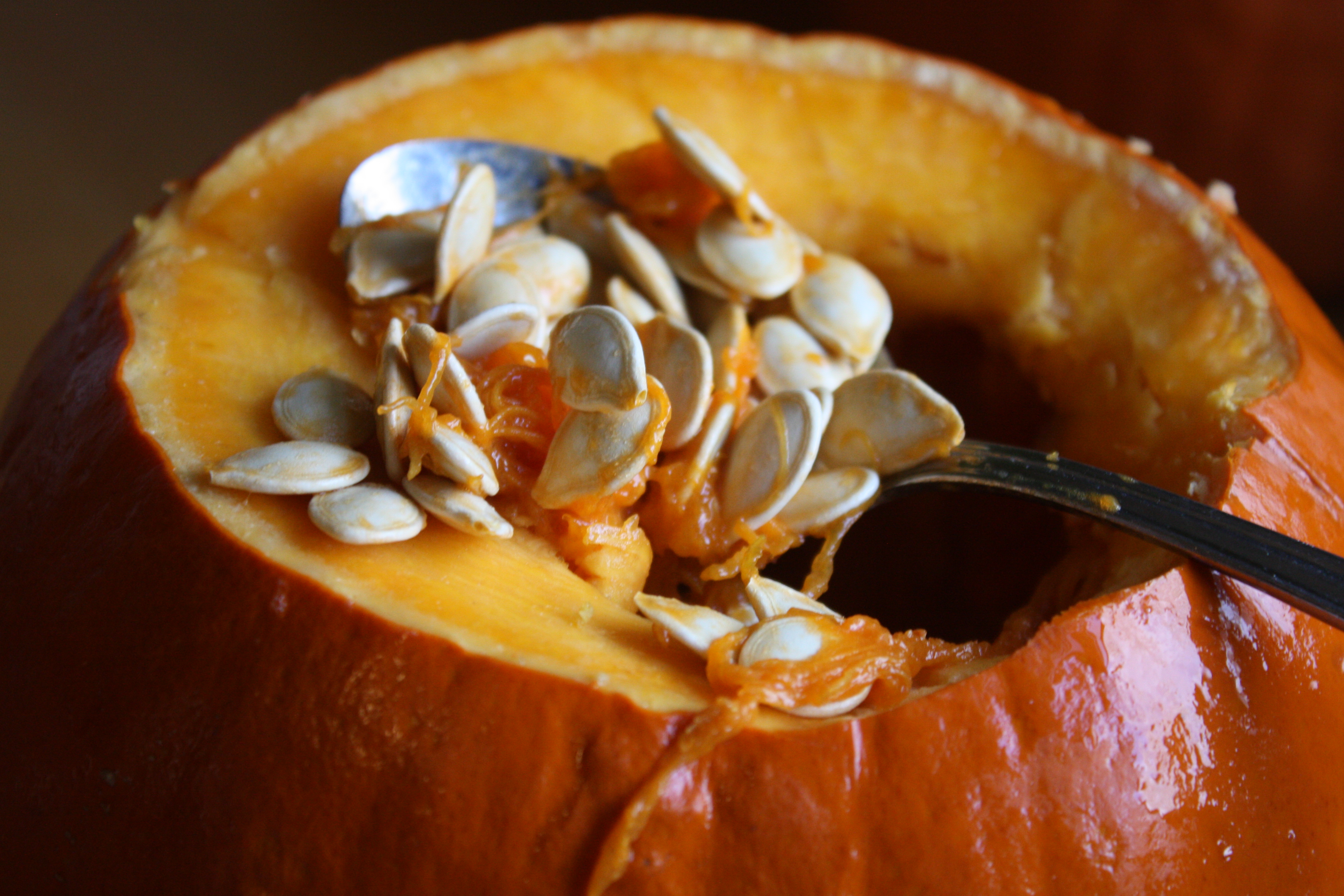
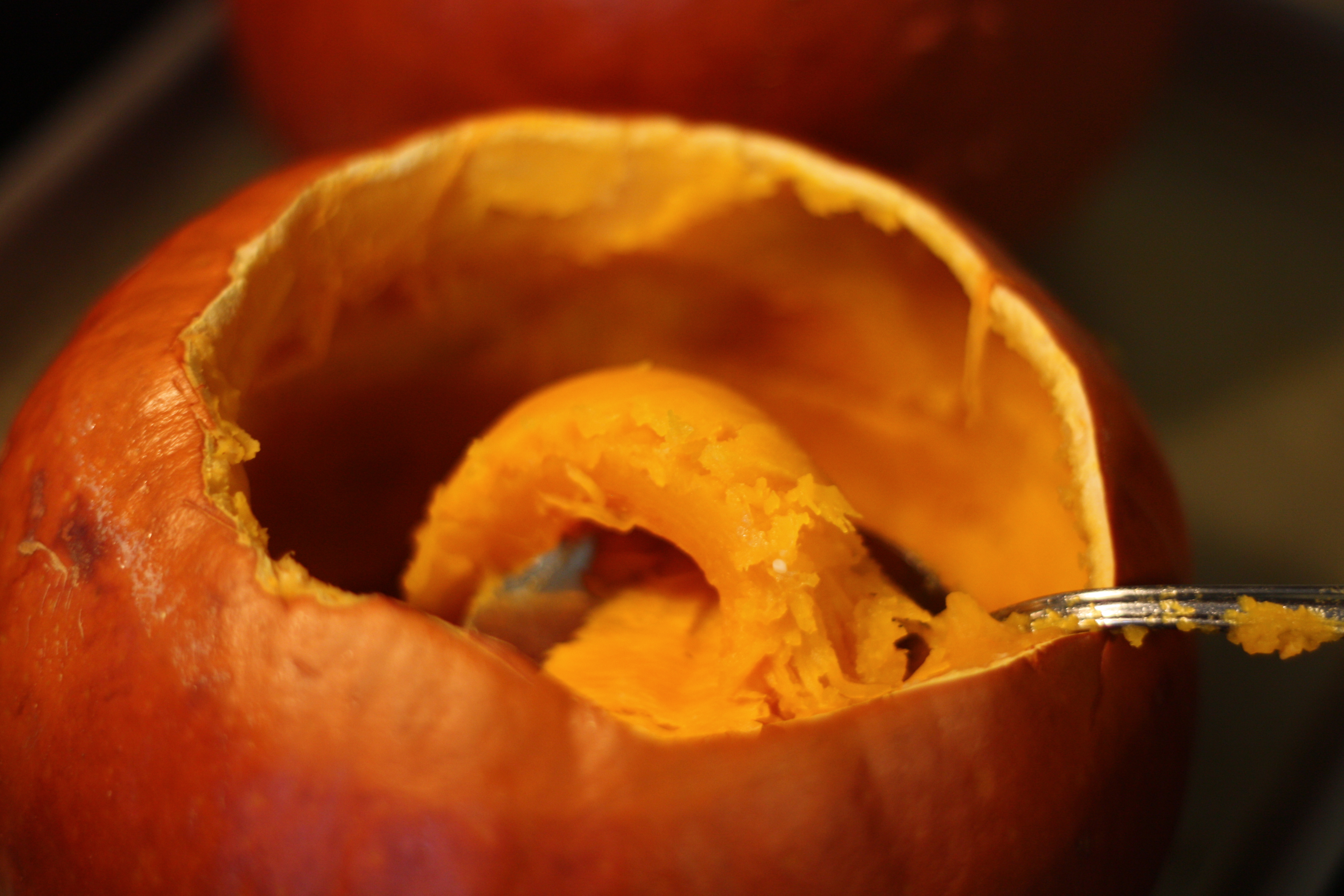
3. Use a spoon or ice cream scoop to remove all of the seeds and stringy parts from the pumpkin. Save the seeds for roasting.

4. Place the pumpkin upside down on a baking sheet (cut sides down, if you were able to cut your pumpkin in half). Fill the bottom of the baking sheet with a thin (1/4 inch) layer of water.

5. Roast at 375 degrees for about 90 minutes. Test by inserting a fork into the inside of the pumpkin. It should be quite tender. Allow to cool.

6. Scoop out the tender insides.

7. Use a blender, food processor, or immersion blender to puree until smooth. Refrigerate until ready to use.

** Two small Pie Pumpkins should produce about 3-4 cups pumpkin puree.

If you’re preparing fresh pumpkin puree, be sure to roast the seeds separately for a tasty snack. I seriously ate so many pumpkin seeds yesterday that I’m beginning to suspect I may be sprouting a pumpkin in my belly. They are a delicious and highly nutritious snack.

To roast the pumpkin seeds: Rinse the seeds and separate from the stringy pumpkin pieces. Discard the stringy pieces. Lay the pumpkin seeds in a single layer on a paper towel to dry. Spread the seeds onto a baking sheet. Toss with a bit of olive oil. Sprinkle with sea salt and pepper. Bake in a 375 degrees oven for about 20 minutes. Enjoy!

Stay tuned for the recipe for Fresh Pumpkin Coconut Pie, coming up next!

It’s Thanksgiving Week! Herb Roasted Turkey Breast with Pan Gravy

You didn’t think I’d leave ya hanging for Thanksgiving, did ya? I’d never do a thing like that! I figured it wouldn’t do you very much good if I waited until the day after Thanksgiving to share all of the delicious things I ate, so I’ve decided to officially declare this Thanksgiving Week on The Gourmand Mom.

We’ll start with the basics; turkey and gravy; and go from there. We’ll work our way through a fantastic Spiced Sweet Potato Puree with Pecan Streusel. Our mouths will water over some homemade Cranberry Orange Sauce. Then we’ll take a look back at my favorite stuffing recipe and a few other previously posted dishes which would make perfect additions to any Thanksgiving table. After that, we’ll try out a new doughy dinner rolls recipe I’ve got my eyes on. Finally, we’ll move on to the desserts; my mom’s Pumpkin Coconut Pie and my favorite Chocolate Pecan Pie. After that, well, we’ll just have to see where it goes from there.

Today, we’re starting with the turkey. I’ll let you in on my dirty little secret. I haven’t roasted a whole turkey in years. For the past fews years, I’ve been roasting a bone-in whole turkey breast separate from the drumsticks. Some people may claim that this is Thanksgiving culinary sacrilege. I claim that it produces the best end result. Here’s the deal… when you cook the turkey whole, you’re forced to continue cooking that big ole turkey until the slowest cooking parts come up to a safe temperature. In the mean time, this often results in overcooking and drying out the faster cooking breast. And who likes dried out turkey breast?? Not me!

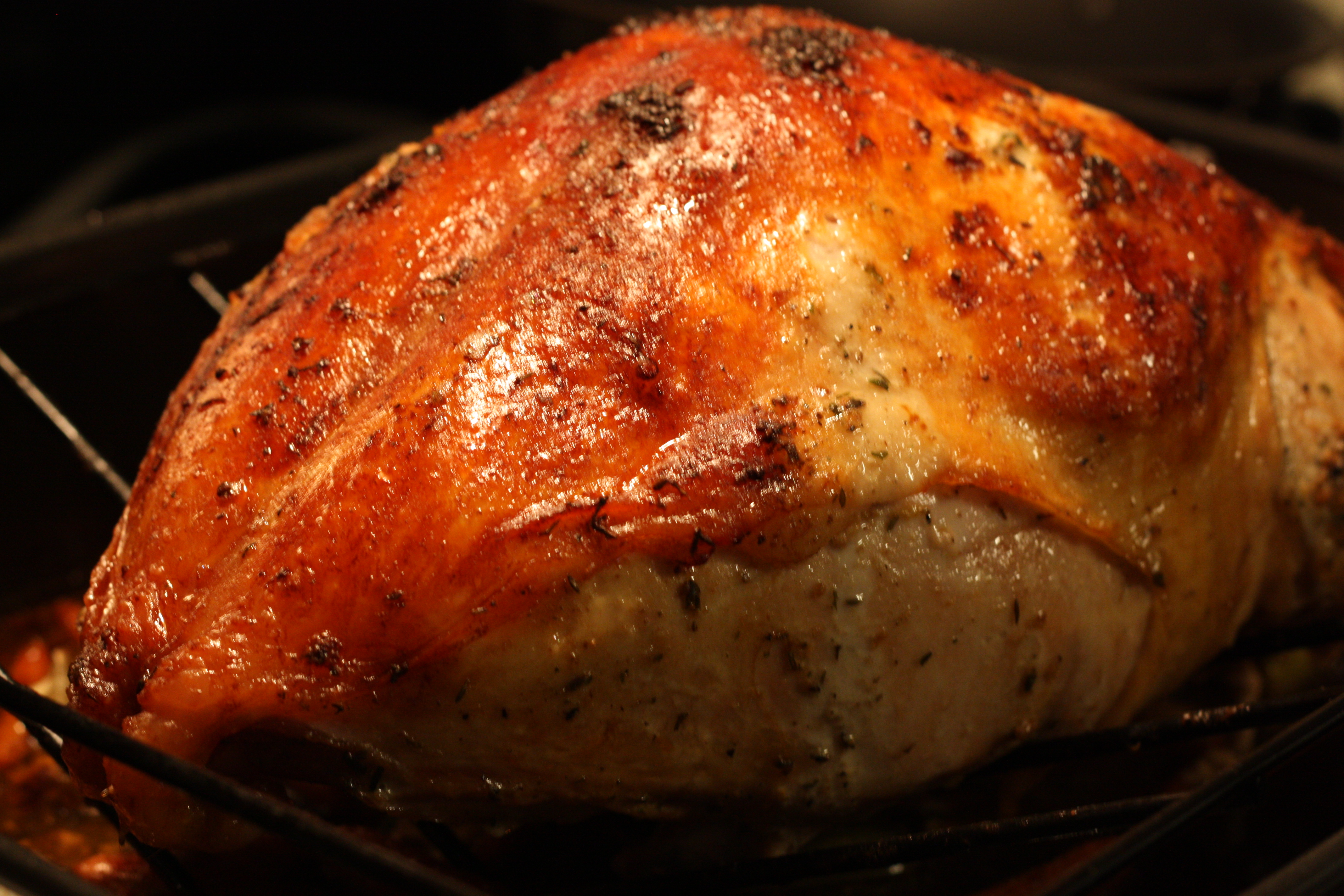
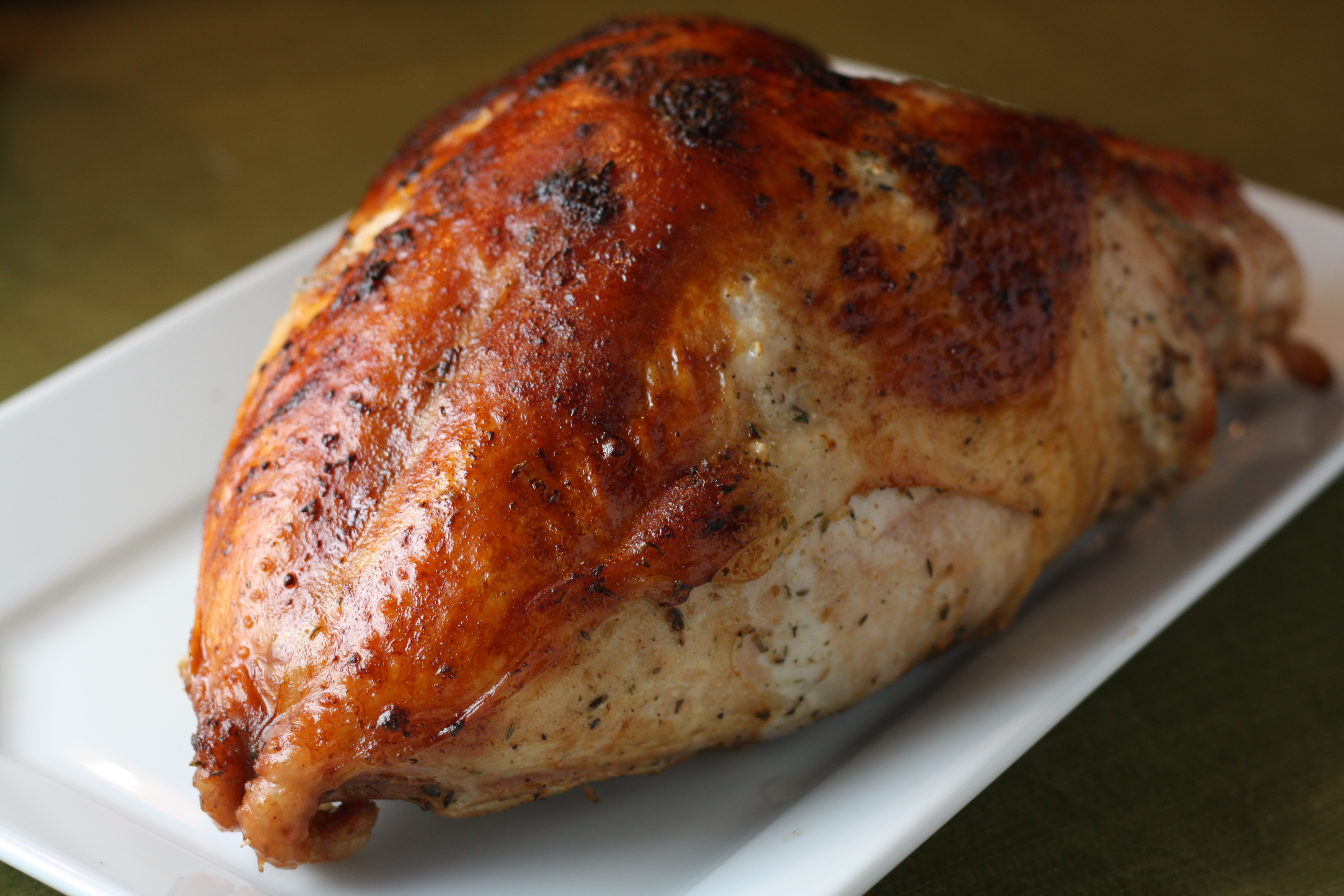
By cooking the turkey breast separate from the drumsticks, you can cook each part to perfection. The roasted turkey breast continues to make a stunning presentation on the Thanksgiving table.  Serve it with roasted drumsticks on the side and you’ll hardly notice the difference. Besides, how long does everyone really sit and gaze at the whole turkey before it gets carved and served anyway? The roasted turkey breast is big, golden brown, and perfectly moist. Your guests will have nothing to complain about.

Because the turkey breast is smaller, it will require less cooking time. Furthermore, the smaller size is easier to handle overall. So, my recommendation is to cook a large turkey breast separate from the drumsticks. My grocery store carries whole turkey breasts right alongside the whole turkeys. One large turkey breast should serve at least 6-8 people with some leftovers. If you’re serving a large crowd, buy two. For dark meat lovers, grab a couple drumsticks. Go crazy. Buy more than two. Then roast (or braise) the drumsticks separately and serve with your perfectly roasted turkey breast.

There are many creative recipes out there for turkey. Food Network is consistently a wonderful source for turkey recipes and other Thanksgiving menu ideas. Today, we’re sticking with a basic herb-roasted preparation. We’ll rub the turkey with an herbed butter, then begin by roasting at a high temperature to achieve a nice brown color on the skin while searing the exterior to lock in the juices. Then, we’ll lower the heat and let the turkey finish cooking to perfection. As the turkey cooks, delicious juices will collect on the bottom of the roasting pan. We’ll enrich the flavor of those juices by placing a few aromatics, in the form of celery, carrots, and onions, in the bottom of the roasting pan. While the turkey is resting, we’ll be able to turn those juices and a bit of chicken stock into a simple and delicious pan-gravy.

Herb Roasted Turkey Breast with Pan Gravy

Ingredients

  • 1 6-7 pound Turkey Breast (bone in)
  • 1/2 stick Butter, softened
  • 1 Tablespoon Dijon Mustard
  • 1 teaspoon Garlic, minced
  • 1/2 teaspoon Salt
  • 1/2 teaspoon Pepper
  • 1 teaspoon Thyme
  • 1 teaspoon Rosemary
  • 3/4 cup Carrots, coarse chopped
  • 1 Onion, quartered
  • 3/4 cup Celery, coarse chopped
  • 2 cups Chicken Stock

Directions

The night before, remove the turkey breast from it’s packaging. Place on a rack in a roasting pan and sit, uncovered in the refrigerator.

Preheat oven to 475 degrees. In a small bowl, combine the butter, mustard, garlic, salt, pepper, thyme, and rosemary. Rub the herbed butter all over the turkey. Working from the edges, try to loosen the skin and rub some of the butter directly onto the turkey breast. In the bottom of the roasting pan, scatter the carrots, celery, and onion. Add the chicken stock to the bottom of the pan. Place the pan on the middle rack of the oven and roast for 25 minutes. The skin should take on a nice golden browned color. Baste the turkey with the pan juices. Then, lower the heat to 325 degrees. Periodically, baste the turkey with the juices from the bottom of the pan. (If the bottom of the pan becomes too dry during cooking, add a little more stock.) Continue cooking until the internal temperature reaches 165 degrees. Use an instant read meat thermometer, inserted into a deep part of the breast, to check the temperature. A 7 pound turkey will take approximately 2 hours at 325 degrees, after the initial 25 minutes at 475 degrees. When the turkey is cooked, remove the pan from the oven. Loosely cover the turkey with foil and allow it to rest for about 20 minutes. Meanwhile, prepare the gravy and side dishes.

Serves about 6-8, generously

Turkey Pan Gravy

Ingredients

  • 3 Tablespoons Butter
  • 3 Tablespoons Flour
  • Drippings from Turkey
  • 1 1/2 cups Chicken Stock (approximately)

Directions

Pour out the turkey juices from the roasting pan. Strain to remove the vegetables. Allow the juices to sit for a few minutes. The fat will rise to the top. Pour off the fat and reserve the remaining juices. Add chicken stock to the juices to make a total of 2 cups liquid. In a saucepan, combine the butter and flour over medium heat, whisking continuously. Cook for a minute or two. Then, whisk in the turkey juice/chicken stock. Bring to a simmer.Cook for 2-3 minutes until the gravy begins to thicken. Taste and adjust seasoning with salt and pepper, as desired.

Makes 2 cups

Now, if you’ve just got to create that beautiful, Norman Rockwell style, picture-perfect bird, here are a few tips for handling that whole turkey:

  • Do not stuff your turkey. Stuffing your turkey presents a food safety and moist turkey challenge. Since the stuffing is in contact with the raw turkey, it will need to reach a temperature of 165 degrees to be safe. In order to reach this safe temperature, you’ll often end up cooking the turkey longer than necessary. Instead, bake your stuffing separately and throw a few herbs and aromatics into the turkey cavity; celery, onions, carrots, garlic, thyme, rosemary, etc.
  • Allow your turkey to sit uncovered in the fridge overnight before roasting. This will help to produce a crispier skin.
  • Start your turkey at a high temperature (475 – 500 degrees) for the first 20-30 minutes, then reduce heat to 325 or 350 degrees to finish cooking.
  • Don’t bother with that flipping the turkey technique you may have seen. In my opinion, it’s more trouble than it’s worth.
  • To brine or not to brine? Brining your turkey in a solution of salt, water, and other seasonings is said to produce a juicier and more flavorful turkey. There are people who swear by brining to produce the best turkey. I’m not one of those people. I’ve brined and I’ve not brined. In my opinion, the difference is minimal. But if you’ve got the time  and space to do it, go for it. Click here for a useful resource on brining.
  • Loosely tenting the turkey with foil during cooking can help to prevent over-browning and keep the turkey moist. Be sure to remove the foil during the last 45 minutes to achieve a nicely browned skin.
  • To be safe, all parts of your turkey should register 165 degrees on an instant read thermometer. Some resources list 180 degrees as the minimal temperature. The USDA recommends 165 degrees as measured in the  innermost part of the thigh and wing and the deepest part of the breast.
  • Let your turkey rest for at least 20-30 minutes before carving. This is a good time to make the gravy and finish reheating your side dishes.
  • After dinner, throw the whole turkey carcass into a large pit of simmering water. Follow my procedure for chicken soup to make a tasty turkey soup. Click here for my chicken soup procedure.

A few excellent resources for turkey info:

FDA – Let’s Talk Turkey

Food Network – Top Ten Turkey Tips

Food Network – Turkey Recipes and Turkey Calculator

How to Roast Peppers

Roasted peppers are a sweet and delicious addition to many meals. My favorite thing is to build a little sandwich of roasted red peppers, fresh mozzarella, and a drizzle of balsamic reduction on ciabatta. Then, I wrap it up in foil and pop it in the oven until the cheese gets a bit warm and melty. Mmmmm! I’m drooling just thinking about it.

Roasted peppers are a cinch to make at home, so save yourself the money and make your own, rather than buying those jarred peppers. Here’s a little photo guide on how to easily roast your own peppers. Then, check out my Italian Mac and Cheese recipe (coming up later!) for a tasty way to put them to use!

Start with firm, fresh peppers. You can use any kind of pepper. My favorite variety for roasting are Red Bell Peppers.

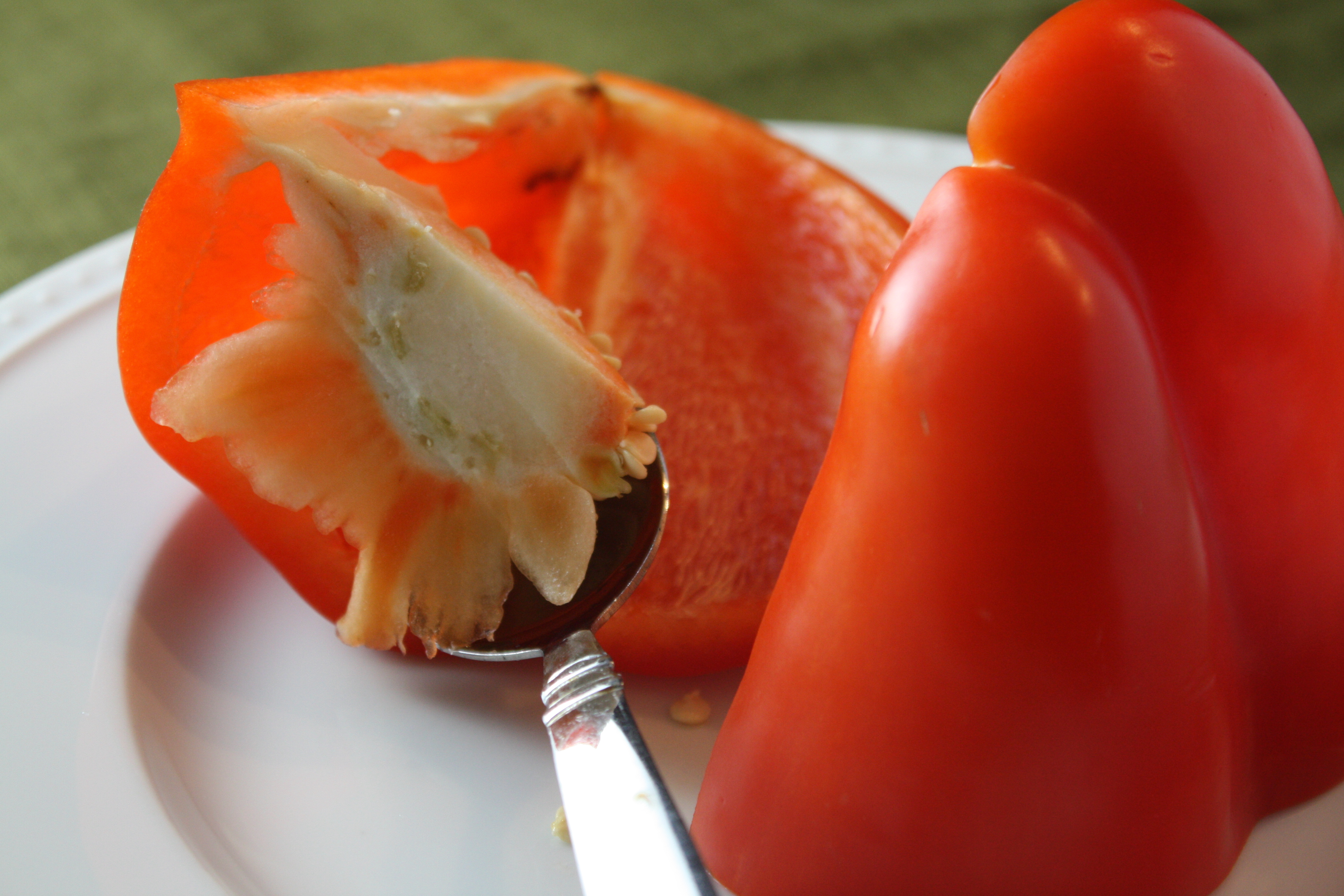
Cut the pepper in half. Use the edge of a spoon to remove the seeds and ribs.

Pour a drizzle of oil over the pepper halves and rub to evenly coat the skin side. Place the peppers, cut side down, on a baking sheet.

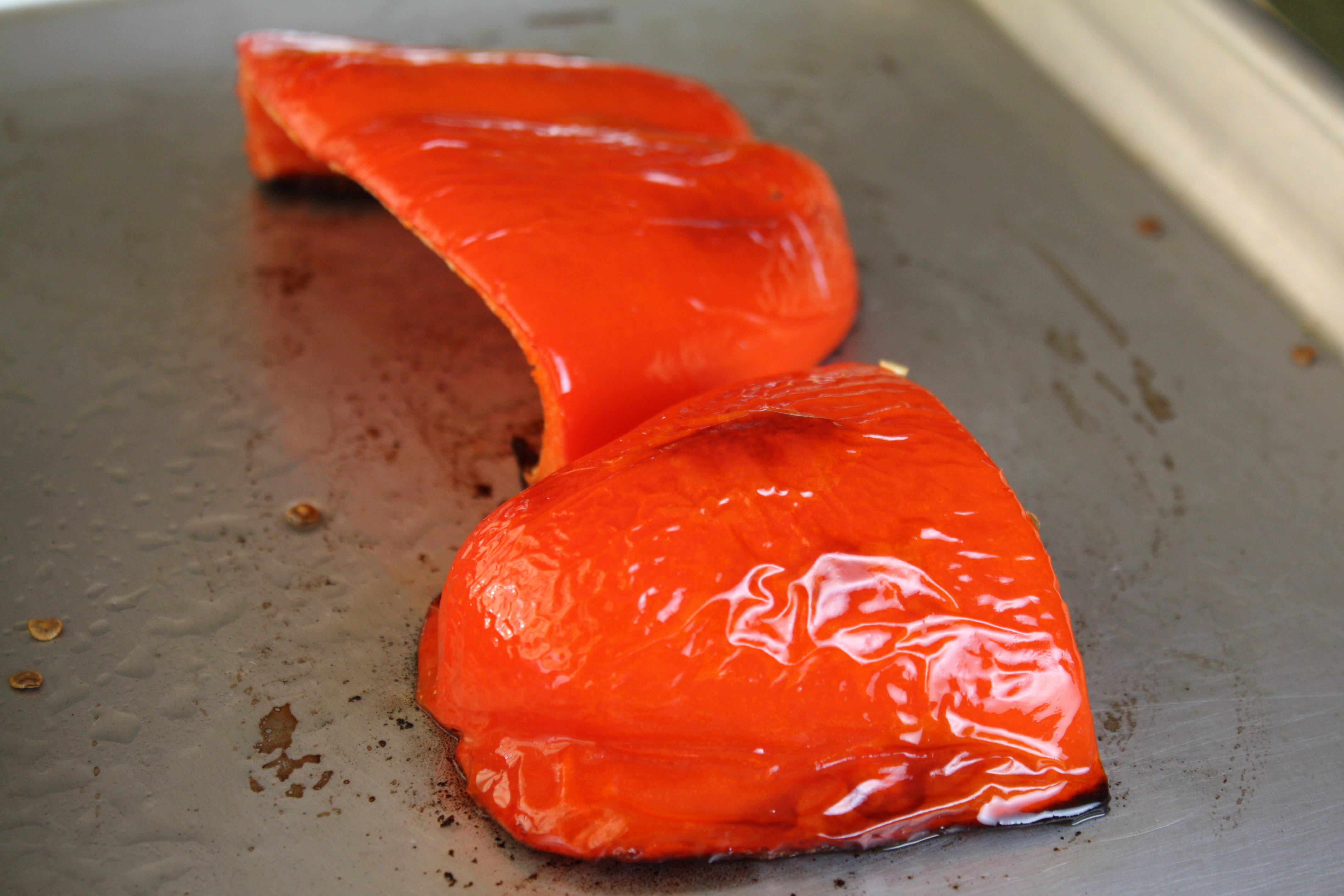
Cook in a 425 degrees oven for 15-20 minutes, until the top appears lightly browned and the skin begins to pucker.

Remove from the oven and place the hot peppers in a sealed ziploc bag. Allow to cool for 15-20 minutes. This step will help the skins to release from the peppers.

Peel the skin away from the peppers. If necessary, use the tip of a paring knife to release an edge, then simply peel the skin away.

Enjoy your homemade roasted peppers!

How to Supreme an Orange

Posted on

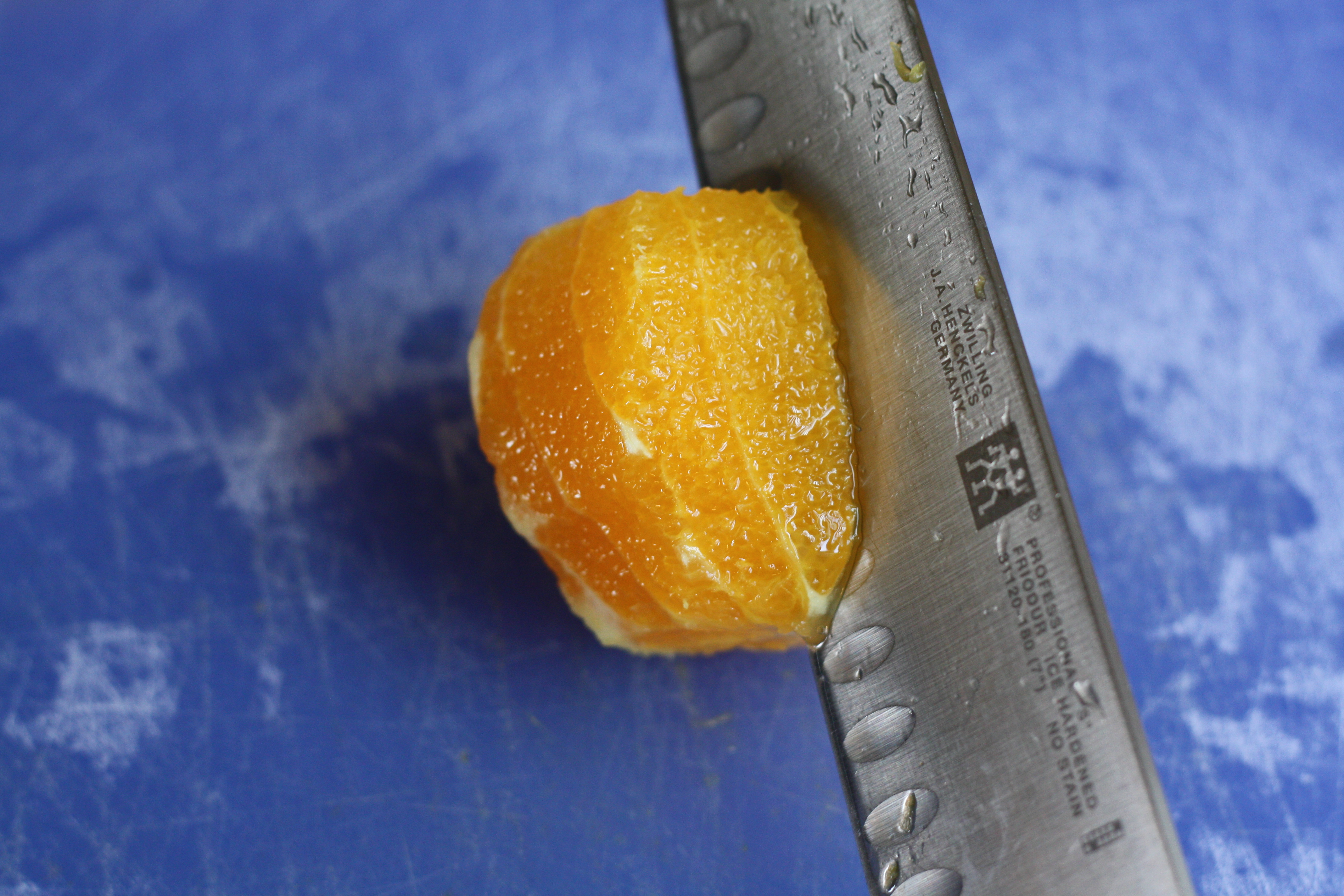
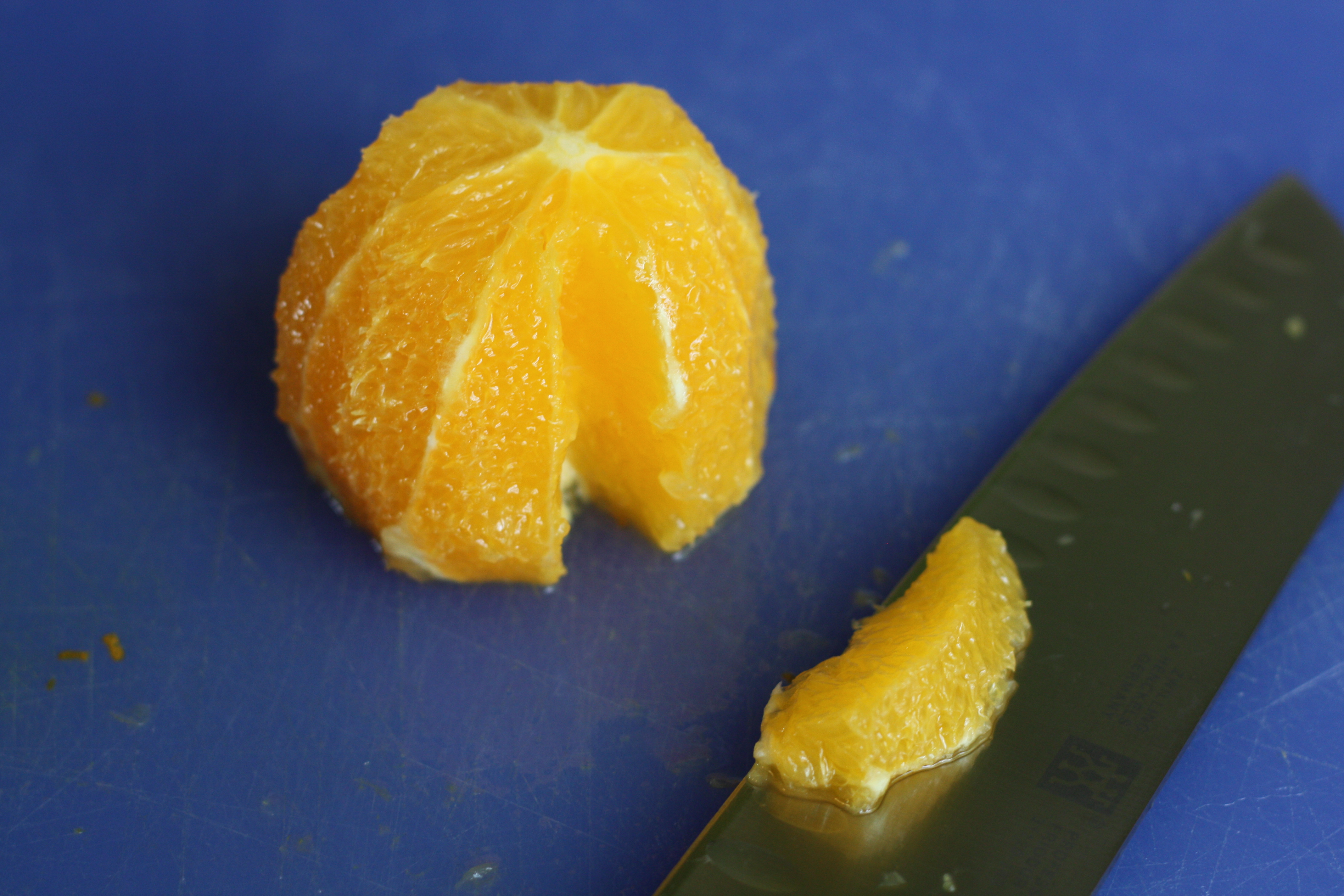
To surpreme an orange is simply the process of  removing the peel, pith, seeds, and membranes, which leaves you with clean, sweet orange segments. You may remember that I used orange supremes in the Piña Colada Salsa recipe and we’ll be using them tonight in duck a l’orange. Orange supremes are also delicious in salads. This same process can be used for lemons, limes, or other citrus fruits.

Start with an orange.

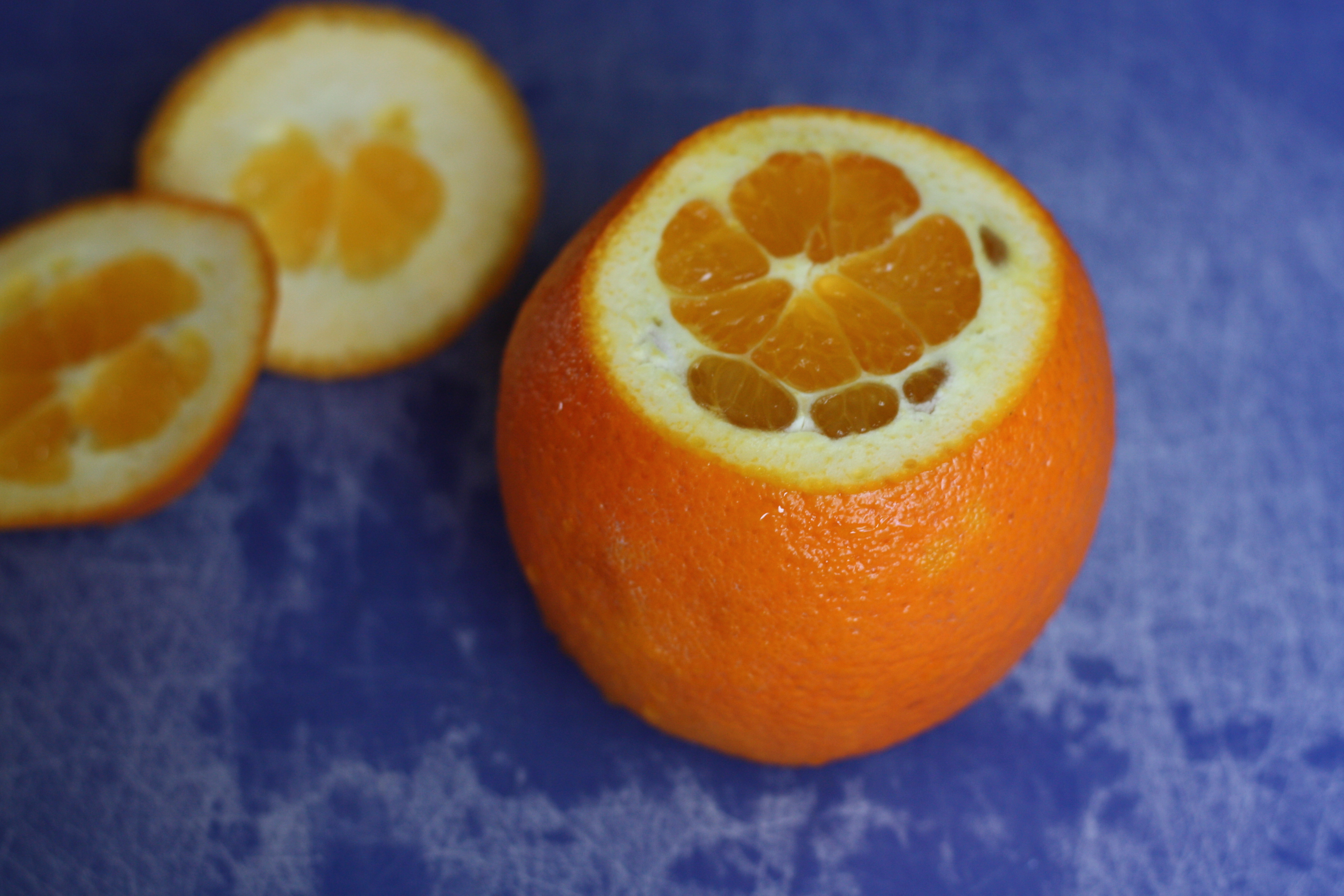
Cut off the top and bottom of the orange.

Use a knife to cut off the peel and any white pith.

You should be able to clearly see the membranes between the segments.

Carefully cut the segments from between the membranes.

Repeat the process until all orange segments are removed.

Lobster Macaroni and Cheese

Posted on

Today’s a very special day! Right now, at this very moment, you are reading my 100th blog post! Wow! One hundred posts! Where in the world did the time go? It seems like just yesterday that I was spending all of my free time tending to my imaginary mafia.

Change a diaper. Beg for untraceable cell phones and illegal transaction records. Play legos. Save up enough Thai Baht to buy a Nguhea Sniper Rifle. Clean up the play-doh that’s been rubbed into the carpet. Try to collect the last faberge egg for my Moscow collection. Console a crying baby. Spend 24 million rubles on a musk ox. All in a day’s work.

Then, I abandoned my mafia and entered the blogosphere. Now I alternate between toys, cooking, temper tantrums, food photography, snuggling, recipe writing, laundry, editing, bath time, and menu-planning. I suppose that being The Gourmand Mom is a much more productive role than Mafia Wars Mom.

So, you may be wondering what else has changed during these past 100 posts.

Well…

Writing recipes feels a whole lot easier than the first few posts that I fumbled through. I hope they’ve become easier for you to follow.

I’ve baked more bread products than I ever did in my pre-blog life. In fact, I had to buy a new cover for my dining room table, since the old cover seemed to be harvesting yeast which my three year old so kindly scattered across the table.

I’ve gained back a couple of the pounds I worked so hard to lose. Going to have to fix that. But it’s been for a good cause and I had fun doing it. Perhaps I can file for some sort of blogger’s compensation for my troubles?

My love of cooking has been completely reinvigorated.  Having a forum for sharing recipes and stories about food has been truly fulfilling for me. Thank you for being my audience.

Having an audience has forced me to add even more variety to my cooking. Since I’m guessing you don’t want to read about the same recipes every week.

My children have become the most skilled toddler sous chefs. I think I need to find little aprons and chef’s hats for them.

Through practice, my photography has become more purposeful. Now, rather than taking a hundred pics to get five that are post-worthy, I take about fifty. Though I’m still quite the novice photographer, I’m getting better at judging lighting and approximating camera settings.

It’s been a fun hundred posts. I’m looking forward to writing a hundred more!

In honor of such a momentous occasion, I’ve been saving something special for you. My favorite food in the whole world is macaroni and cheese (or ‘Ronis and Cheese, as my little guy calls it). And I don’t discriminate. I love ALL macaroni and cheese, whether it’s frozen, from a box, or made fresh from the finest cheeses. I like it baked or creamy. I like it smothered with cheese and bread crumbs or not. Just give me any macaroni and some form of cheese and I’m a very happy girl.

Today is a special day though, so a special macaroni and cheese is in order. And I’ve got just the thing to turn something sort of pedestrian into something elegant and worthy of a celebratory meal. That’s right… Lobster!! Lobster makes everything fancy. Now, once we throw lobster into the mix, we need to pay special attention to the cheese selection. Now would NOT be the time for American cheese or Velveeta. They’ve certainly got their place in the world of mac and cheese, but it’s definitely not here. Now’s the time for smooth cheese with grown-up flavor. I’m using three of my all time favorite cheeses; Gruyere, Fontina, and Brie. You can substitute other cheeses, if desired. Try gouda, chevre, provolone, asiago, or sharp cheddar.

Our sauce starts as a basic Bechamel Sauce, which is simply a white sauce, made with milk that is thickened with a roux. (Check out my roux guide by clicking here.) The thickened milk is then seasoned with salt, pepper, and a pinch of nutmeg. Bechamel is one of the five French mother sauces, meaning that many other sauces can be made with a base of bechamel. To our bechamel, we’ll melt in the delicious cheeses. Finally, we’ll toss the macaroni with the sauce and warm lobster meat. If you feel like racing lobsters, go ahead and buy some live lobsters, steam them, and collect the meat. Or, do as I did and buy a container of frozen lobster meat. You grocery store may also sell lobster tails, which can be steamed.

Before we get to the recipe, I want to let you in on a little secret. I made the macaroni and cheese on Saturday when we had people over. And I actually sort of botched it. Not a complete botch, but a definite error of convenience. My prime focus at the time, was on the burgers. My intention was to submit the burger recipe for a contest. So, I wanted to be able to devote all of my attention towards working out the timing and flavor balance of the burger components. Then the storm came, which totally turned the burger plan upside down. Anyway, I prepared the macaroni and cheese earlier in the afternoon and stuck it in a baking dish, figuring that I’d bake it in the oven to reheat with a little extra cheese melted on top. As I should have anticipated, the pasta drank up most of the sauce during the baking. It was still very flavorful, but not the creamy mac and cheese I’d intended.

Never fear though. The recipe I’m writing for you does not include a baking step. So, your macaroni and cheese will be creamy and delicious. If you do want to prepare it ahead of time, I’d recommend tossing the pasta with just a bit of sauce. Then, refrigerate the bulk of the sauce and the pasta separately. You can reheat both and combine, along with the lobster, when you’re ready to eat.

This is good, good stuff. If there were a way to send food through the world wide web, I’d send you each a taste and a glass of celebratory champagne. But since that’s not possible yet, I’ll share my recipe instead. Then you can whip yourself up a batch of fancy ‘Ronis and Cheese.

Lobster Macaroni and Cheese

Ingredients

  • 1 box Pasta, such as Campanelle
  • 1/2 cup Gruyere
  • 1 cup Fontina
  • 1/2 cup Brie
  • 3 cups Milk
  • 3 Tbsp Butter
  • 3 Tbsp Flour
  • 1/8 tsp Nutmeg
  • 1/8 tsp Cayenne
  • 1/2 tsp Salt
  • 1 pound Lobster Meat

Directions

Cook the pasta al dente, according to package directions. Drain and rinse with cold water to stop the cooking. Set aside. In the same pot that you cooked the pasta, whisk the butter and flour together over medium heat. Cook for 2-3 minutes, stirring constantly. This is your roux for thickening the milk. It should have a pasty consistency. Remove the roux with a spatula and set aside. Add the milk to the pot. Bring the milk to a simmer. Then, begin to whisk in the roux, whisking until smooth. Allow the milk to simmer with the roux for a few minutes until it begins to thicken. Whisk constantly. Add the nutmeg, cayenne, and salt. Turn down the heat to low. Add the cheese and stir until smooth. Taste and adjust seasoning with salt and pepper, if desired. Add the lobster meat and the cooked pasta to the hot sauce. Stir for a minute or so until it’s well combined and hot.

I hope you’ve been enjoying this blog during these first one hundred posts. Let me know how you’ve liked it so far and if there’s any way I can serve you better! Thanks for reading!

These are a Few of My Favorite Things

Posted on

Raindrops on roses and whiskers on kittens

Bright copper kettles and stuff in my kitchen

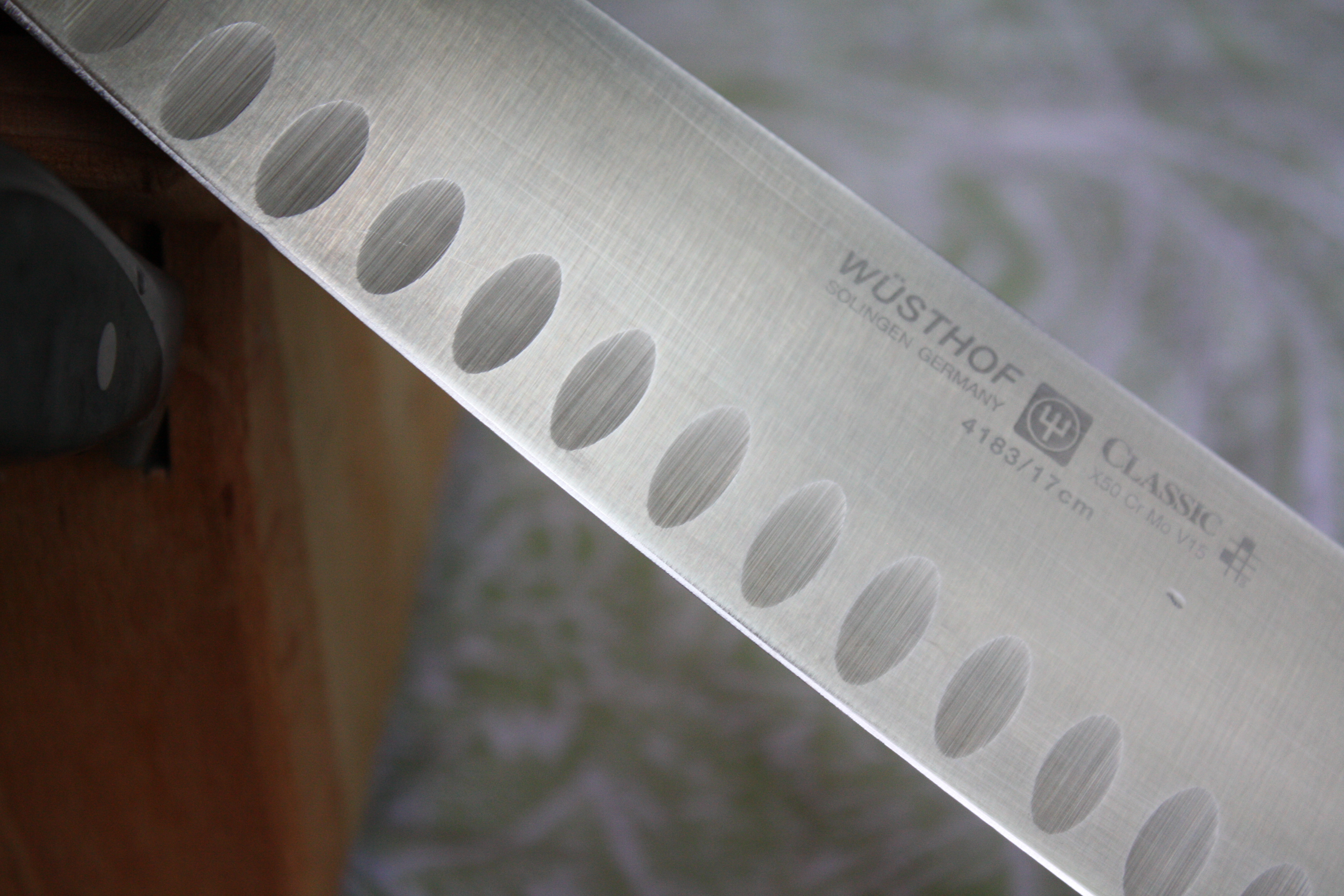
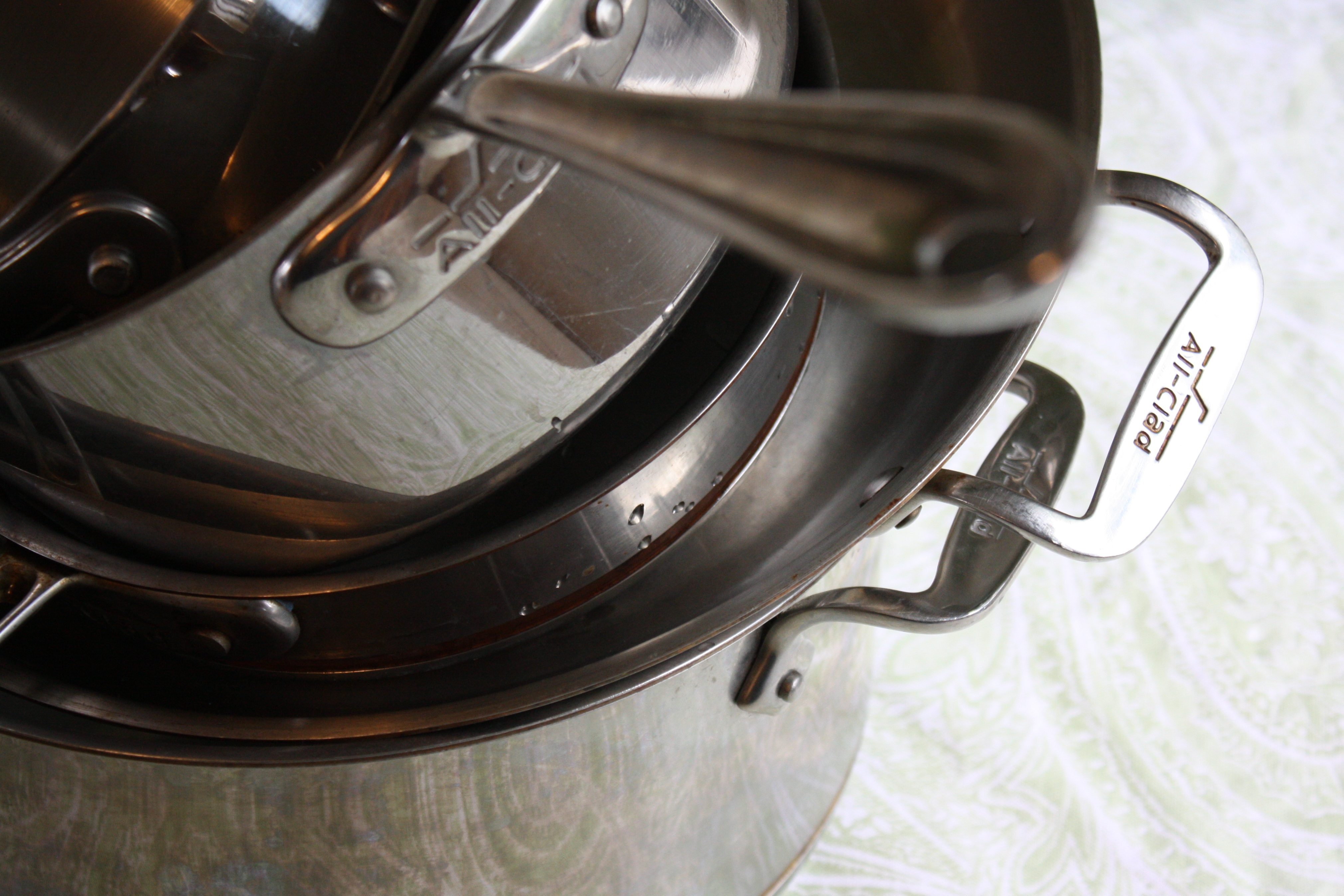
Shiny steel All-Clad pans, sharp Wusthof knives

These are the things which make cooking so nice.

When I’m chopping…

And sauteeing…

And I’m browning meat,

I simply make use of my favorite things…

And then we sit down to eat!

I have been collecting kitchen gear for as long as I can remember. I’d already begun a decent collection before I left for college. For years afterward, my birthday wishlist involved pots and pans. I got a knife one year for Mother’s Day. I asked Santa for a stainless steel colander. My collection has been built slowly over time. I’ve spent months collecting gift certificates at holidays and saving up for a prized item. I love diamonds and pearls as much as the next girl, but as far as shiny things go, I’d rather have a good knife or a pan. There are always more items on my wishlist, but at this point, I’ve got a pretty functional cooking collection. I love it all, but there are certainly some items which get more regular use; the items I couldn’t cook without. If you’re looking to build your cooking equipment collection, perhaps you’ll find some useful tips here.

These are a few of my favorite things…

Knives

A couple good knives will change your culinary world. Sharp, high quality knives are safer to use than any dull knife. Most of my knives are Wusthof or Henkels, because I like the way they feel, but Shun and Global make excellent knives too. It’s a personal preference thing. You have to get your hands on the knives and see what feels good to you. Look for forged knives (not stamped) made of high-carbon stainless steel, with a full tang (that piece of metal that runs from the blade all the way through the handle. I like a knife with a good amount of heft. Of all the knives in my knife block, my Santoku knives (Japanese chef’s knives) and my long, serrated bread knife get the most use. If I could only have two knives, those would definitely be my keepers.

Pots and Pans

Oh, my darling pots and pans! Don’t ask me about my pots and pans, unless you have a lot of time on your hands. I could talk for hours about them. All-Clad should pay me for the time I’ve put into raving about their cookware. My pots and pans are the prized gems of my collection. I’m an All-Clad girl through and through; copper-core, given my druthers. I’d rather save my money for one good All-Clad pot than fill up my cupboard with a collection of something else. In my opinion, this cookware is as good as it gets. Truth be told, these pots and pans are not cheap. But, they will last you forever. You’ll pass these pots and pans onto your grandchildren. Seriously. Don’t worry about trying to buy a whole collection at once. You’re better off buying a pot or pan at a time based on your needs. Whatever you choose, look for cookware that’s sturdy with solid construction. Avoid pots and pans with a disk base, which will be more likely to warp if overheated. I’ve had that happen more than once in my pre-All-Clad days. I’d recommend that most of your pots and pans are a high quality stainless steel, which is most durable and won’t interact with foods. Look for cookware that is oven safe, since it’s a really convenient thing to be able to move a pan from stove top to the oven. I’m leery of non-stick surfaces due to health concerns, though I do keep at least one non-stick pan on hand for omelets. My favorite cookware, the All-Clad Copper-Core line, features a five layer construction with the durability of stainless steel on the interior and exterior sandwiching layers of highly conductive, even-heating aluminum and copper. It’s also handy to have a good cast-iron skillet, grill pan, and dutch oven on hand. Le Creuset makes excellent and beautiful enameled cast-iron cookware.

Instant-read Meat Thermometer

This is one of those items that I think belongs in every kitchen. I use mine almost every night. It takes the guesswork out of determining if your meat is cooked, helping to ensure that things are cooked safely, without overcooking. To use an instant-read meat thermometer, first remove the meat from the heat. If you’re measuring something large, like a roast, remove the pan from the oven. If you’re measuring something smaller, like a chicken breast, lift it slightly from the pan with a spatula or tongs, before inserting the thermometer. You want to be sure you’re measuring the temperature of the meat, not the heat in the pan, oven, or grill. Insert the thermometer into the center of the meat. Make sure that it doesn’t poke out the other side or make contact with the hot pan. Read the temperature, then remove the thermometer and continue cooking, if necessary.

Assortment of Bowls

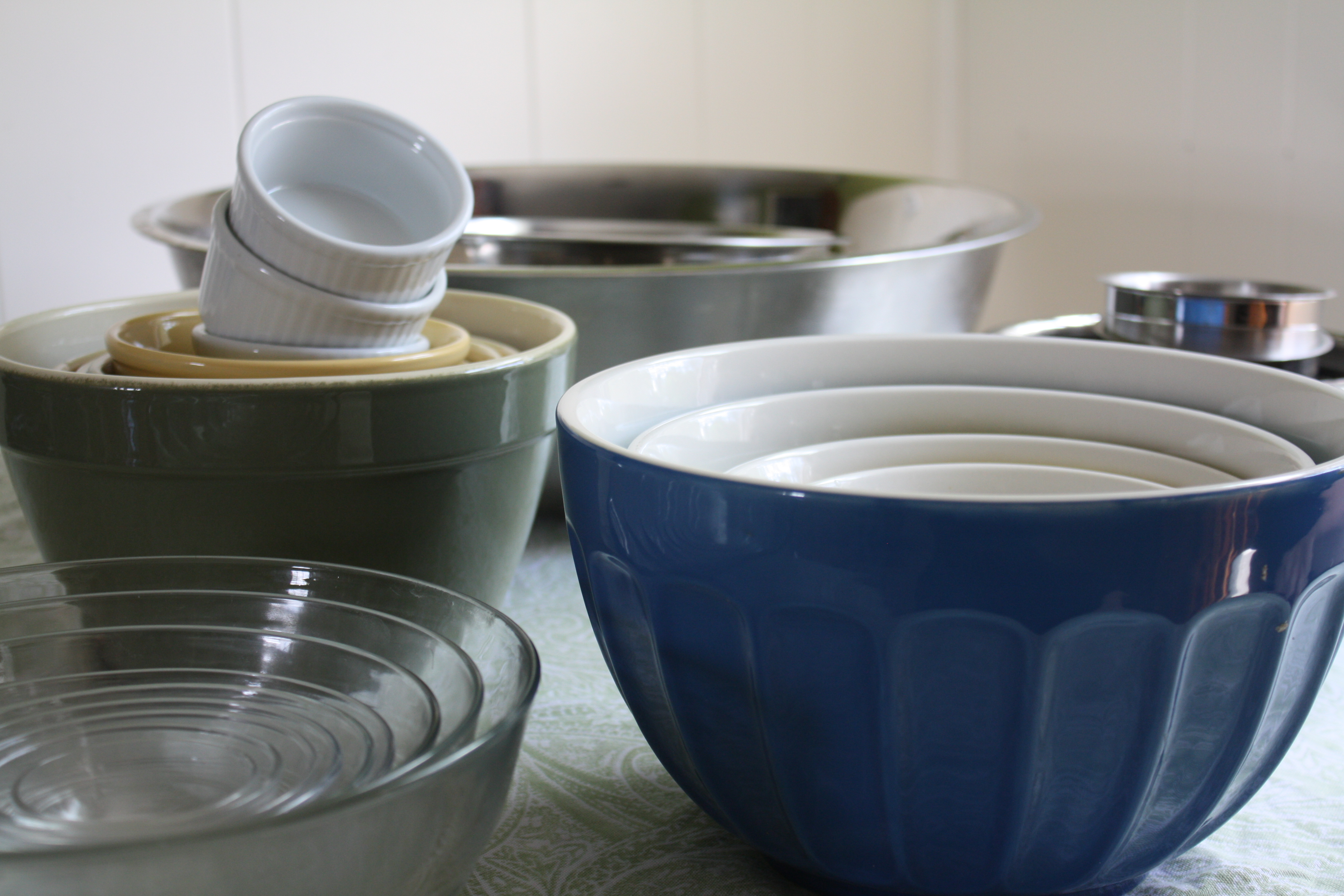
Sort of an obvious one, but I love my bowls! I’m partial to the bright ceramic ones, but the stainless steel bowls are definitely most versatile. I especially LOVE my huge stainless bowl, which is invaluable when I’m making big batches of salads for parties or mixing up cookie dough.

Colanders and Strainers

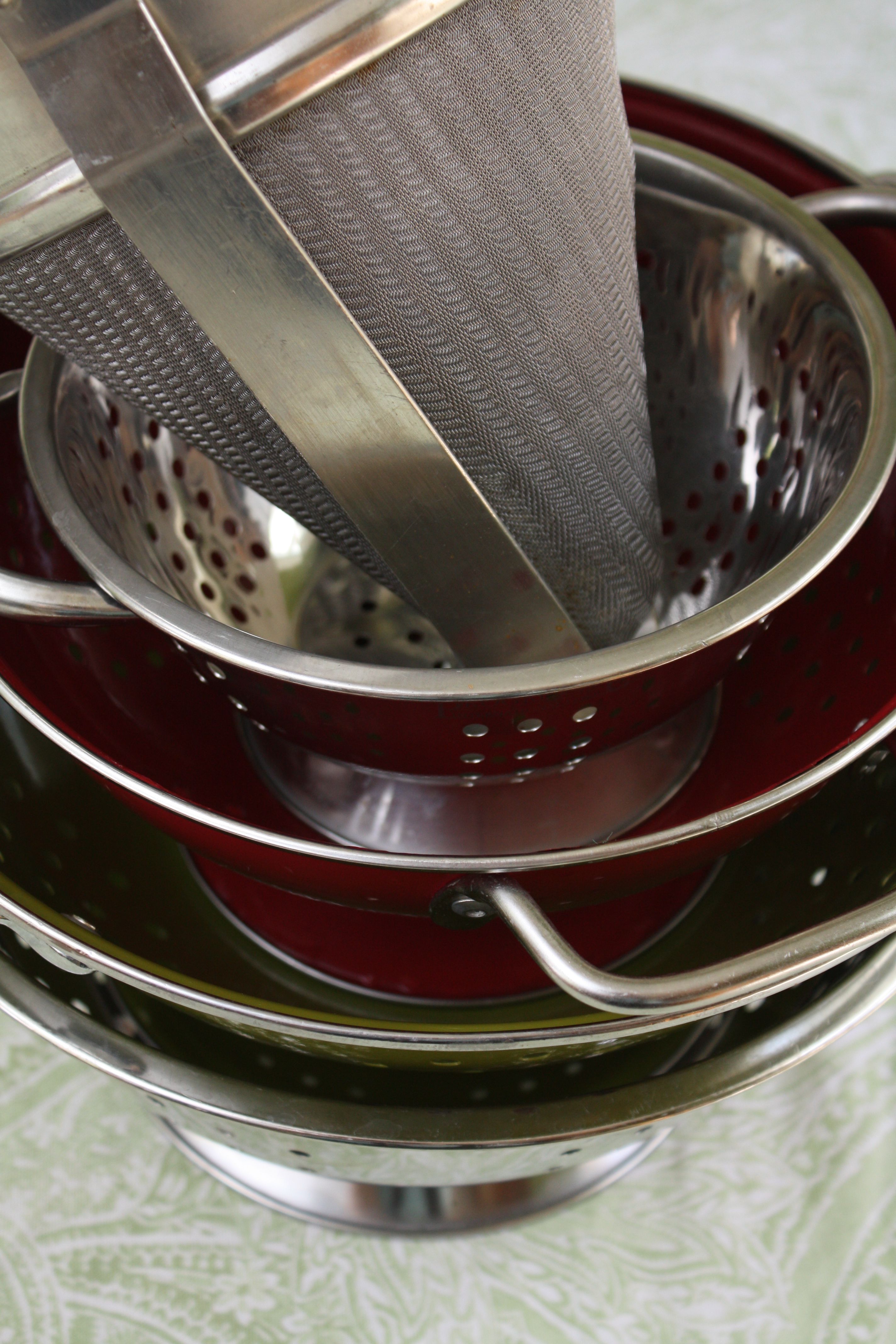
I love pretty enameled colanders, though admittedly the stainless steel ones are more durable. There’s really no reason for anyone to have as many colanders as I do, but I love them. The conical shaped strainer is called a chinois (pronounced shin-WAH). It’s a very fine mesh strainer, great for straining sauces or stocks.

Baking Sheets

Nothing too exciting about these. Just a couple of sturdy aluminum baking sheets, which get a tremendous amount of use.

Salt and Pepper

So, maybe salt and pepper doesn’t seem to go along with the other items on this list, but somehow they belong here. I keep my little canister of kosher salt sitting next to the stove. It gets used in almost every single thing I cook or bake. Salt is a flavor magnifier. A touch of salt can make a dramatic difference in the flavor of a dish; turning something bland into something spectacular. Don’t neglect your salt. Keep it handy and use it often.

Immersion Blender

I hardly use my small kitchen appliances; partly because they’re out of the way and I don’t have a more convenient place to store them and partly because I like be hands-on when I cook. I honestly love chopping, slicing, kneading and whisking until my arms are sore. I have just about every small kitchen appliance in the book; large and small food processors, hand-mixers, stand mixers, ice cream makers, coffee grinders, espresso machines, and blenders. But they are all lonely and neglected. Out of all of the small appliances I own, the one that gets the most use is my immersion blender. It’s a relatively inexpensive addition to any cooking collection. It doesn’t take up a lot of space and it’s easy to clean. I use mine for smoothies, blended soups, pureeing vegetables and fruits, making sauces, and lots of other things.

Good cookware doesn’t make the cook, but it sure helps!

I love talking about cooking equipment, so if you ever have a question, just ask!

How to Caramelize Onions

Posted on

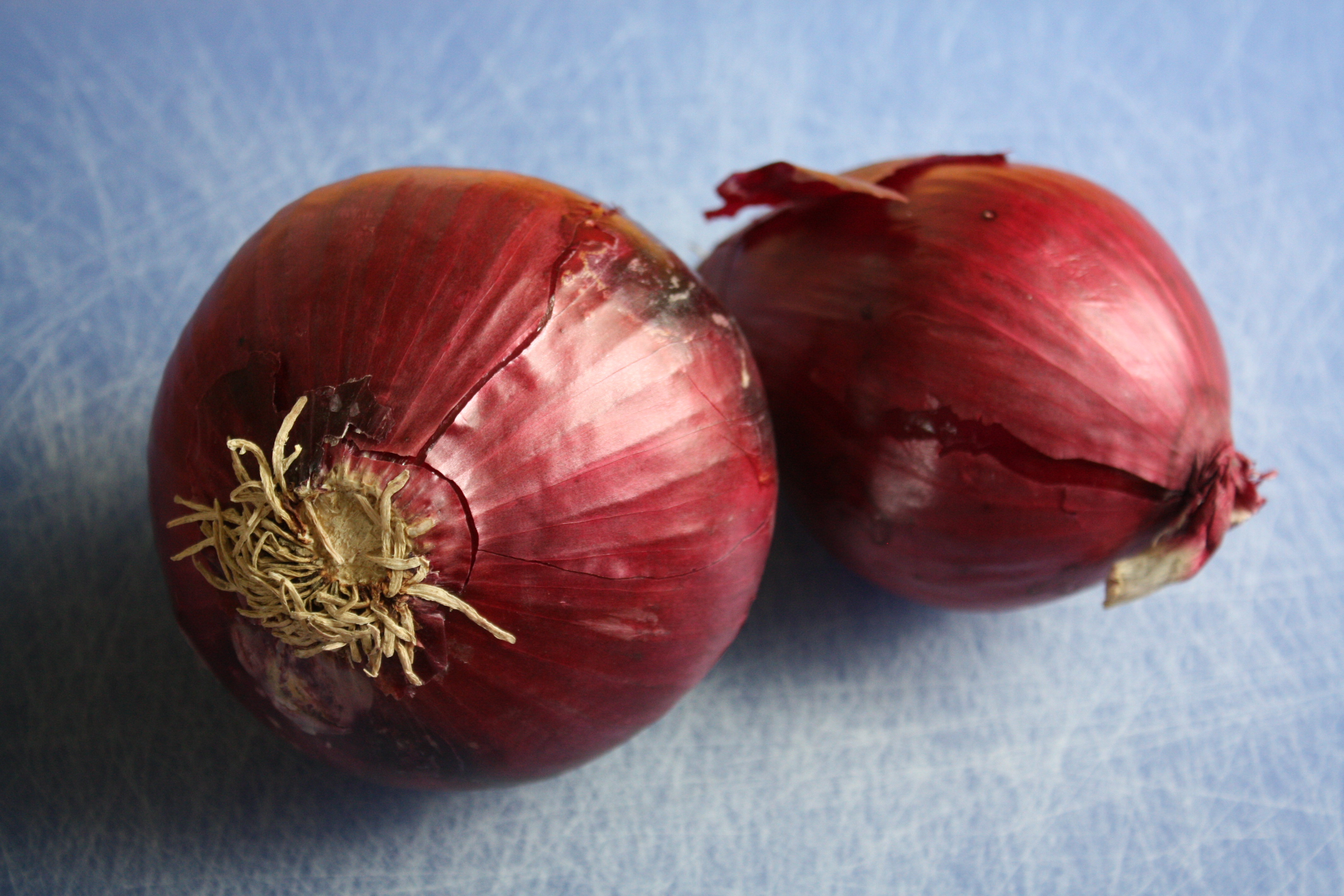
Caramelized onions are onions which have been cooked slowly to develop and caramelize the onion’s sugars. They have a very sweet, mild onion flavor, which tastes delicious on burgers, tarts, sandwiches, pizzas, salads, and steak, amongst other things. They make the best base for French Onion Soup. Heck, I’d even put them on ice cream! You can caramelize any type of onion or even shallots. Here’s a step by step guide for making caramelized onions.

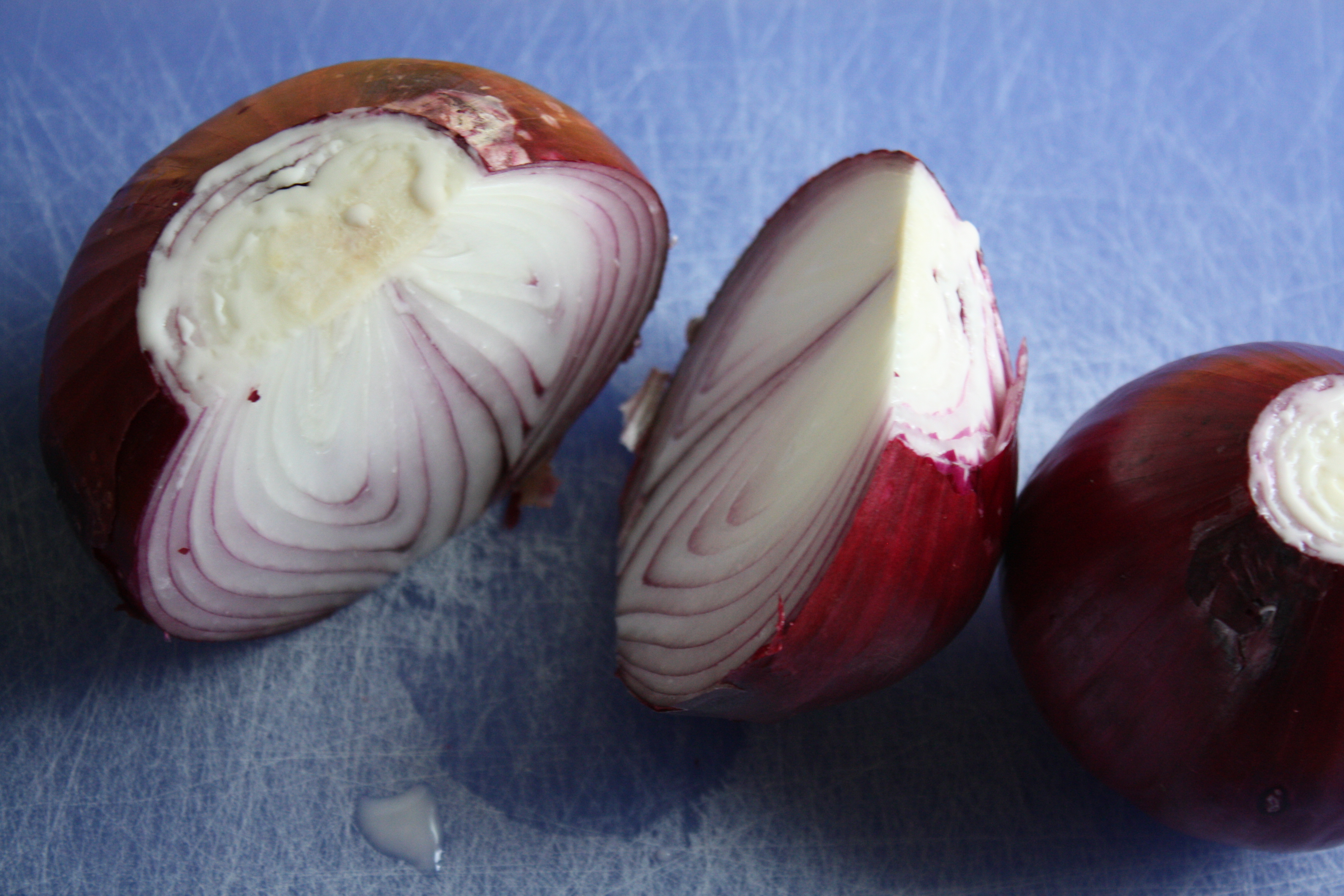
Start with a couple onions.

Cut off both ends of the onion.

Stand the onion on one of the cut sides and cut it in half.

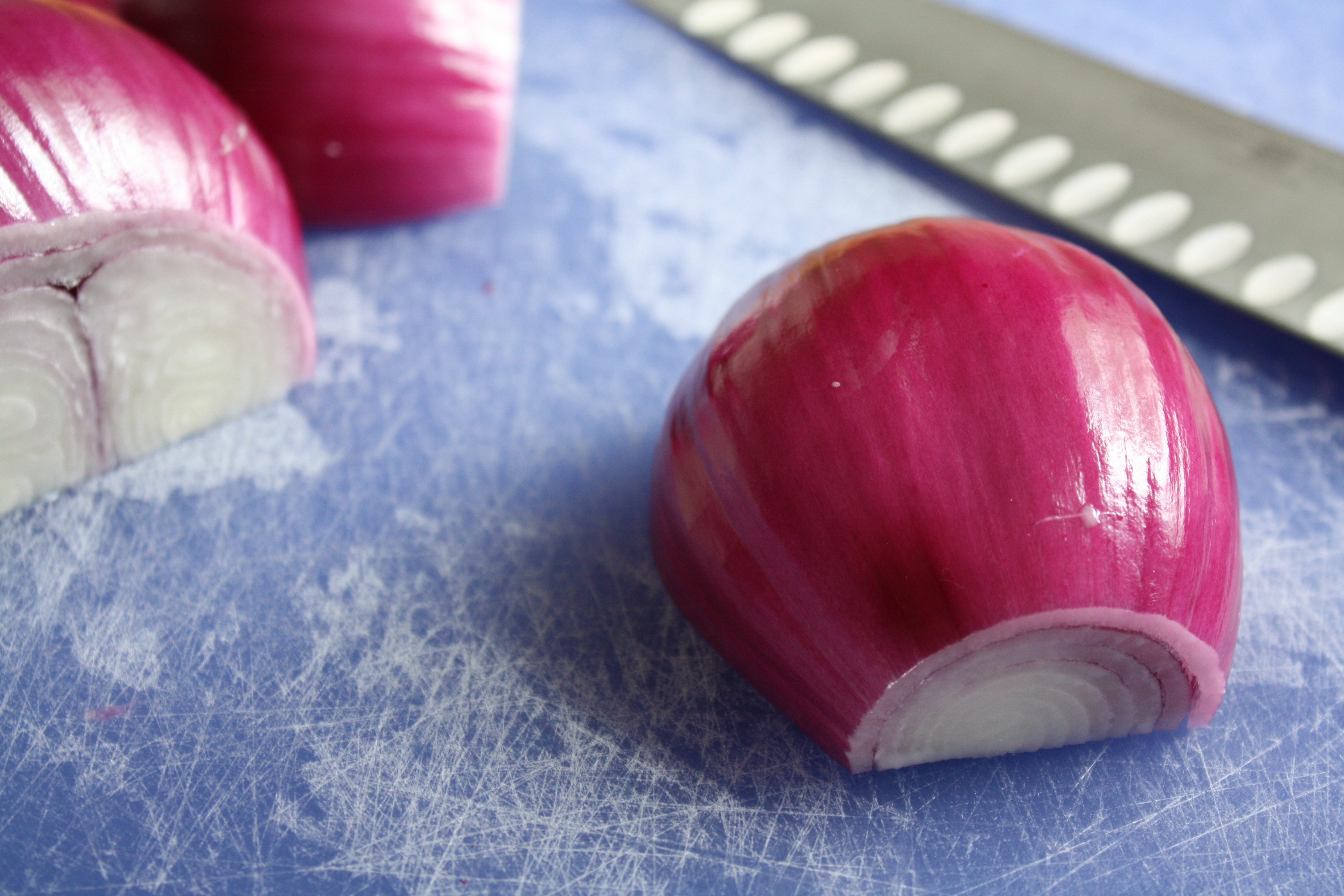
Lay the onion cut side down.

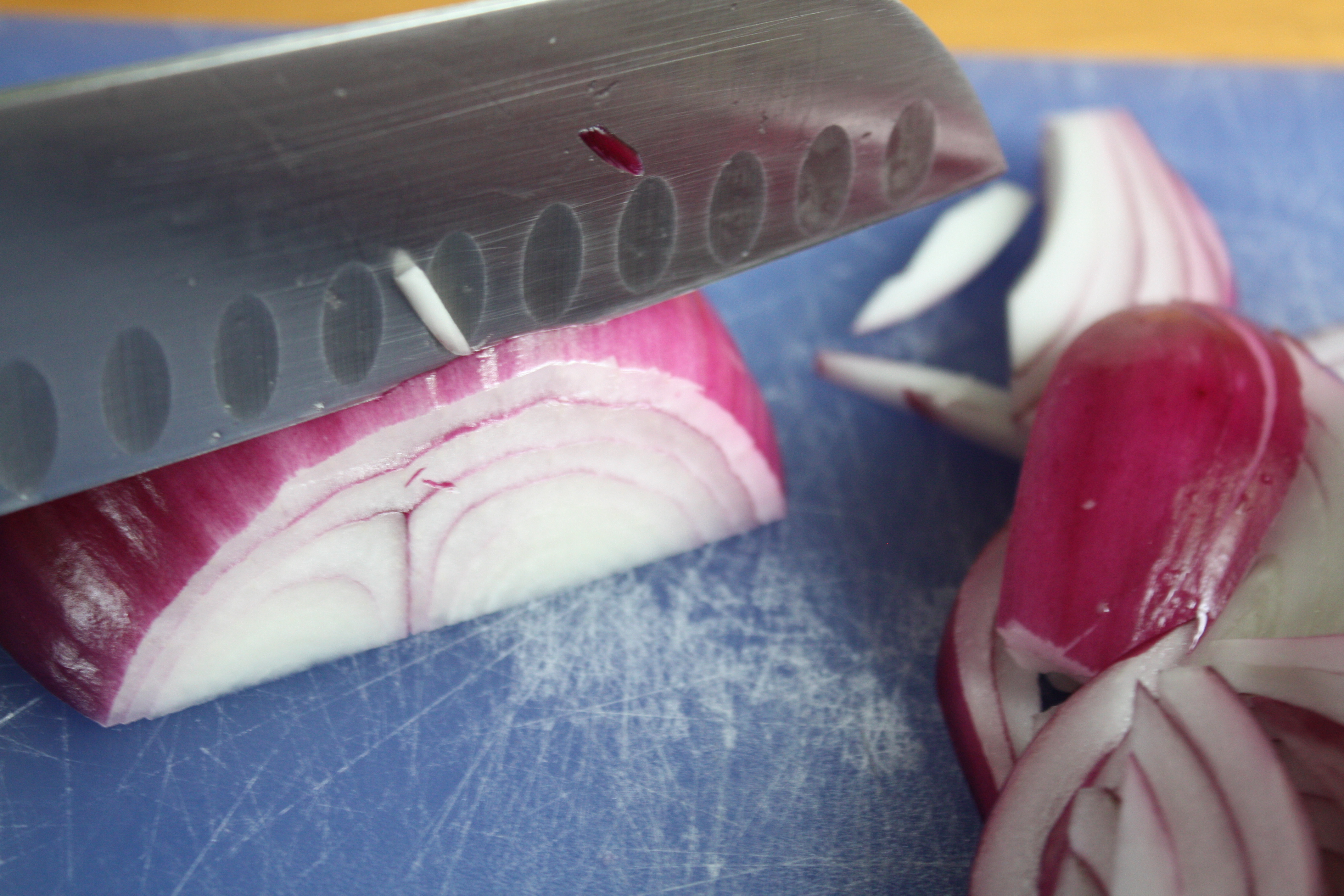
Cut the onion into slices from root to the opposite end.

Do NOT cut the onion into half-rings. Onion cut in this manner will fall apart during cooking.

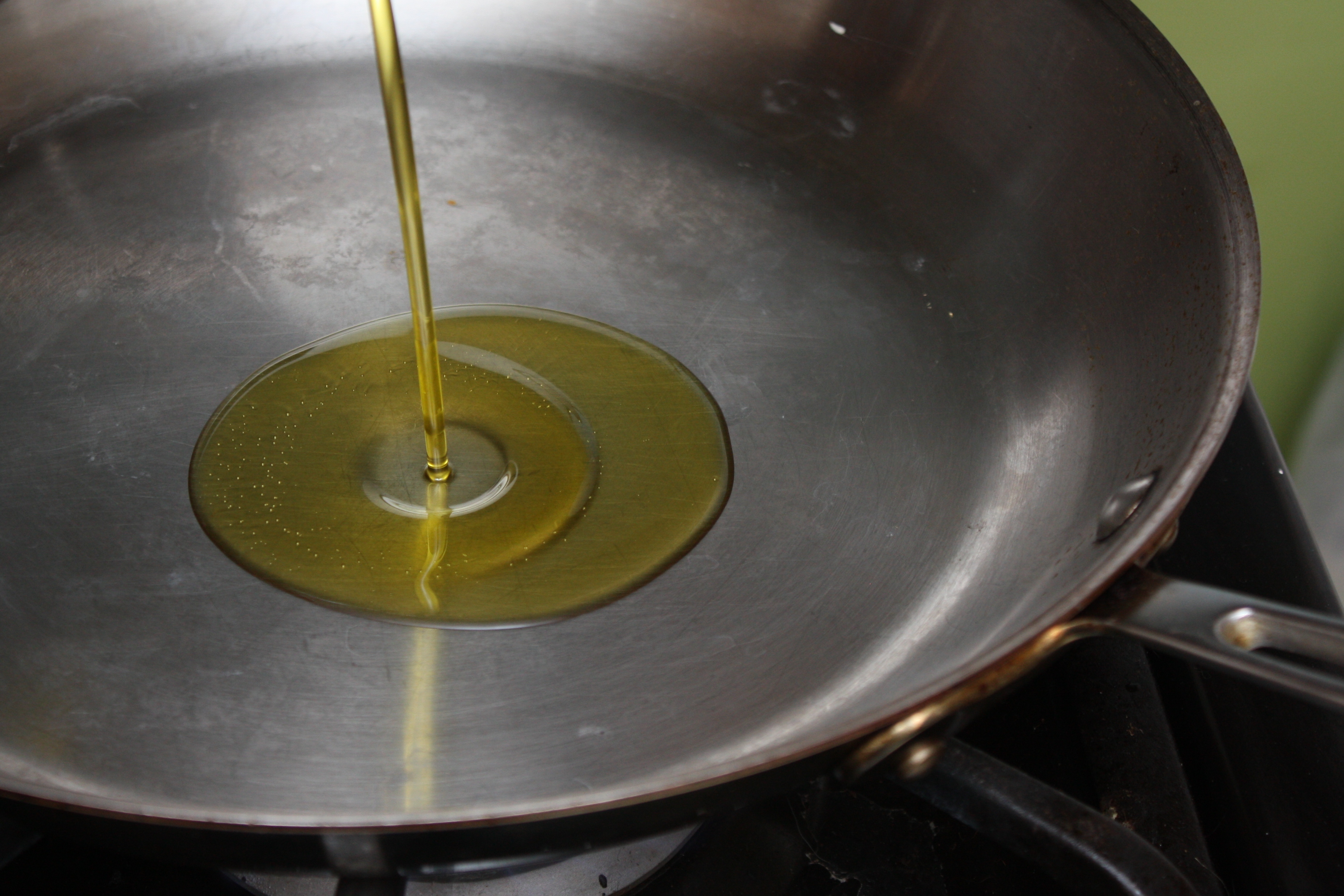
Put a couple tablespoons of oil or butter into a pan. Heat over medium heat.

Add the onions to the pan.

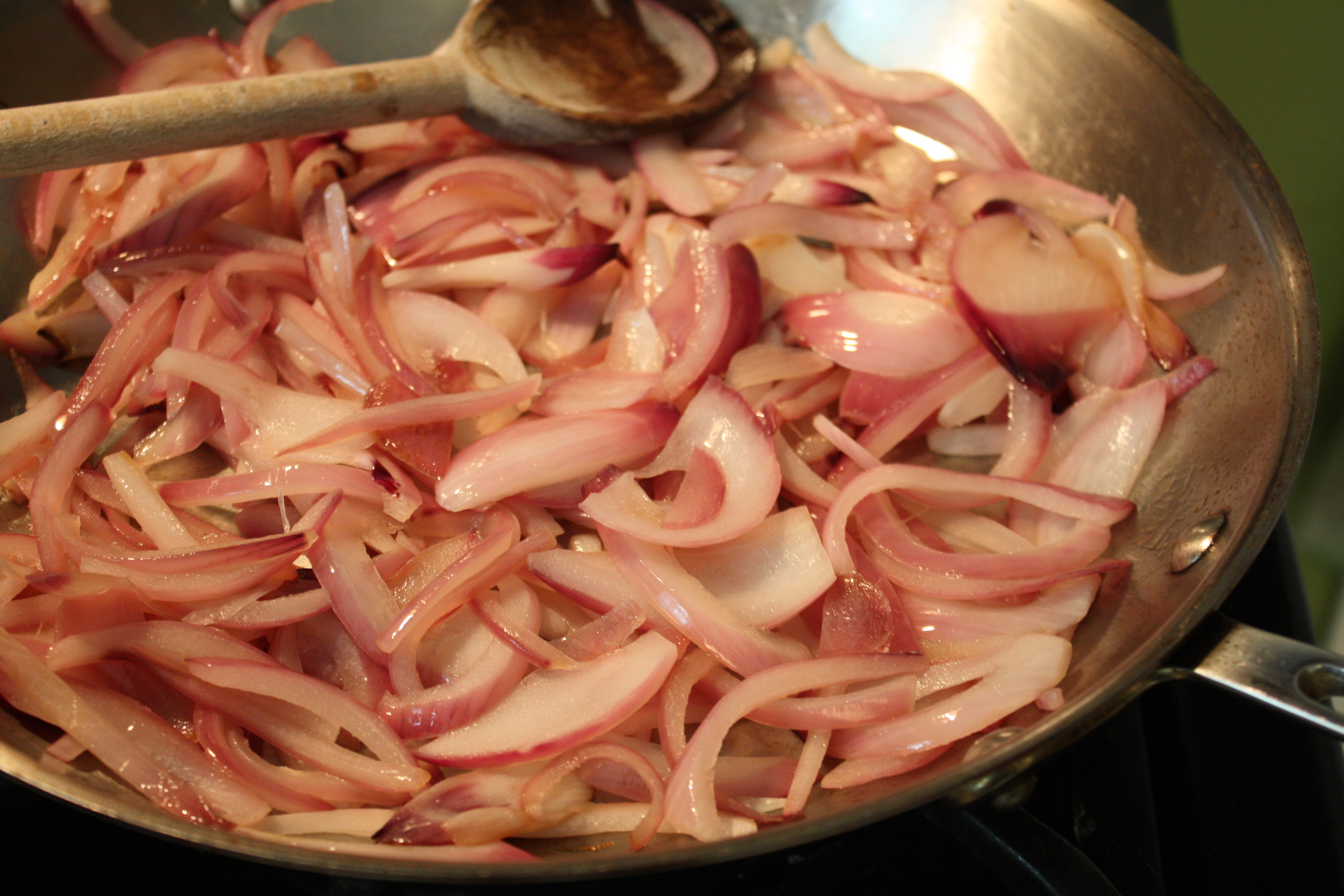
Cook for a few minutes over medium heat, stirring frequently to prevent burning.

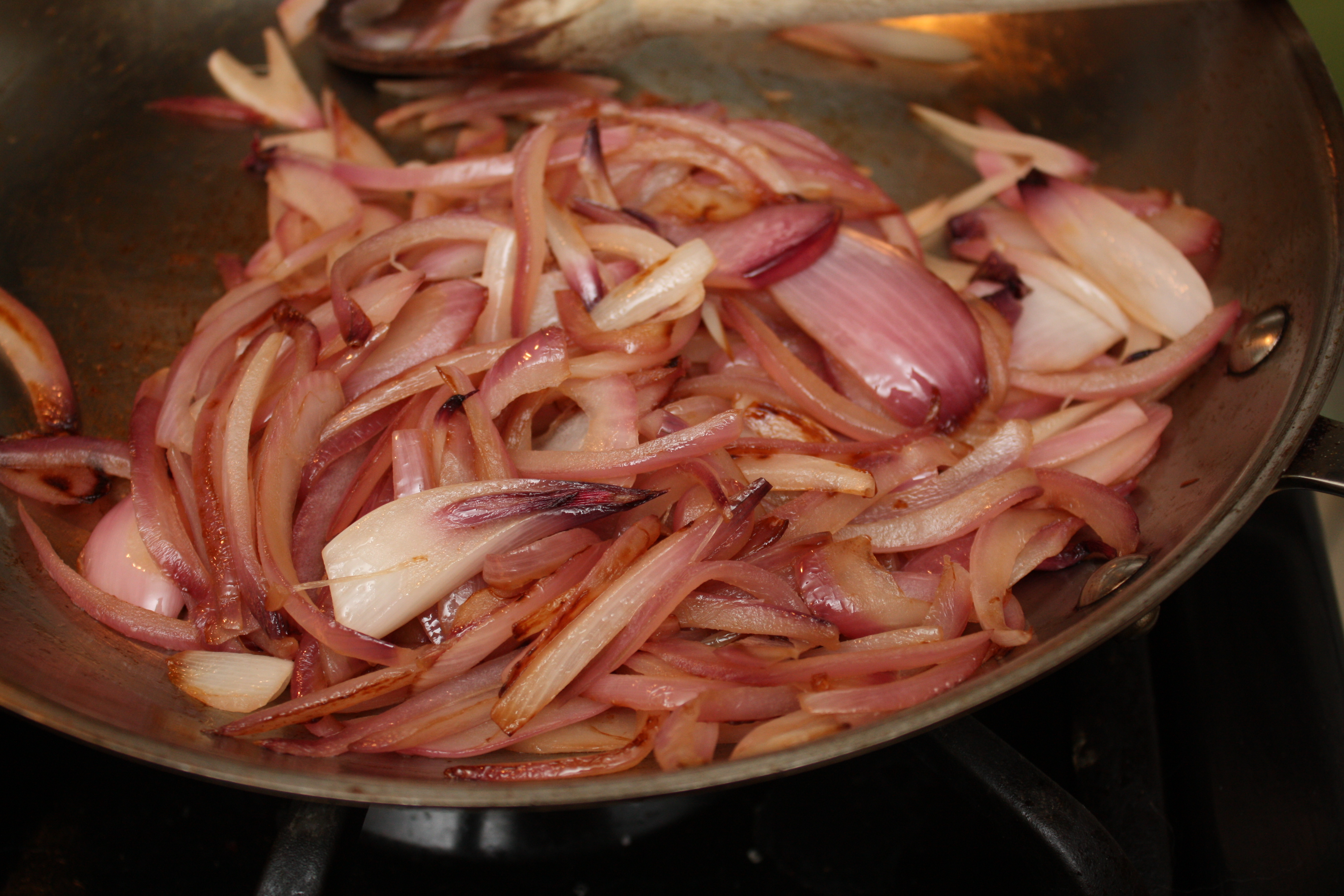
Turn the heat down to medium-low and continue cooking for another 15-20 minutes until the onions reduce in size and take on a caramel-brown color. Stir often and adjust the heat, as necessary, to prevent burning.

Enjoy your sweet, delicious caramelized onions!

Feta Cheese Mousse and Summer Fruits

Posted on

I shrieked at the grocery store. People were staring, a look of pity on their faces for the poor, crazy girl shrieking over produce. Or maybe their look was of concern for the two children in the crazy girl’s care. But I promise there was good cause for shrieking. Honest, there was.

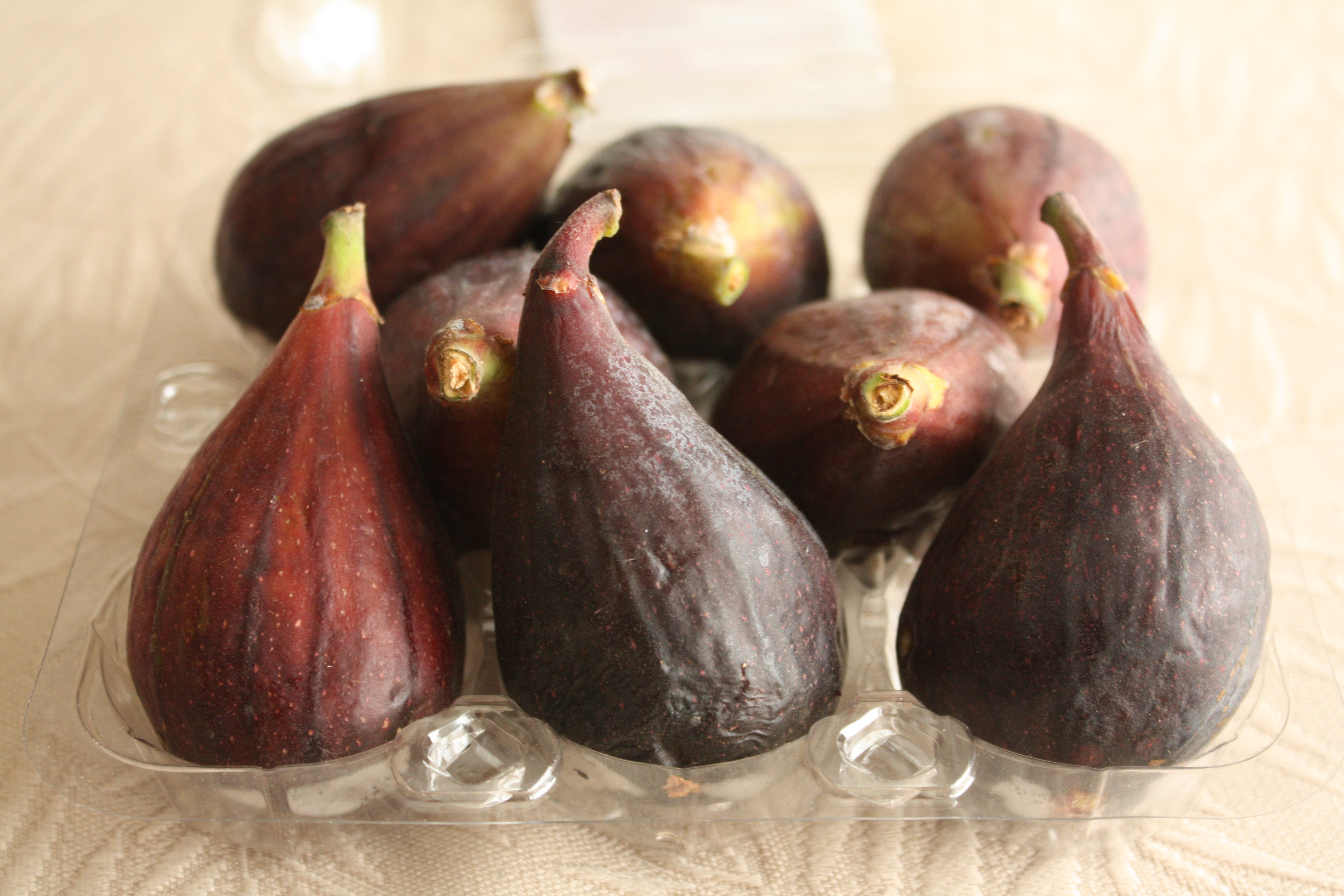
You see, I had gone to the store to buy watermelon for today’s recipe. My grocery store likes to play a game with its customers by constantly rearranging the items in the produce section. I swear that if I walked from the produce section to frozen foods and back again, the apples would be someplace different. Anyway, I found the watermelon. Score one for me! And then I spotted the sign; the sign which read Fresh Figs. Fresh Figs!!!  My heart skipped a beat. My eyes went into overdrive scanning for the aforementioned fresh figs! They landed on their target and that’s when the shriek escaped from my mouth. First fresh figs of the season!

I told you there was a perfectly reasonable explanation for my reaction!

Figs make me think about Greece and a lovely dinner my husband and I enjoyed on the patio of a restaurant that sat on one edge of a huge town square. As we were preparing to pay the bill, the waiter brought over two glasses of ouzo, on the house. We were delighted. Moments later, the owner of the restaurant appeared, carrying a plate full of fresh figs and other fruits. It was the first time I’d ever tasted a fresh fig. The owner, whose English was excellent, chatted with us for a while. He then proceeded to plan our wedding, which was to take place the next morning at the church across the square, excitedly claiming that he knew the priest and could arrange everything for us. Just come back tomorrow morning and you get married, he instructed. We did not take him up on his offer to marry that next morning, though part of me wishes we did. But that was well before our marrying days. Good memories though, which make figs taste extra sweet to me.

Thankfully, fresh figs fit beautifully into my existing plan for today. I’ve been thinking a lot about cheese mousse since making the mixed berry mousse last week. I’d tentatively decided that I would make a goat cheese mousse this week. Well, after yesterday’s Farfalle with Spinach, Feta, and Pine Nuts, I’ve got a tub of leftover feta cheese in my fridge. So, Feta Cheese Mousse it is! My plan was to pipe the goat cheese mousse into cubes of fresh watermelon. We’ll still be doing that. But now we’ll also be piping the mousse onto fresh figs! Oh, glorious summer treat!

Serve these little snacks as a first course appetizer, an hors d’ oeuvres, or even as a lunch over some mixed greens!

Feta Cheese Mousse

Ingredients

  • 1 cup Feta Cheese, softened
  • 1/2 cup Cream Cheese, softened
  • 3/4 cup Heavy Cream, divided

Directions

Whip 1/2 cup of the heavy cream until it begins to form firm peaks.* Set the whipped cream aside. Use a food processor, blender, or immersion blender to combine the feta, cream cheese, and 1/4 cup heavy cream until smooth.  Blend a bit of the whipped cream into the cheese mixture. This will lighten the mixture. Then, gently fold in the remaining cream. Do not over-mix or you will lose the fluffiness of whipped cream.

Refrigerate while you prepare the fruits.

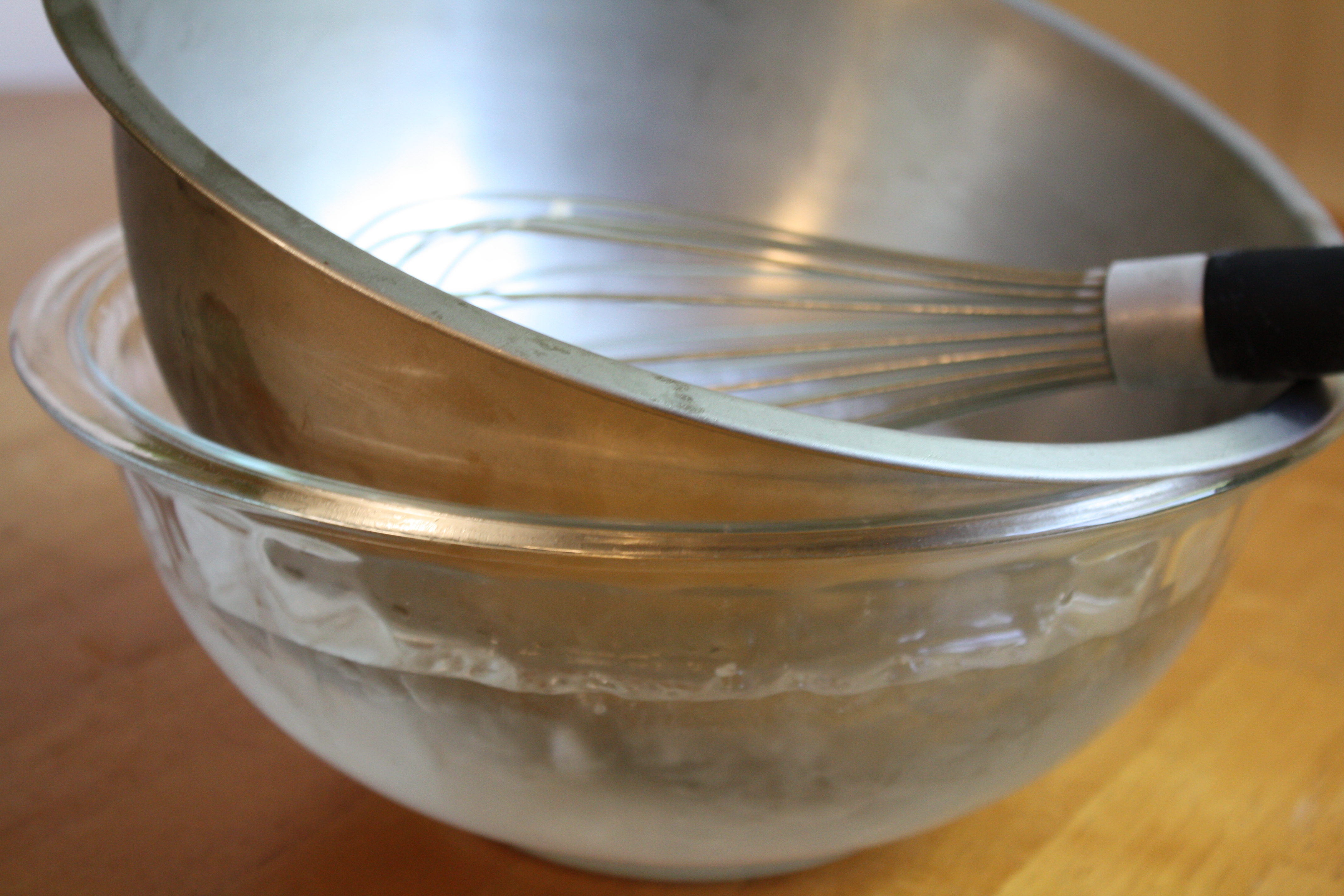
*When whipping cream, it’s important to keep the cream and equipment cool. Place your whipping bowl and whisk in the freezer for a few minutes before beating the cream. Then, set the bowl in an ice bath as you beat the cream. The bowl with the whipped cream can stay in the ice bath while you blend the cheese.

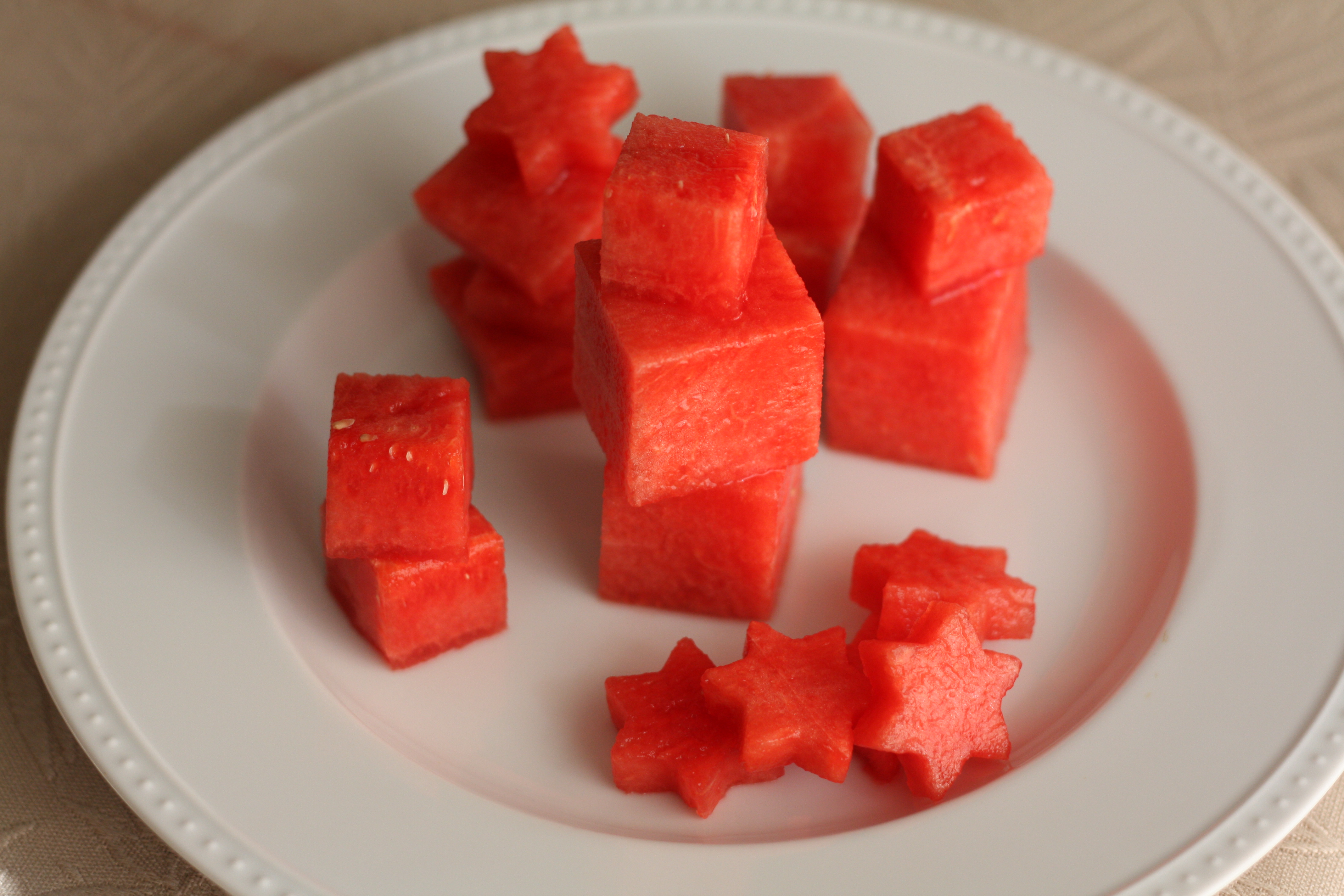
To prepare the watermelon, cut the heart from the rind. Then, cut the watermelon into your desired shapes. Small cubes or tiles work well. You can also use a cookie cutter to create circle or star shaped tiles.

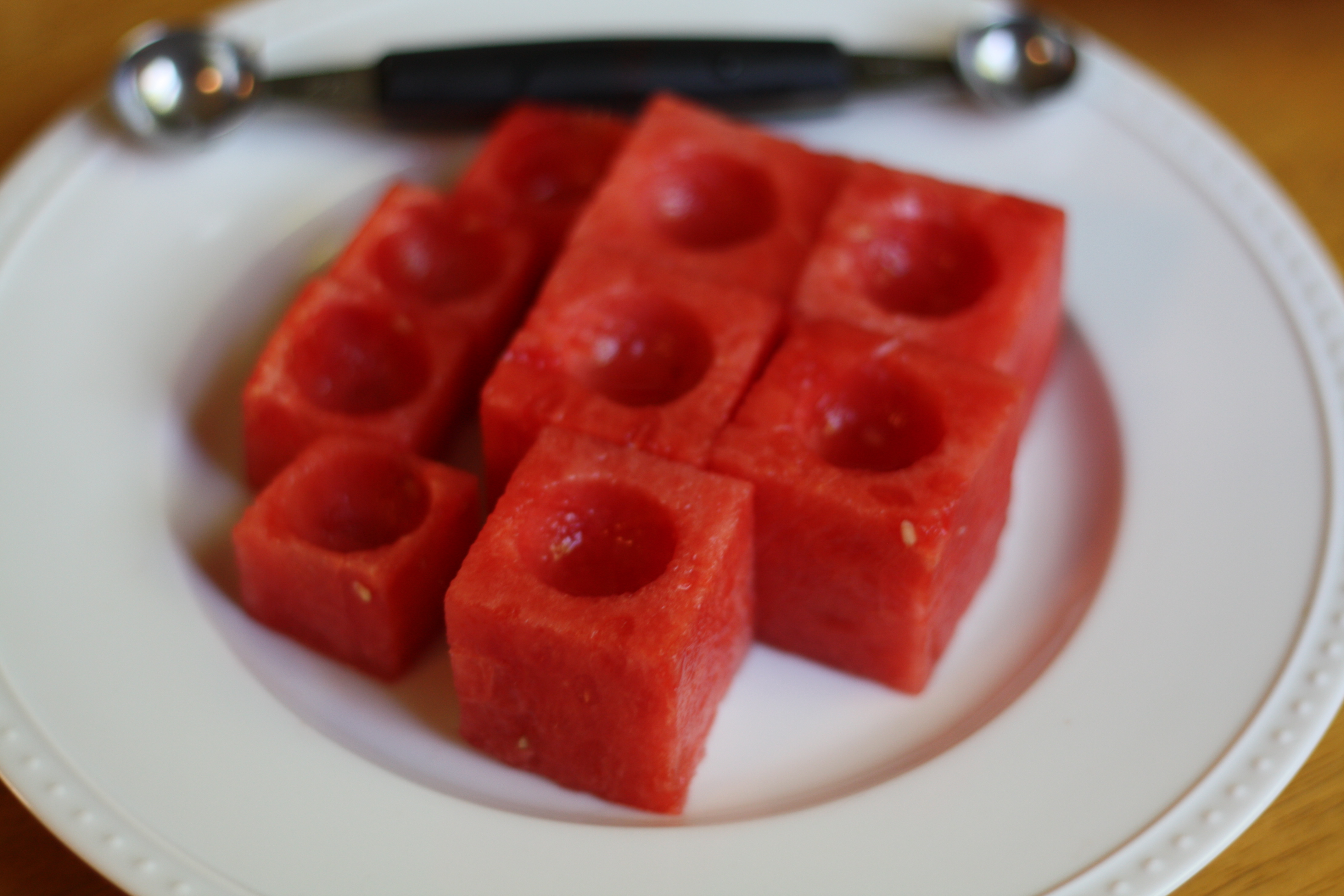
Use a melon baller to remove a portion of the cubes.

I’m sure you can find a use for the leftover watermelon scraps.

This is curious...

Satisfied Watermelon Face

Spoon the mousse into a pastry bag and pipe it onto your watermelon and figs. To create a makeshift pastry bag, cut off the corner of a ziploc bag. Insert your pastry tip. Fill the bag with the mousse and pipe it into your fruit. The mousse would also be delicious on vegetables, crackers, bread.

Ziploc Pastry Bag

Watermelon with Feta Cheese Mousse and Mint

Sweet Summer Treat

The Gourmand Mom

Good food, seasoned with a dash of life