RSS Feed

Author Archives: amydeline

Rice Krispie Treat ‘Sushi’

Posted on

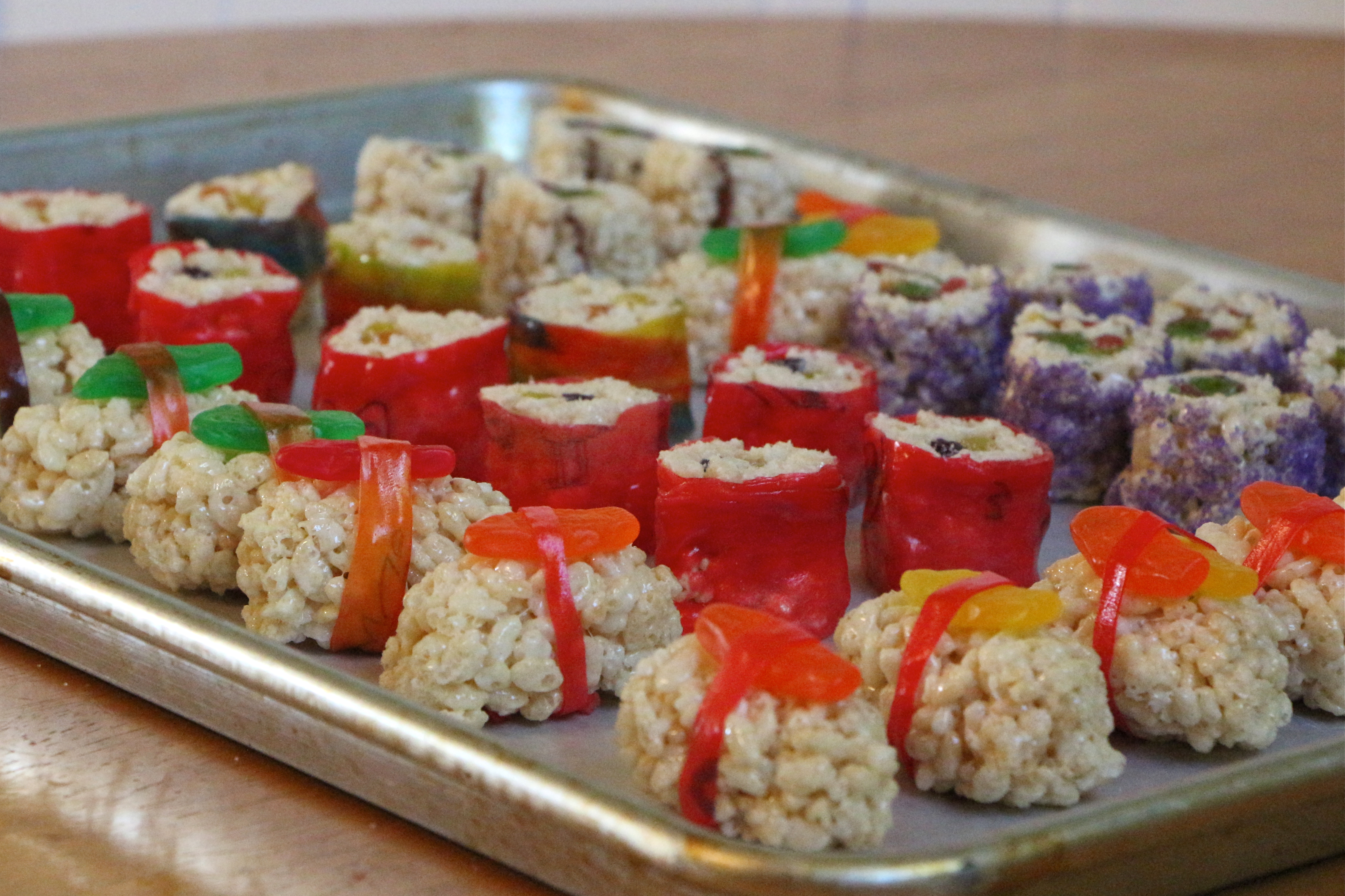
I’m just about ready to put this chat about ninja parties to bed. (I’ve got a recipe for some really delicious and very un-ninjalike Moroccan lamb meatballs in a minted apricot glaze coming up soon.) But before we bid farewell to ninjas, I wanted to share a quick photo guide for making the rice krispie treat ‘sushi’ which we served as part of our dessert spread. It’s super easy and insanely cute. The hardest part was peeling those darn fruit roll-ups off the wrapper.

You can find lots of variations of this sort of thing all over the web. Here’s how I did it…

You’ll need:

  • 3 tablespoons butter
  • 4 cups mini marshmallows
  • 6 cups rice krispies cereal
  • A baking sheet
  • Wax paper
  • Non-stick cooking spray
  • A few long, soft candies (like twizzlers, gummi worms, or sour straws)
  • Fruit roll-ups (green would be most realistic looking, but might be difficult to find)
  • Swedish fish candies

Step 1: Melt the butter in a large pan over low heat. Add the marshmallows. Stir until melted. Remove from heat, then stir in the rice krispies.

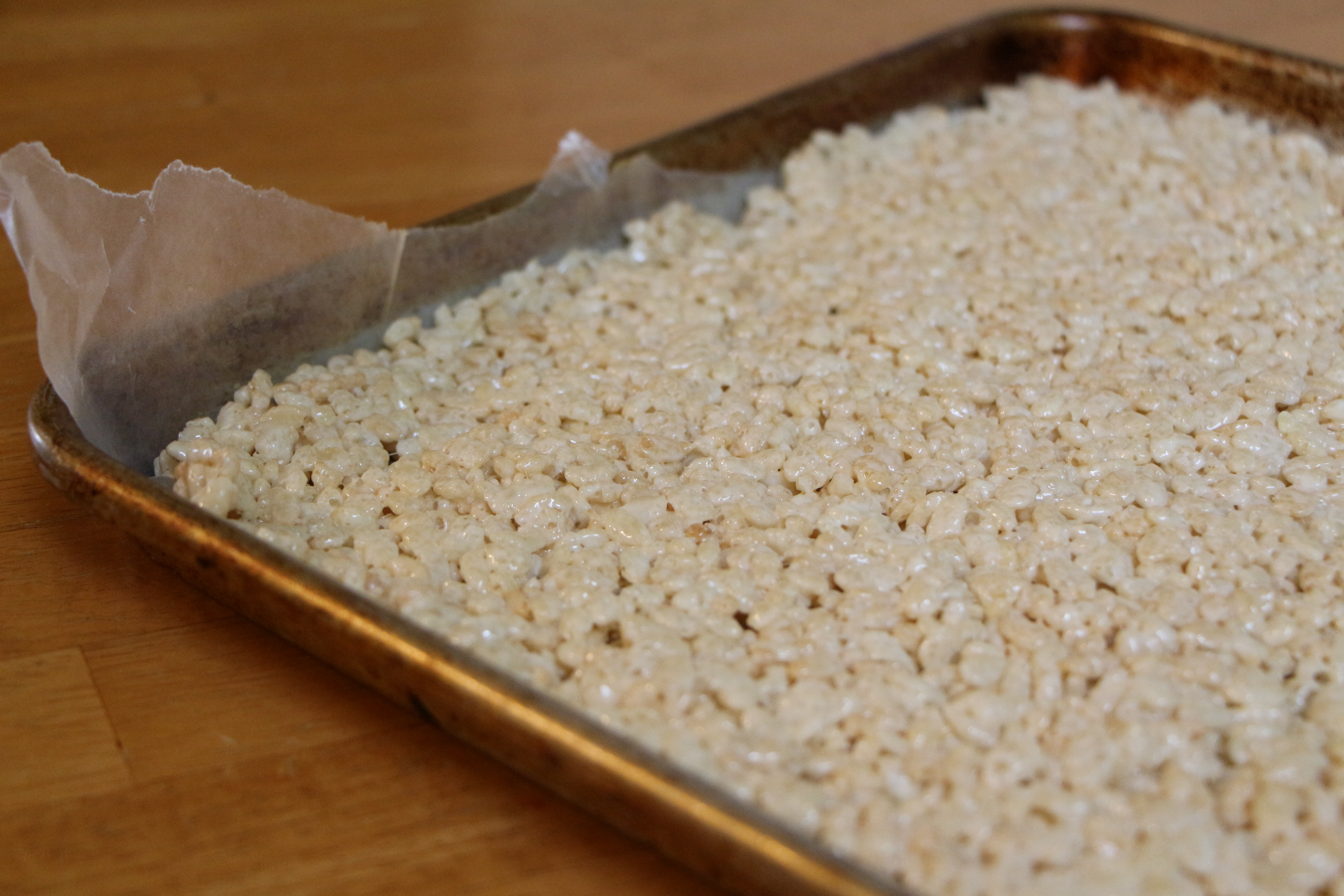
Step 2: Arrange a piece of wax paper on a baking sheet. Spray the wax paper with non-stick cooking spray. Transfer the rice krispie treat mixture to the baking sheet. Spray your hands with the cooking spray, then press the rice krispies into a thin (less than 1/2″) even layer.

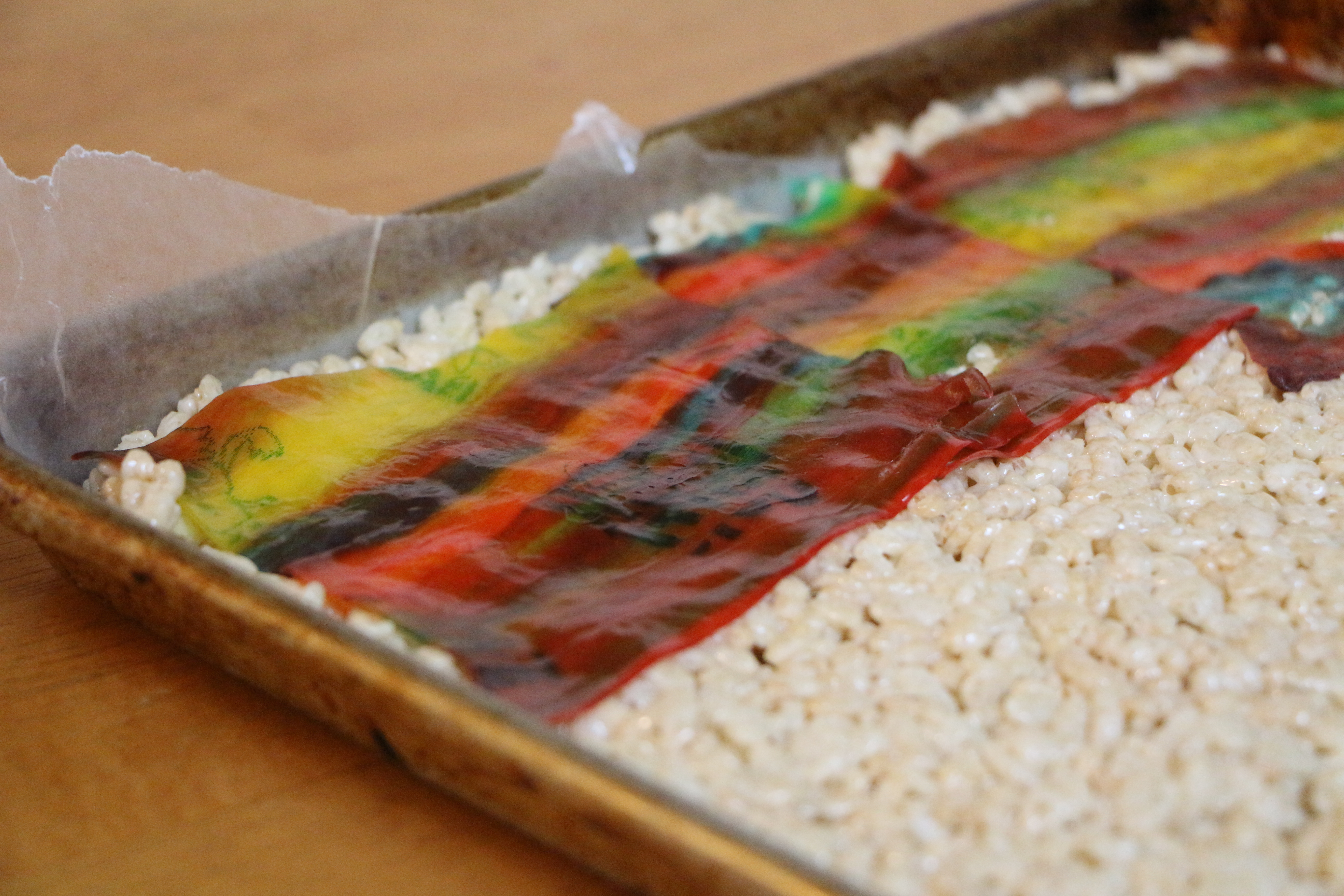
Step 3: Arrange a few fruit roll-ups (the ‘nori’) on top of the rice krispie treats.

Step 4: Place a couple of the long candies on top of the fruit roll-ups. I used sour straws. Multi-colored Twizzlers or gummi worms would also work well.

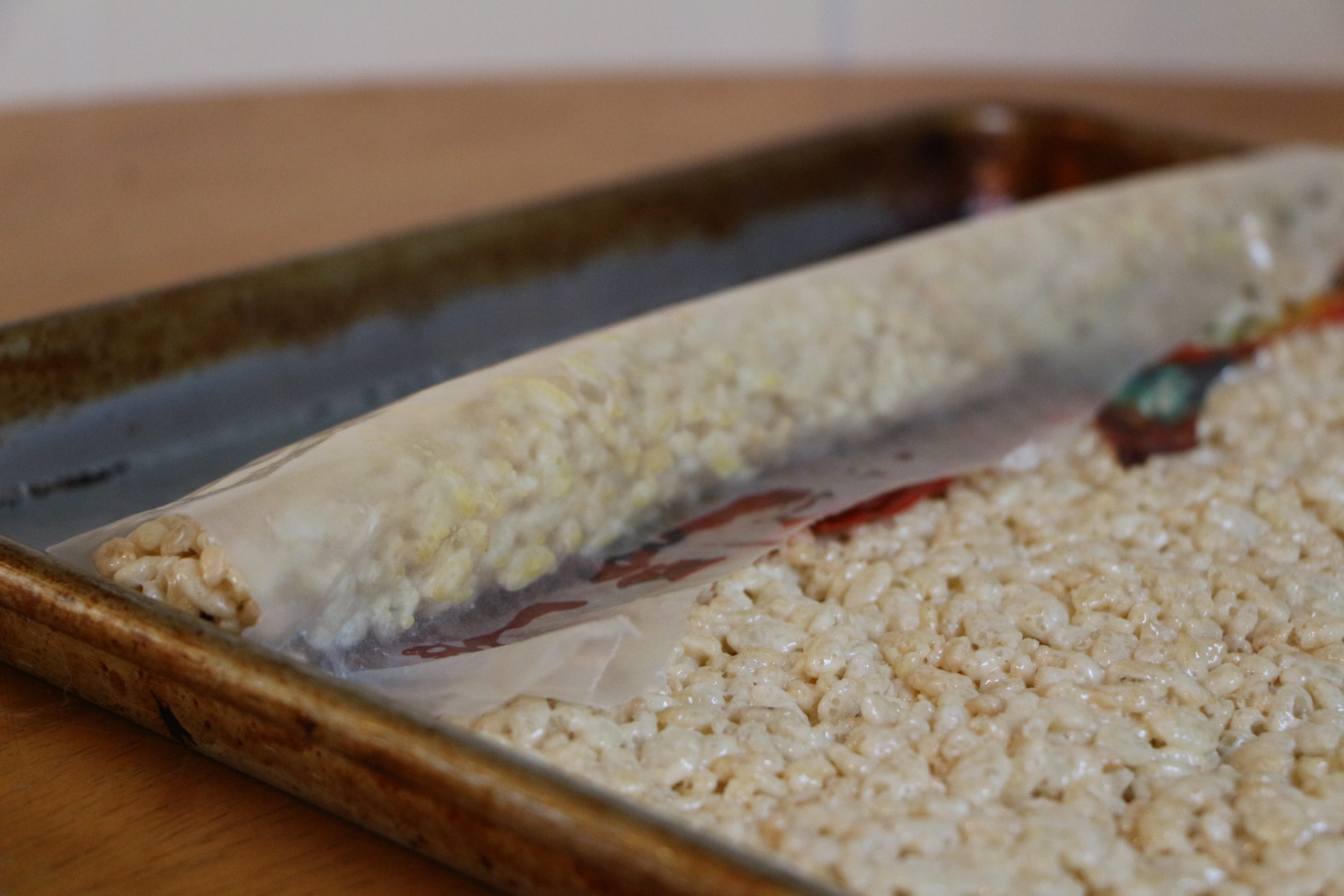
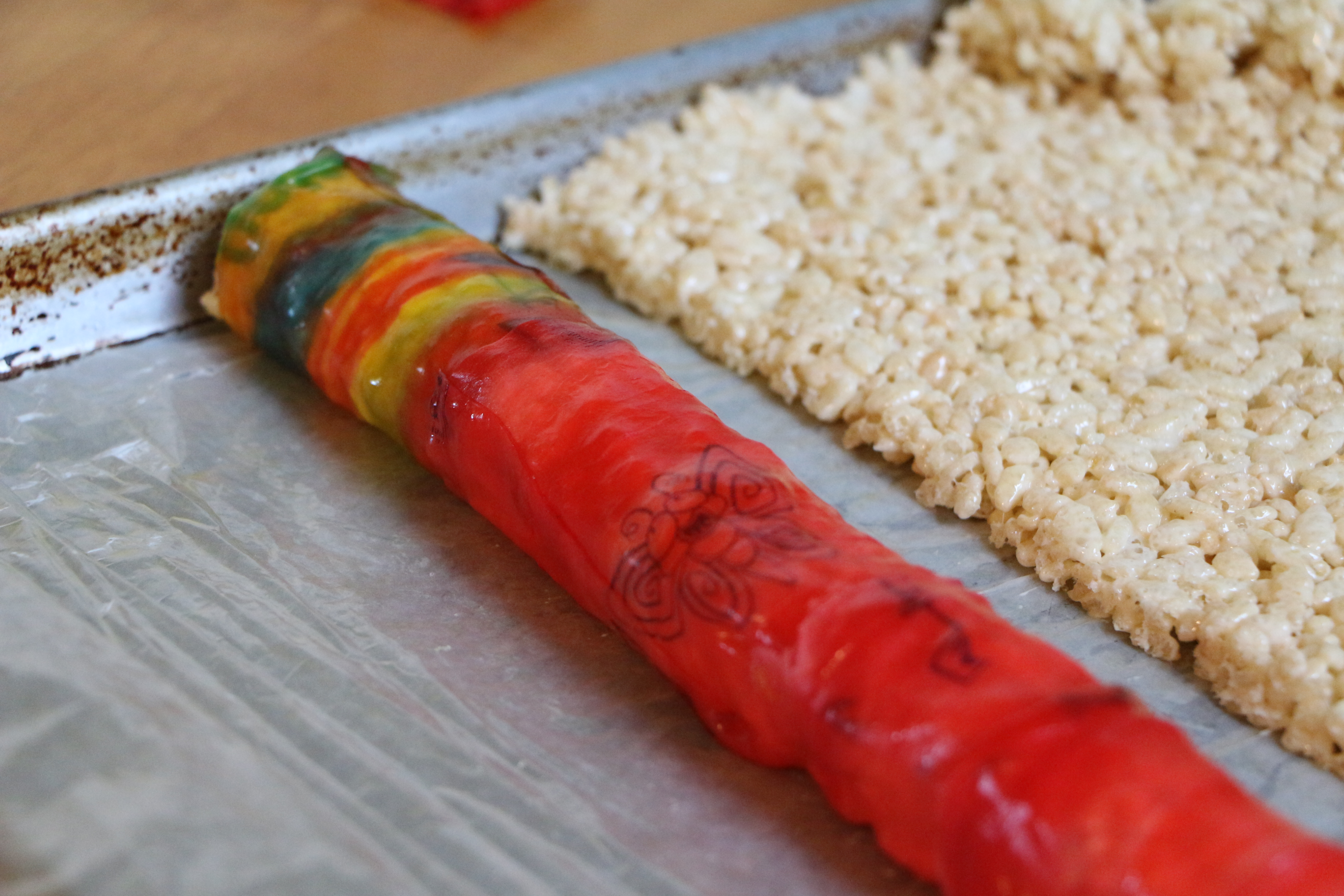
Step 5: Lift up the edge of the wax paper and begin to roll the rice krispie treats around the fruit roll-ups and candy. Use the wax paper to help squeeze and tighten the roll.

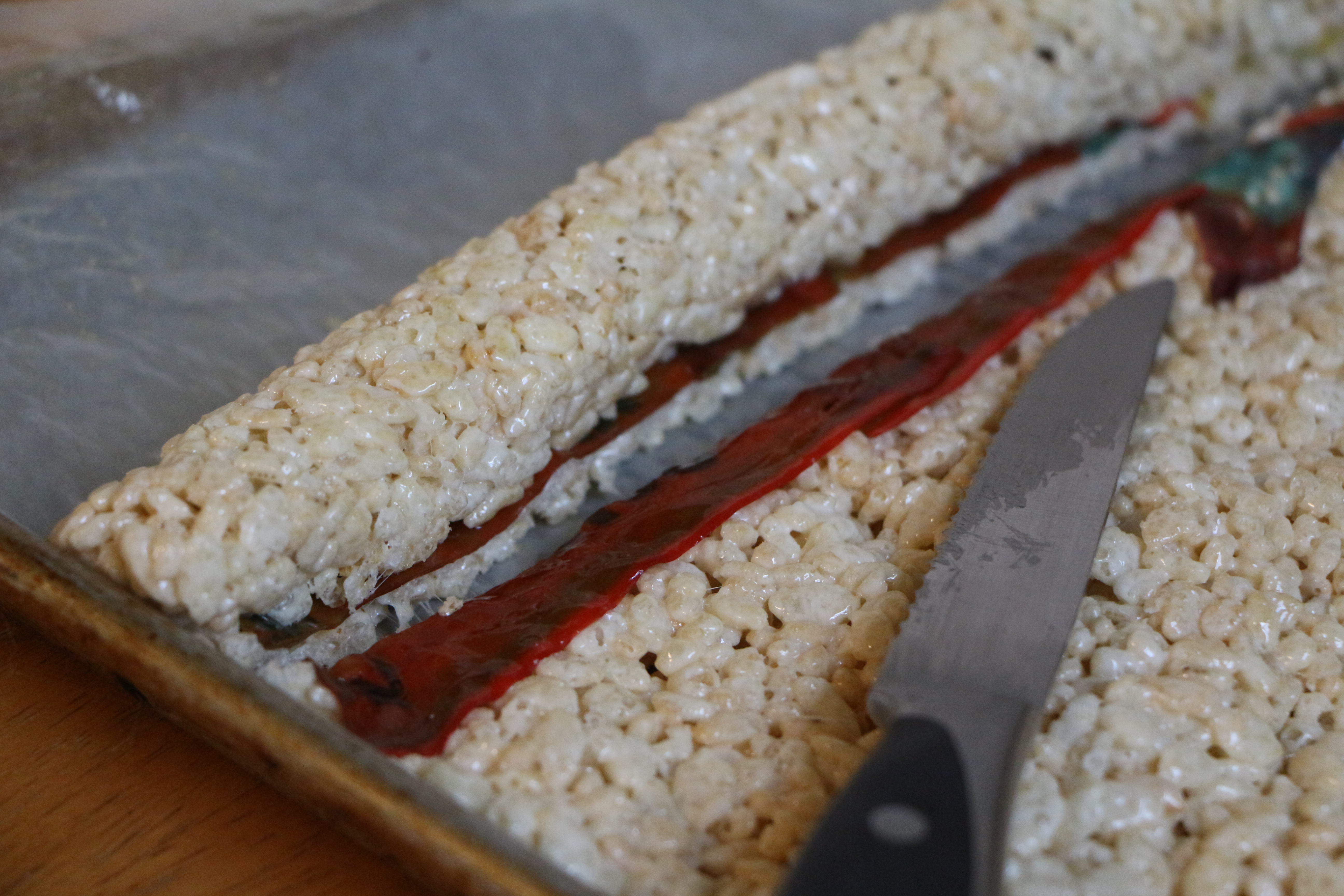
Step 6: Once you’ve achieved a small ‘California Roll’ size, use a knife to cut the roll from the remaining rice krispie treats. Slice into pieces. Roll in colored sugar ‘roe’, if desired.

Repeat to make additional ‘California rolls’. Alternately, you can roll the candy within the rice krispie treats, but reserve the fruit roll-ups to wrap around the outside of the roll prior to slicing in pieces.

To make ‘nigiri sushi’: Using your hands, mold portions of the rice krispie treats into small oblong clumps. Place a swedish fish on top. Use thin strips of fruit roll-ups to wrap around the rice and fish.

Serve with a bowl of chocolate syrup ‘soy sauce’.

Easy Vegetable Lo Mein and Pork Eggrolls

Posted on

Well, the ninja party was a grand success. We had a huge turnout of both children and adults, the weather was perfect, and laughter could be heard in every corner of the house and yard throughout the entire event…just as it should be! I love throwing parties of any kind, but I especially love throwing the boys parties, which are planned around a theme of their choice. This ninja theme sort of took on a life of its own and we all had a lot of fun with it.

We gave the party an Asian feel with a few Chinese New Year decorations I picked up online (shhhh…don’t tell anyone they weren’t authentic ninja decorations) and a whole bunch of red, black, and gold balloons. Little accents of tiny ninjas, dragons, and Asian fans were scattered about.

The boys dressed as ninjas and my gracious brother-in-law agreed to make a surprise appearance in full ninja attire. A bit of quick thinking at the radio had us listening to Kung Fu Fighting, as the ‘ninja’ evoked mixed feelings of terror and elation from the birthday boy and our young guests, while the adults giggled on the sidelines.

Good friends, good fun, and good food…

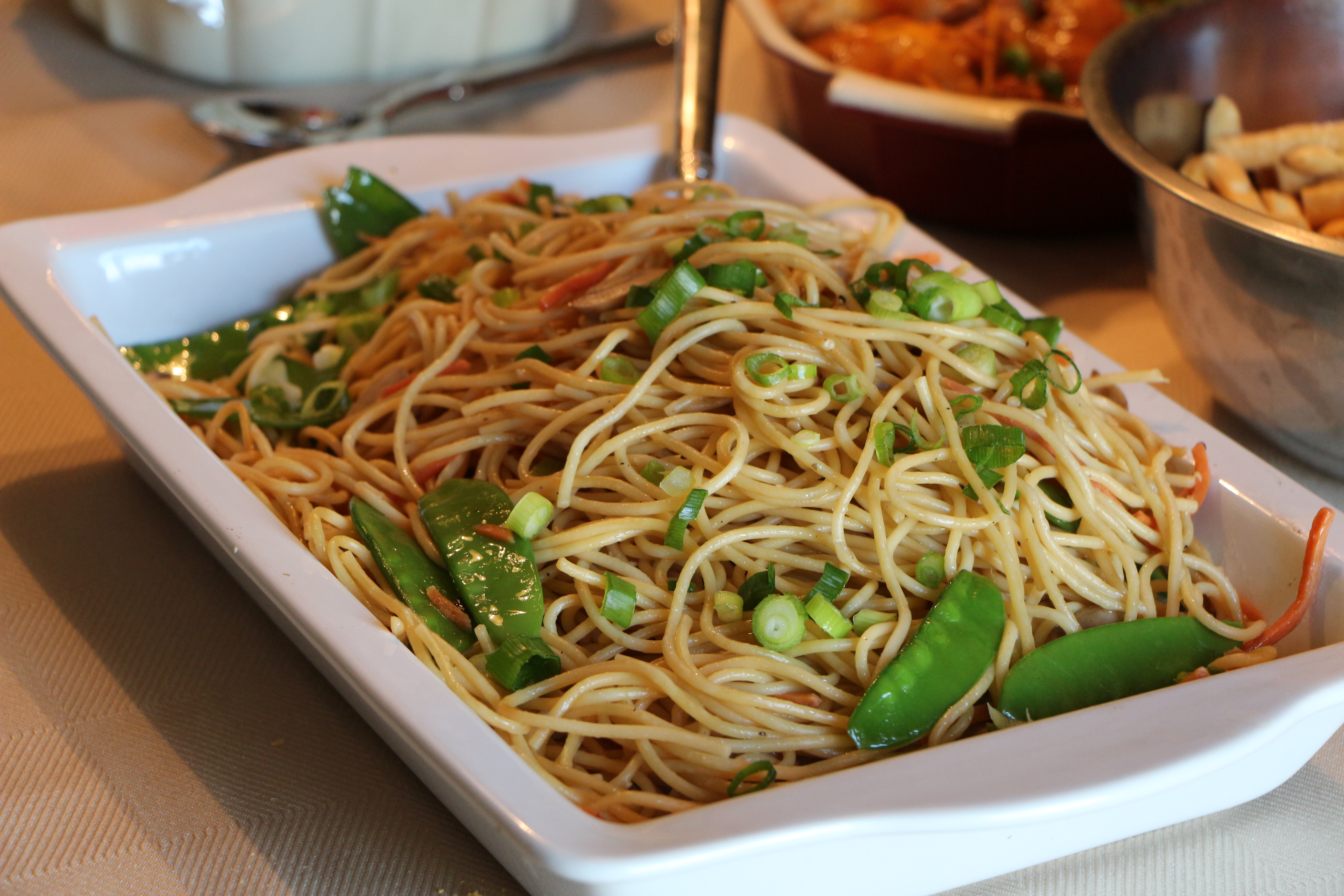
For our ninja themed party, I served a crowd-pleasing selection of Asian dishes. Though ninjas may be most closely associated with Japan, I planned the party buffet around a more familiar Chinese-takeout menu, which I was certain would be enjoyed by both the adults and children at our event. I made the sweet and sticky orange chicken, which I shared with you in a previous post, along with a mountain of homemade pork egg rolls (and a few veggie ones for our vegetarian guests) and a big batch of super simple vegetable lo mein. Grilled teriyaki beef skewers, sprinkled with toasted sesame seeds and jasmine rice completed the feast.

I’m sharing the ‘recipes’ for both the lo mein and egg rolls below, though I should note that the batch I made was quadruple of what I’m sharing below and in the flurry of party-prep, I didn’t take exact measurements or record times as I cooked. Use the recipes as a guide, but as always, taste as you go. It’ll be ‘right’ when it tastes good to you. And be creative with the ingredient lists. You can substitute any sort of veggies in the lo mein and add meat or seafood, if you desire.

Focus on Technique – How to Julienne

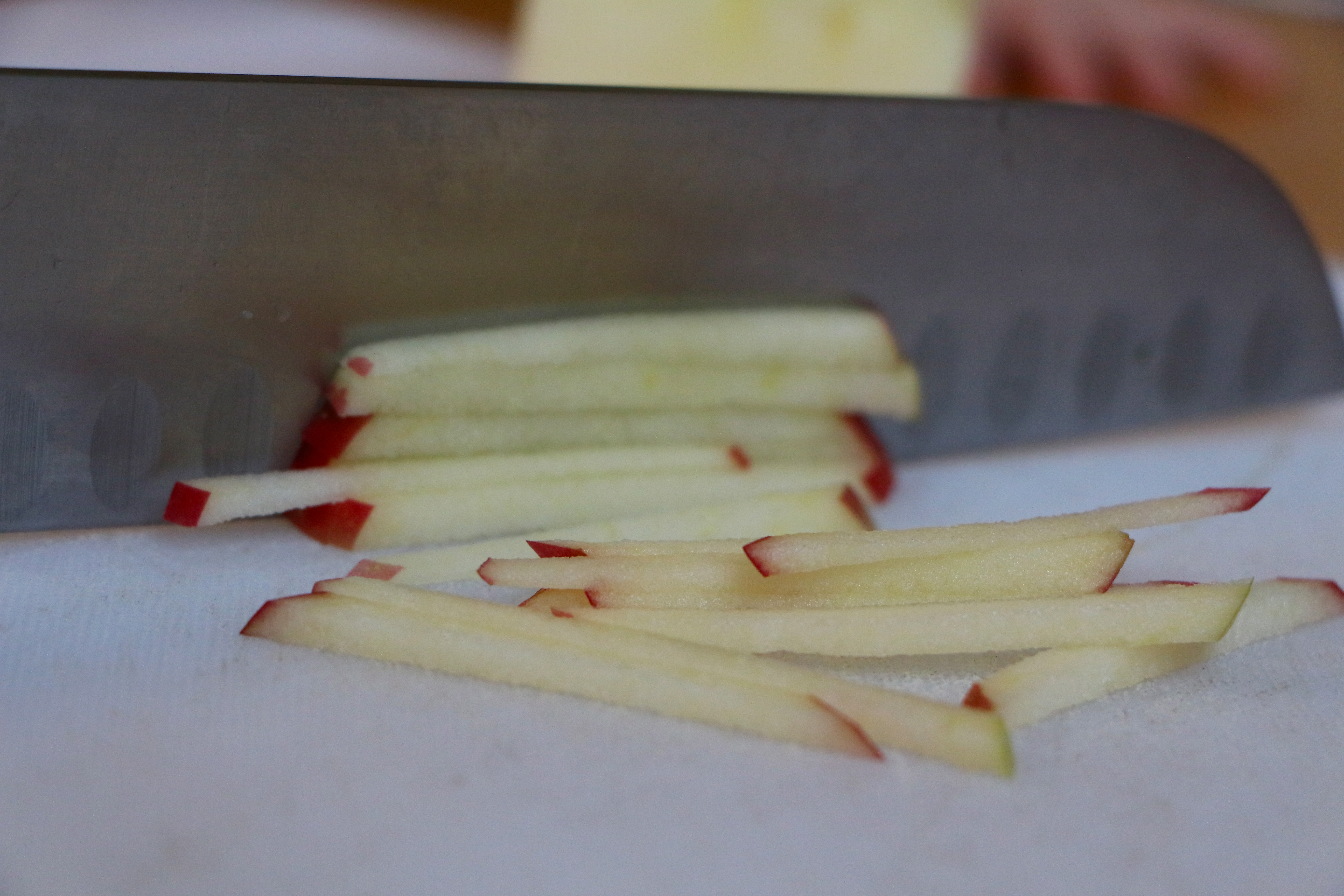
Julienne is a type of culinary knife cut, wherein the resulting pieces are long and thin, roughly the size and shape of a matchstick. A julienne cut is often used to make shoestring potatoes or can be used to cut a variety of veggies for sushi, soups, or garnish. A julienne cut appears most pleasing when the pieces are a uniform size, shape, and length.

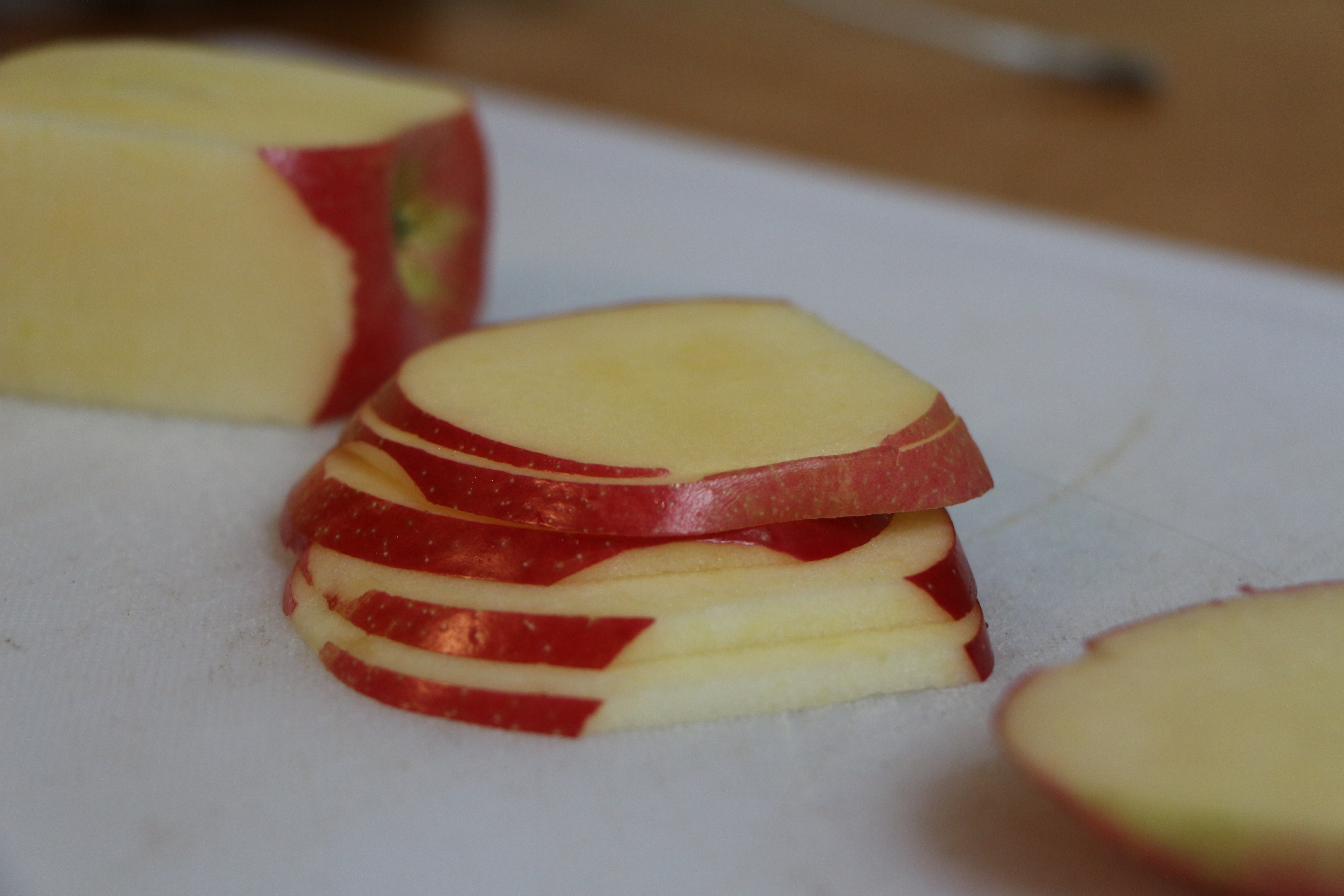
To achieve a nice, even julienne, start by squaring your fruit or vegetable. To do this, cut off the rounded portion of one side. Lay the flat side down onto the cutting board, then slice off the rounded part of each side. Turn the fruit or vegetable to cut off the remaining rounded side. Then, thinly slice the fruit or vegetable, to about 1/8″ thickness. Finally, stack the slices and carefully cut into matchsticks, about 1/8″ wide.

*If you were to cut the matchsticks into teeny tiny 1/8″ cubes, you would have a cut known as brunoise, pronounced broon-wah.

Easy Vegetable Lo Mein

Ingredients

  • 1 pound spaghetti or lo mein noodles, cooked al dente according to package directions
  • 2 tablespoons sesame oil
  • 1 teaspoon garlic, minced
  • 1 teaspoon fresh ginger, grated
  • 1 cup mushrooms, sliced
  • 1 cup sugar snap peas
  • 1 cup carrots, julienned
  • 2 green onions, sliced
  • 1/4 cup soy sauce
  • 1 tablespoon fish sauce or oyster sauce
  • Salt and pepper

Directions

Heat sesame oil in a large pan over medium heat. Add the garlic, ginger, and veggies. Cook for about 10 minutes, until tender, stirring frequently. Add the cooked spaghetti, soy sauce, and fish sauce. Toss to combine. Taste and adjust seasoning with salt, pepper and/or additional soy or fish sauce, as desired.

Garnish with additional sliced green onions, if desired.

For the Egg Rolls:

To prepare the filling: Heat about a tablespoon of sesame or vegetable oil in a large pan. Add about 1/4 pound bulk pork sausage. Cook for several minutes, using a spoon to break it into small pieces as it cooks. Add about 4 cups cups of cole slaw or Asian slaw mix (very thinly sliced cabbage, julienned carrots, celery). Cook for several minutes, stirring frequently until the cabbage is wilted and tender. Drizzle about 1-2 tablespoons soy sauce over the mixture. Season with salt and pepper, to taste.

To assemble the egg rolls: Arrange an egg roll wrap with one of the points facing you. (If desired, you can layer two egg roll wraps, for a chewier egg roll.) Place a mound of the filling, about 1/3 cup, in the center of the wrap. Grab the point closest to you and wrap it up and around the filling. Then, grab each of the side points and fold them in towards the center. (Brush the points with a bit of water to help them stick.) Brush the top point with a little water, then continue rolling up towards the top point.

To cook the egg rolls: Heat about 1/2″ vegetable oil over medium-high heat, to about 375 degrees. Place a few eggrolls in the hot oil. Cook for a couple minutes on each side, until hot, golden, and crispy. Drain on a paper towel.

Makes about 10 eggrolls

*Detailed pictures of the rolling process can be seen HERE.

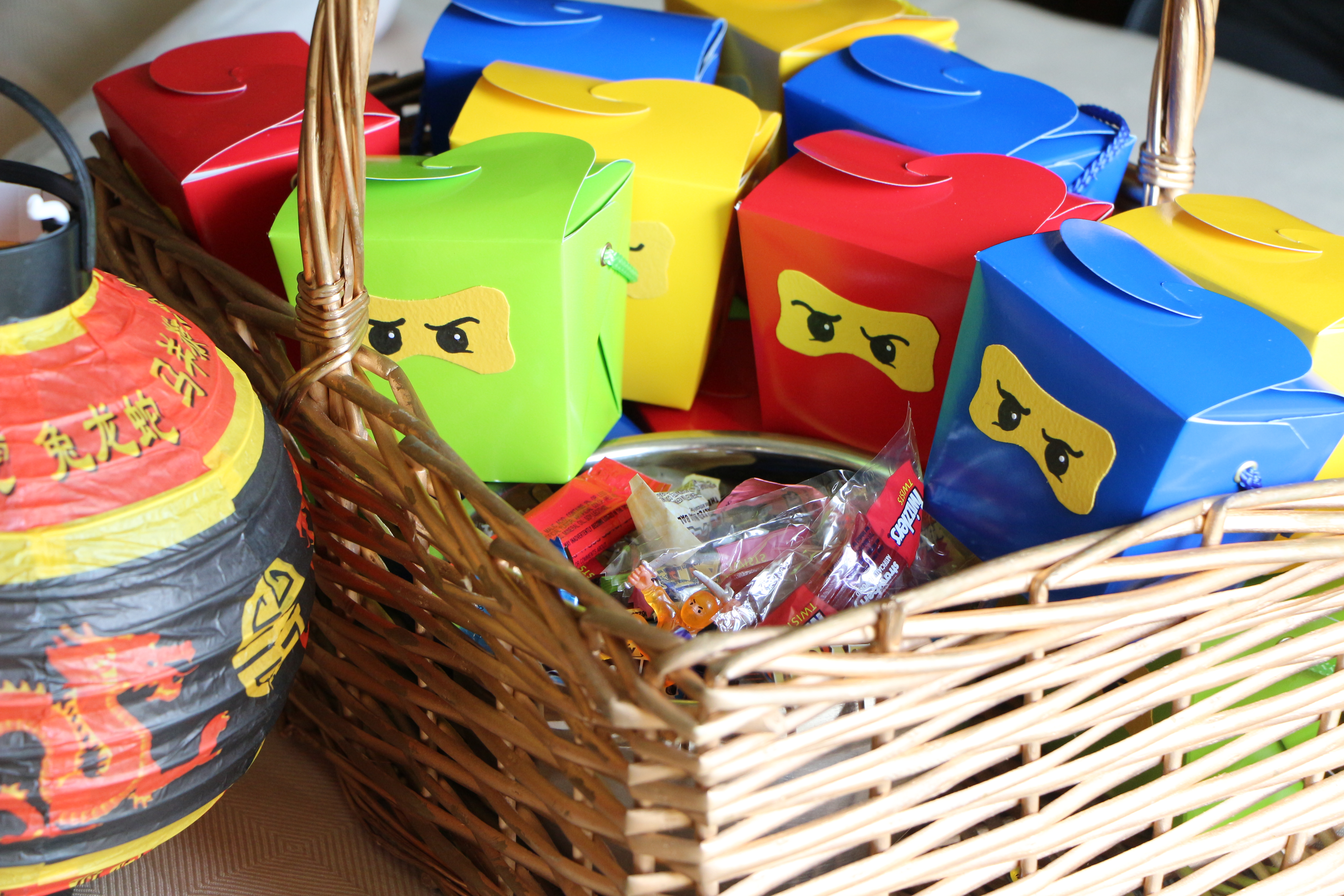
Ninjago (ninja lego) treat bags

Orange Chicken

You know that feeling you’re left with after a major spring cleaning of your house…purging the junk, wiping away the dust, polishing the knick knacks…that refreshed feeling of comfort in your space, when everything is organized, neat, and tidy?

Well, after taking the past few weeks to put a fresh polish on some things around this site, that’s just about how I’m feeling. And it feels good…

  • The Recipe Collection is up to date and organized in a way which I hope will make browsing the vast selection of recipes on this site a bit more user friendly.
  • The Gallery page now includes a much more comprehensive collection of photos, which are bigger and arranged in a more appealing manner. Best yet, clicking any photo will bring you directly to that recipe. Hovering your cursor over any picture will provide a brief description of the featured recipe.
  • A few new step by step guides have been added to the How-To Photo Guides page.

I’ve still got a bit more housekeeping to do around here, but I really hope you enjoy browsing around those pages!

It’s been a productive few weeks. But the best thing about stepping away from new posts for a bit is that it gave me a little time to reflect on where I am and where I’m going with this little blog. I started this blog two and a half years ago as what felt like a natural extension of what I was already flooding my social networks with…ramblings about cooking and eating. Very quickly, I discovered that it gave me a great feeling of satisfaction to produce a blog post…a delicious dish, a few photos, a written recipe…that tangible ‘job completed’ feeling that’s rare in my life as a stay-at-home mom. The very act of clicking Publish was rewarding to me. Even more rewarding was finding that people were actually interested in what I’d published. And that sure felt good!

Rice Krispie Treat ‘Sushi’ for our ninja-themed party

What started as a sort of personal food journal, took on a life of its own, with readers and subscribers and a facebook page and a twitter account (which I don’t really know how to use). But at the end of the day, this is just my little space about food, with no aspirations of being anything other than what it is. It’s not a baking blog or a gluten-free blog or a South Beach blog, though it contains recipes that fall into each of those categories. It’s not a gourmet blog or even a family-friendly blog, though there are plentiful recipes in each of those categories as well. Admittedly, the collection of recipes on this site is a bit scattered.

But you know what? So am I. So is my family. And this blog is a snapshot of our lives… One day I’m intent on losing the weight that’s been nagging at me since having our third son. The next day I’ve craving chocolate-covered bacon-wrapped twinkies. One day I’m cooking hot dog casseroles with my kids. The next I’m serving slow-braised short ribs in a cabernet reduction sauce at an elegant dinner party with dear friends. (I wear sweatpants regardless of the occasion.) My kids are usually clamoring around my feet when I cook and with three boys ages five and under, it’s almost inevitable that one of them will throw a tantrum, fall off a chair, or start coloring the grout between the bricks on my fireplace just as I’m engaged in some crucial time-sensitive step in a recipe. My photos are rapidly staged and shot close because my table is usually too messy to shoot wider. There’s often a baby climbing my legs while I’m frantically snapping the photos.

It’s chaotic. It’s imperfect. It’s my life. And I’m guessing it’s probably some of your lives too.

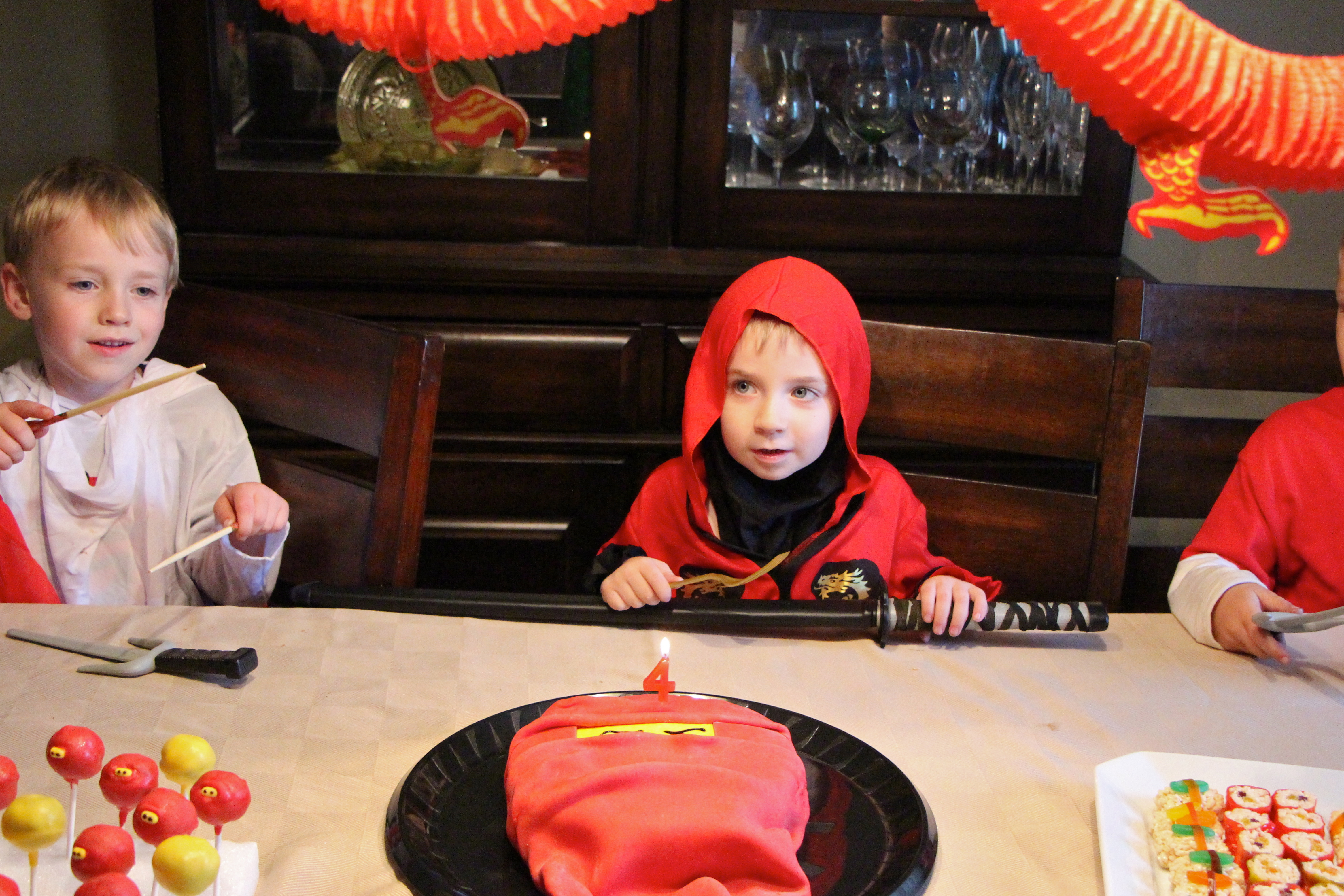
The Birthday Boy!

And that’s not about to change anytime soon, but there is something new I’d like to bring to this blog… The most wonderful thing about the culinary program I completed many years ago is that it left me with so much more than a collection of tasty recipes. It armed me with an understanding of techniques, which I can now apply towards everything I do in the kitchen…the tools and the confidence that enable me to walk into the kitchen and cook without recipes or to read another’s recipe and quickly understand what I can substitute or alter to fit my family’s tastes. That’s the thing I hope to share with all of you. I want to take my posts here one step further than just some story about my chaotic life and an awesome recipe for braised short ribs or pumpkin parfaits or cheddar bacon biscuits. I want each post to leave you with understanding of why the recipe works and how you can take that idea and make it part of your culinary toolbox. So, from here on out, that’s what I intend to do. Everything else will remain the same, but with each new post, I’m going to pull out one or two techniques or tips which are demonstrated in the recipe and be just a bit more explicit about the how or why.

Ninjago (Ninja Lego) Cake

Ok then, enough chatting about this blog. Time to get back to actually blogging on this blog… We’re throwing our middle guy, Lucas, a grand ninja battle…errr, I mean party, this weekend in celebration of his fourth birthday. It’s gonna be a ninjatastic event with an Asian-themed menu, surprise costumed ninjas, and rice krispie treat ‘sushi’ for dessert. I will share more details, photos, and recipes after the party, but for the moment, I want to share one of the recipes I’ll be preparing for this weekend’s festivities.

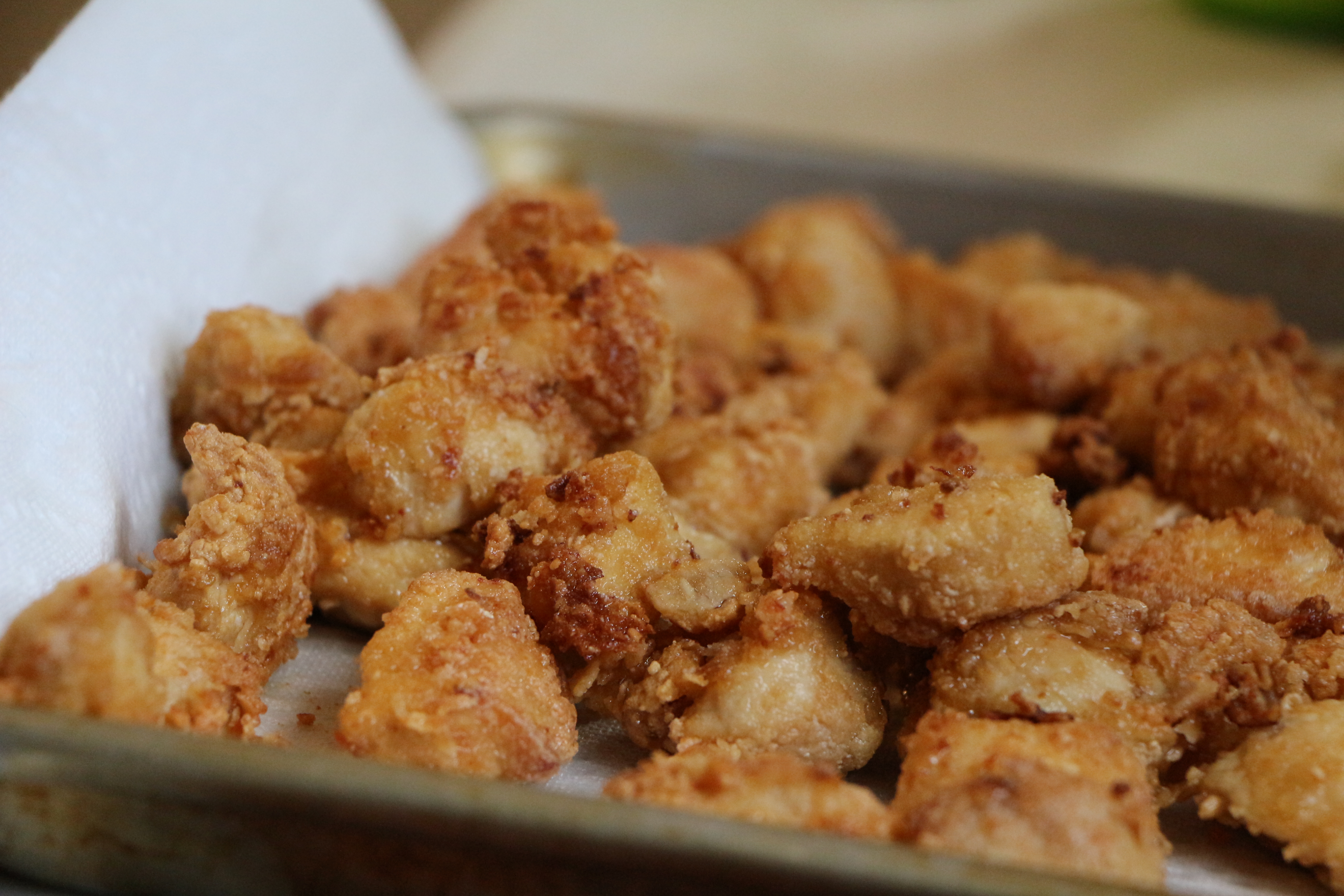
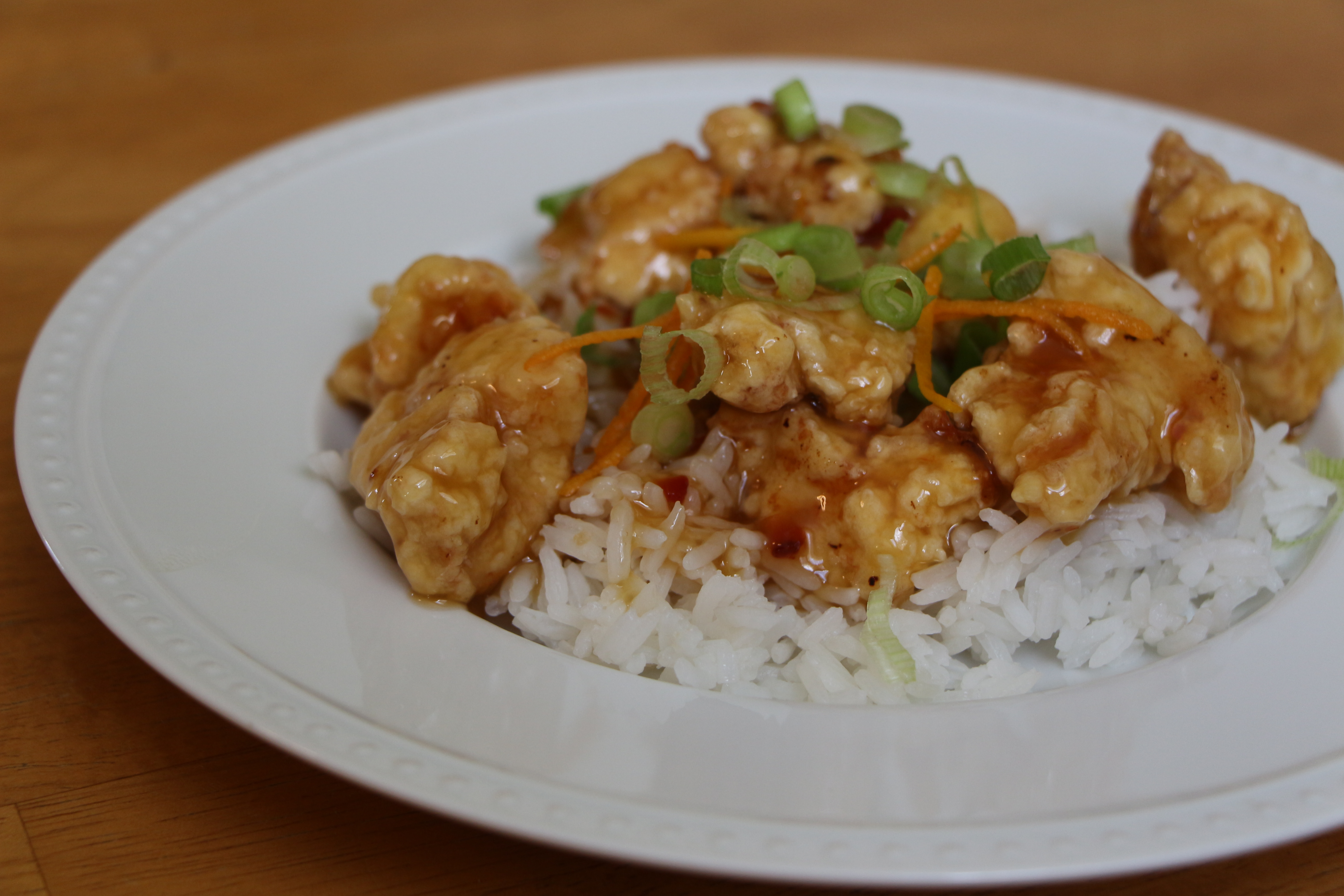
Orange chicken…I just adore the sticky sweet and slightly spicy sauce coating chunks of crispy chicken. As I planned the menu for this little ninja party, it seemed like the perfect fit for a big group of adults and young children. It’s a dish I’ve eaten often and made never. So, I did a bit of searching for a starting point. The big surprise for me was that some of the recipes contained not a bit of orange. No juice, no extract, no peel. Many recipes were more sugar than anything else. And though those recipes may be successful at reproducing the familiar orange chicken flavor from your favorite Chinese takeout restaurant, I just can’t come to grips with an orange chicken recipe made without orange. So, I played around a bit and came up with the recipe which follows. It’s pleasingly sweet, just a bit spicy, and packed with a good dose of authentic orange flavor. Prior to frying, the chicken is marinated in a soy-ginger-orange marinade, then dipped in egg, and coated with cornstarch. A simple sauce, made with orange juice and fresh zest is accented with Asian flavors then thickened to the consistency of a glaze with a bit of cornstarch. Definitely a crowd-pleaser!

Focus on Technique – Thickening with Cornstarch

Cornstarch is an effective (and gluten-free) thickener which can be used in a variety of recipes, including sauces, gravy, pudding, and fruit pie filling. It adds no flavor of its own and produces a clear, glazy result, as compared to the cloudy effect of a butter/flour roux. In general, about 1 tablespoon of cornstarch can be used to thicken 1 cup of liquid. To effectively blend the cornstarch into the liquid to be thickened, you should start by making a slurry, which is simply a mixture of the cornstarch with a bit of cold liquid (usually water). This step prevents the cornstarch from clumping when added to the hot liquid. Add the slurry to the liquid you wish to thicken, then bring to a simmer for a minute or two until the liquid thickens.

Orange Chicken

Ingredients

For the Chicken

1 pound boneless, skinless chicken breasts, cut into 1″ chunks

  • 1/4 cup soy sauce
  • 1/4 cup orange juice
  • 1 teaspoon fresh ginger, grated
  • 2 eggs, lightly beaten
  • 3/4 cup cornstarch
  • 1/2 teaspoon salt
  • Vegetable oil, for frying

For the Sauce

  • 2/3 cup brown sugar
  • 3/4 cup water
  • 1/2 cup orange juice
  • Zest from 1 orange (about 1 tablespoon)
  • 2 tablespoons rice wine vinegar
  • 2 tablespoons lemon juice
  • 1 1/2 teaspoons sambal oelek (crushed chile paste)*
  • 2 teaspoons soy sauce
  • 1 1/2 tablespoons cornstarch
  • 2 tablespoons cold water
  • 2 green onions, sliced

*You can substitute crushed red pepper or cayenne pepper powder to add a bit of spiciness. If using cayenne powder, reduce the quantity.

Directions

For the Chicken

Stir together the soy sauce, orange juice, and ginger. Submerge the chicken in the mixture. Allow the chicken to marinade for about 20 minutes in the refrigerator.

Combine the cornstarch and salt on a plate. Heat about 1/2″ of oil in a large skillet over medium-high/high heat to approximately 375 degrees. (You can use an instant read meat thermometer to estimate the temperature. If you do not have a thermometer, just heat the oil for several minutes until it’s sizzling hot.)

Remove the chicken from the marinade. Place the chicken in a bowl with the lightly beaten eggs. Remove the chicken from the eggs, then dredge in the cornstarch until well coated. Fry the chicken in small batches until crispy, golden, and cooked through, about 5-6 minutes. Turn the chicken once or twice during cooking. Remove the chicken from the oil with a slotted spoon and drain on a paper towel.

For the Sauce

Combine the brown sugar, water, orange juice, orange zest, rice wine vinegar, lemon juice, soy sauce, and sambal oelek in a saucepan over medium heat until well combined. In a small ramekin or bowl, stir together the cornstarch with the cold water. Pour the mixture into the sauce and whisk to combine. Bring the sauce to a simmer. Simmer for a couple minutes until the sauce is thickened.

Just before serving, pour the sauce over the chicken. Garnish with sliced green onions and additional orange zest, if desired. Serve over white jasmine rice.

Tips

  • To maintain the chicken’s crispiness, wait until just before serving to toss the chicken in the sauce.
  • To make ahead of time, fry the chicken and refrigerate until using. Prepare the sauce and refrigerate until using. Reheat the chicken on a baking sheet in a 375 degrees oven for about 10-15 minutes until heated through and crispy. Heat the sauce and pour it over the reheated chicken.

Updated Photo Gallery in Progress

Just popping in to let you know that the updated Photo Gallery page is up and running. I’m still working on adding oodles of older photos to it, but there’s already a good collection to peruse at your leisure. The photos are larger and more uniform than before, but the biggest upgrade is that clicking any photo will bring you to that recipe!! Check it out!

~Amy

P.S. New recipes coming up next week!

The boys cooking dinner on Monday. They made a pretty spectacular Chicken Alfredo Pizza!

Updated Recipe Collection!

Hey friends,

Check out the new and completely updated Recipe Collection tab and let me know what you think!

I’ll be working on the Gallery tab next. Then I’ll be back with some tasty new recipes and a few new ideas very soon!

~Amy

Praline Banana Splits

Posted on

I’m going to disappear for a couple weeks. Not completely vanish, but I’m going to take a little break off of new posts. There are a few things around this blog that require a bit of housekeeping, namely the Recipe Collection and Gallery pages, which I haven’t updated in nearly two years. Eek! So, I’m going to spend a little time focusing on cleaning up a few things around the site that have been nagging at me before resuming new posts.

Before I vanish, I wanted to leave you with something delicious. Mouth-watering inspiration came to me in the form of National Banana Split Day, which will take place on August 25. My twist on a banana split includes one-ingredient banana “ice cream”, caramelized banana halves, and a decadent pecan praline sauce. Yeah…bananas and praline. Yum. 

You may have run across fancy banana ice cream makers out there, but no specialized tool is required to make this perfectly creamy banana confection. A regular food processor or a good blender will do the trick! And since our “ice cream” is made with pure naturally-sweetened, naturally fat-free banana, you can afford to have a little more fun with the toppings, like this pecan praline sauce. Once you try this sauce, you’re going to want to pour it over everything. In fact, I plan to make a second batch to drizzle over my husband’s birthday cheesecake. Best yet, made with fat-free milk, it’s a lighter version than many cream-laden praline sauce recipes, with no sacrifice to the crave-worthy end result.

Enjoy, folks! I’ll be back with you soon and in the mean time, keep an eye around the site for updates!

Praline Banana Splits

Ingredients

For the Praline Sauce*

  • 1 teaspoon butter
  • 1/6 cup pecans, chopped
  • 1/2 cup dark brown sugar
  • 1/3 cup milk (fat-free works well)
  • 1 1/2 teaspoon cornstarch
  • Pinch of salt

For the Caramelized Bananas

  • 1 banana, peeled and sliced in half lengthwise
  • 1 teaspoon butter
  • 1 teaspoon brown sugar

For the Banana “Ice Cream”

  • 3 medium or 4 small bananas, sliced and well-frozen

Directions

For the Praline Sauce: Stir the cornstarch and salt into the milk. Set aside. Melt the butter in a pan over medium heat. Add the pecans and cook for 1-2 minutes, stirring frequently, until lightly toasted. Reduce the heat to low and stir in the brown sugar, until it begins to soften and melt. Whisk the milk mixture into the pecan mixture. Raise the heat back to medium. Continue whisking until the mixture bubbles and thickens, about 1-2 minutes. Remove from the heat and cool slightly.

For the Caramelized Bananas: Combine the butter and brown sugar in a pan over medium heat. Once the butter has melted, place the banana halves in the pan, cut-side down. Gently move the bananas in the pan so that the cut-side becomes coated with the butter and sugar. Cook for 3-5 minutes, until the cut-side develops a golden brown crust. Remove from the pan and cool slightly. Cut each banana half into half crosswise.

For the Banana Ice Cream: Place the frozen bananas pieces into a food processor or blender. Begin by pulsing the slices until they are mostly broken up. Then, continue blending the mixture until it’s smooth and creamy like ice cream.

To Assemble the Banana Splits: Place a large scoop of the banana ice cream in each bowl. Arrange two of the bananas pieces on the sides. Top with a tablespoon or two of the warm praline sauce. Garnish with additional pecans, if desired.

Makes 2 generous banana split sundaes

Recipe for the Praline Sauce adapted from the EatingWell recipe found HERE.

Creamy Chipotle Tomato Soup

Posted on

We have one of those Kinect sensors for the Xbox 360. We bought it on a whim a few months ago, in search of something fun and active to do as a family while we were all cooped up during the chilly winter months. We picked up a few games for the kids and ourselves and we played them often for about two weeks time. Then, our enthusiasm for our new toy waned and the games have gathered dust since.

Mostly, we use the Xbox 360 for watching movies and shows through Netflix. And my husband enjoys the convenience of the Kinect’s voice-command abilities. I, however, have been unable to get comfortable with shouting commands at the little sensor which sits perched on top of my tv. It just feels so We’re the Jetsons to me. Just can’t do it.

My husband, amused at my apprehension to talk to the machine, got a bit surly with it the other night. He started yelling at it, Xbox, make my dinner. Xbox, take a hike. Xbox, smell my feet. At each command, Xbox, upon hearing its name, would stop and try to process the request. Poor, confused Xbox was dutifully attempting to identify and obey each given command, while we sat by and giggled as it struggled.

Well…I’m pretty sure my husband broke the sensor with this little game. It hasn’t worked correctly ever since. It now requires most commands to be repeated multiple times or firmly shouted before it responds. It appears we’re dealing with a little case of boy-who-cried-wolf. The Xbox no longer believes we’re serious when we call it. Either that or it’s just angry and being difficult. It’s smart. It’s learning. And it freaks me out.

Thankfully, I am not reliant on the Xbox for doing my laundry or cooking my dinner.

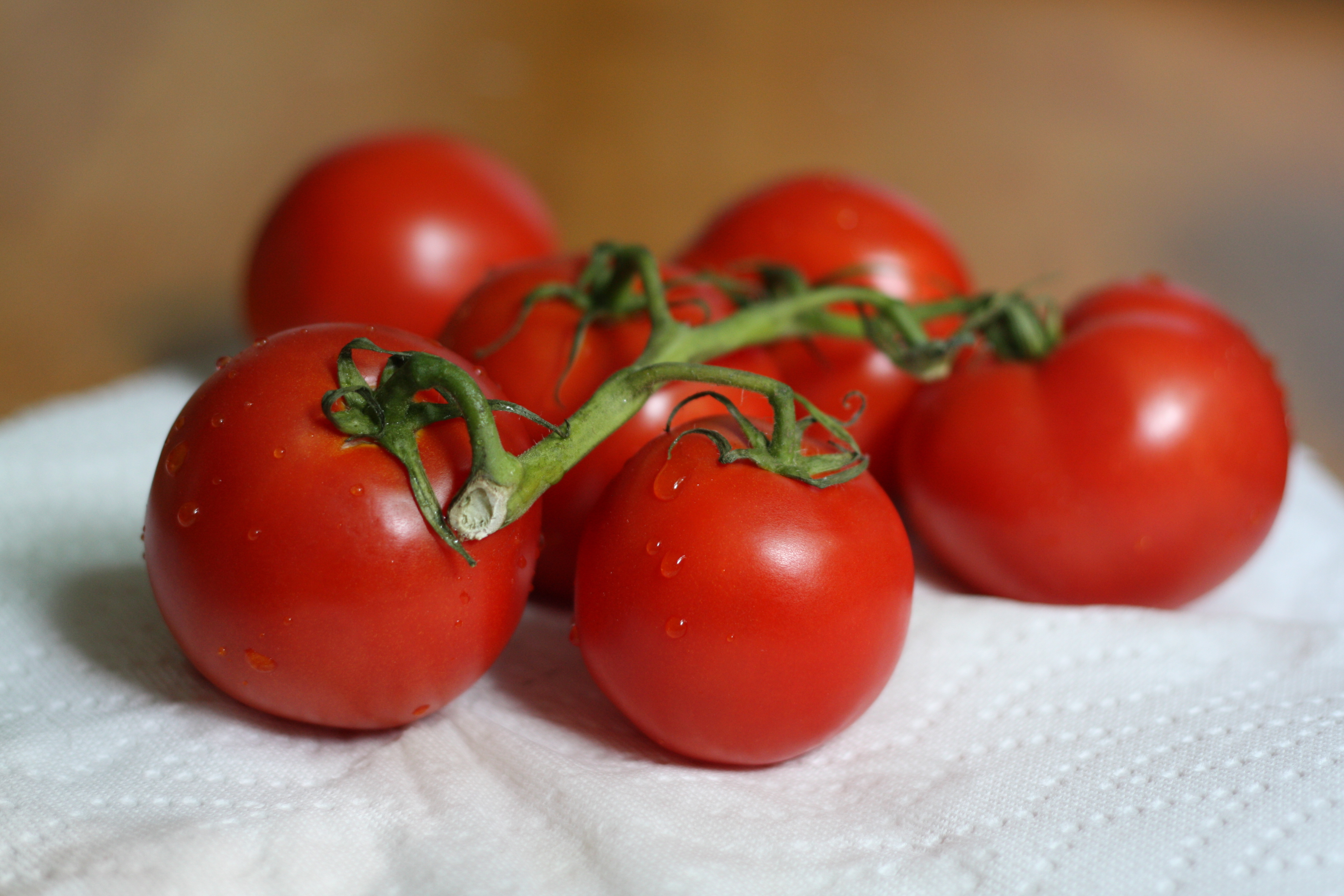
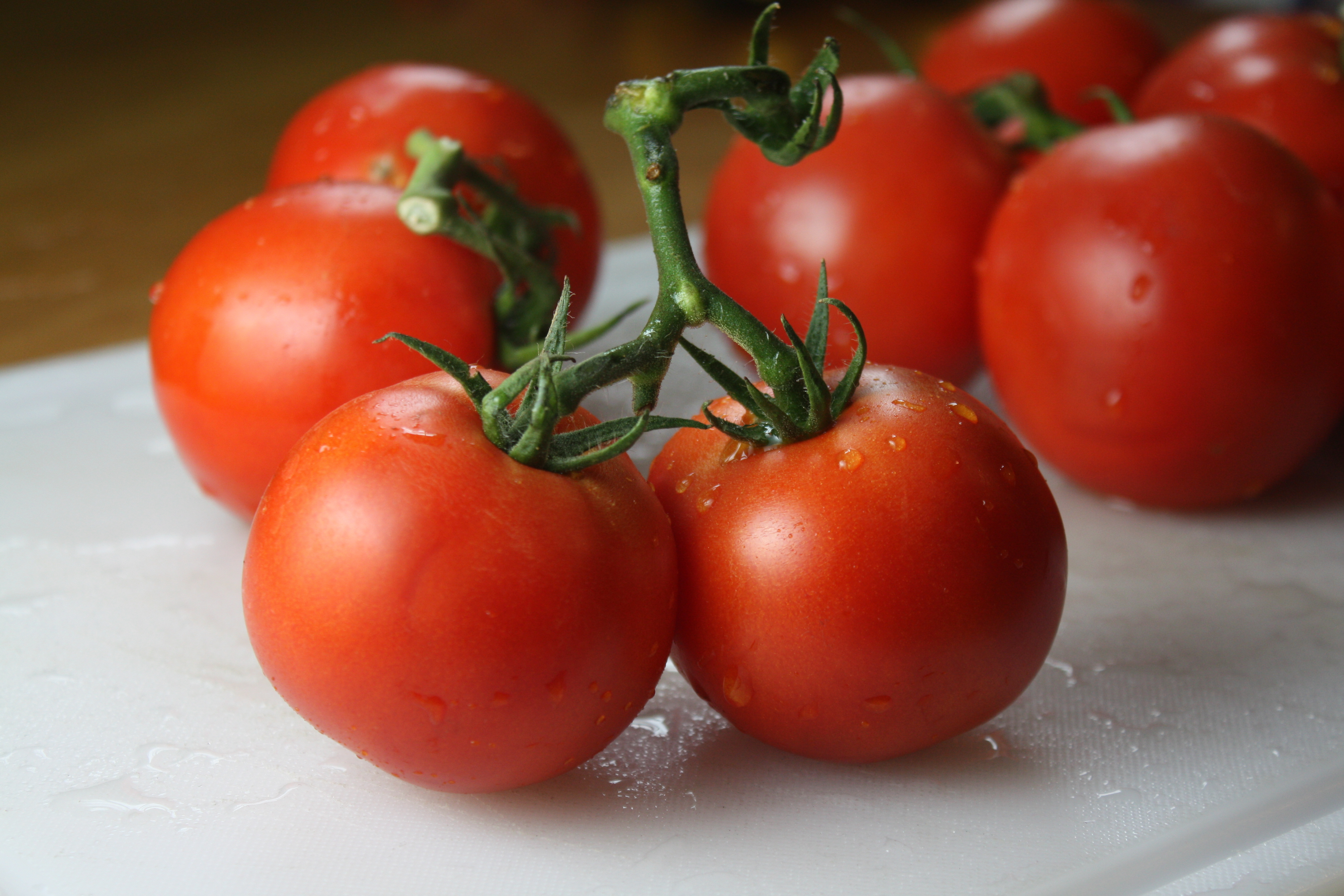
We’re right about at that time of year when gardeners are proudly reaping the fruits of their labor in the form of baskets full of ripe, delicious tomatoes. I myself did not undertake trying to grow anything more than a few herbs and a beautiful flowering plant, which I promptly killed. I can grow some darn fine humans, but the ability to grow things in dirt eludes me. I buy my tomatoes at the grocery store and they have been garden-fresh, ripe, and delicious lately…the perfect tomatoes for fresh tomato soup. At any other time of the year, you might be wise to use canned tomatoes when making tomato soup, but now is the perfect time to use the season-peak ones you’re harvesting from your gardens or picking up in local farmer’s markets.

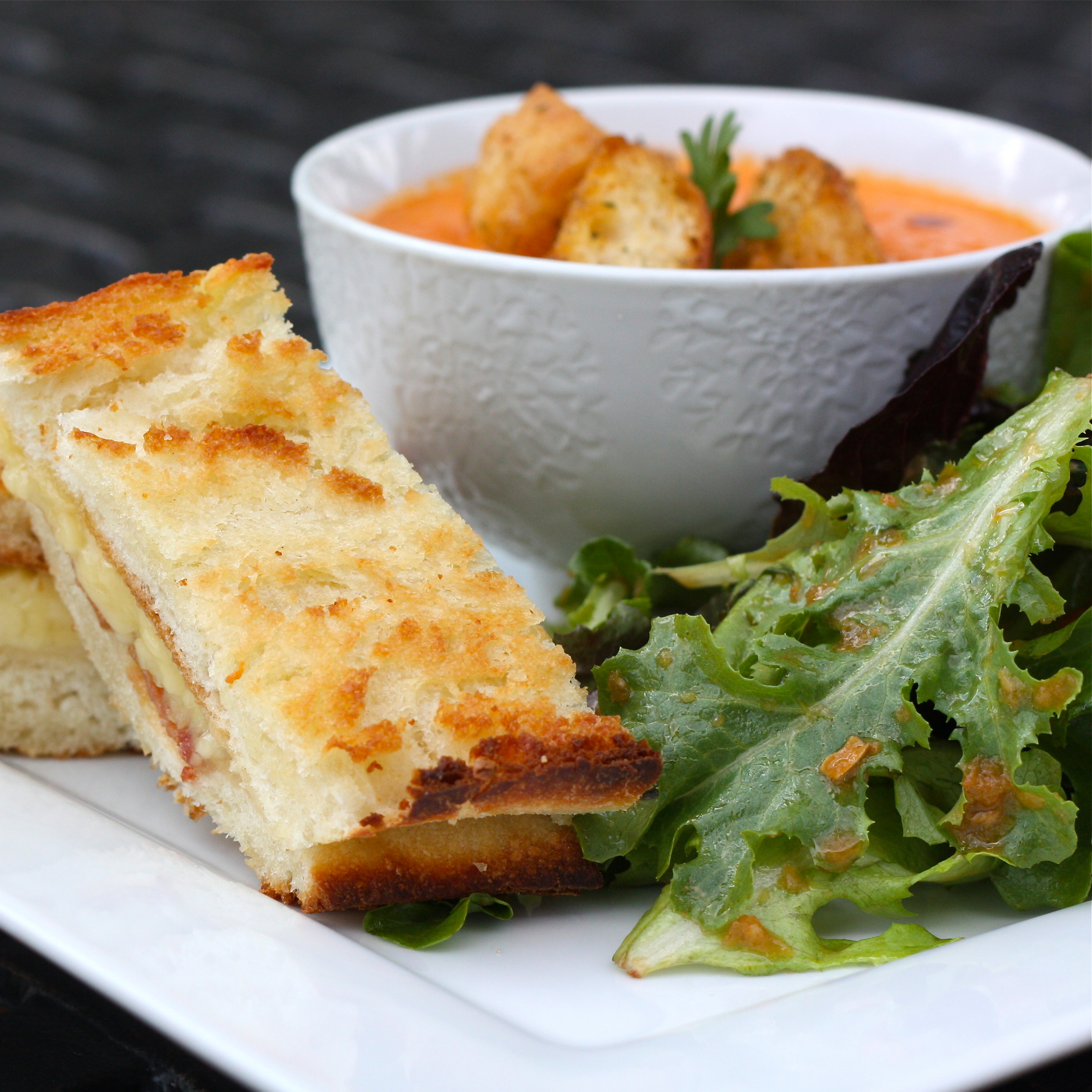
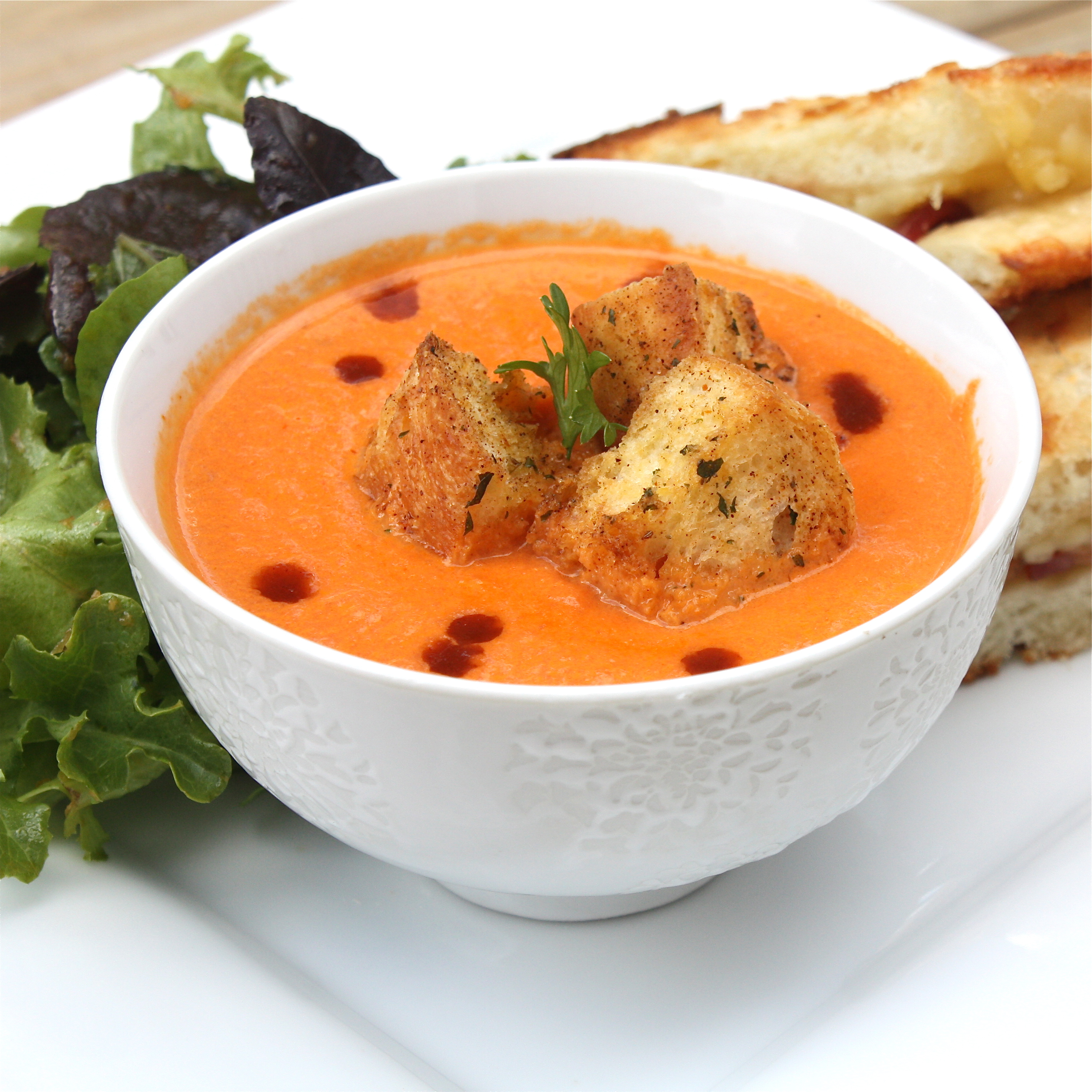
I give my tomato soup a spicy, smokey flavor with the addition of a chipotle pepper. A bit of heavy cream balances the spice and gives the soup a rich texture. The soup is garnished with a few homemade croutons and a couple dashes of chipotle tabasco sauce. On the side, I served a simple mixed green salad tossed in a ginger vinaigrette and grilled brie and gouda with bacon on French baguette. I’m fairly certain that the Xbox would have been incapable of coming up with something so perfectly simple and delicious as this…but don’t tell the Xbox I said that.

Creamy Chipotle Tomato Soup

Ingredients

  • 3 pounds ripe tomatoes, peeled and deseeded, coarse chopped*
  • 2 tablespoons olive oil
  • 1 small red onion, chopped
  • 2 garlic cloves, smashed
  • 1/2 cup vegetable stock
  • 1 chipotle pepper (from a can of chipotles in adobo)
  • 3 tablespoons tomato paste
  • 1/2 cup heavy cream
  • 1/2 teaspoon salt
  • Cayenne pepper, to taste
  • Chipotle Tabasco Sauce, optional (for garnish)

*Click HERE to see my photo guide on how to peel and deseed tomatoes.

Directions

Heat the olive oil in a large pan over medium heat. Add the onion. Cook for 7-10 minutes, stirring frequently, until tender and translucent. Add the garlic and cook for another minute or two. Add the tomatoes, vegetable stock, chipotle pepper, and tomato paste. Simmer over medium/medium-low heat for about 25 minutes, stirring frequently. The tomatoes should almost completely break down during the cooking time. Allow the mixture to cool slightly, then transfer to a food processor or blender. Blend until smooth, then return to the pan. Add the cream. Season with salt, to taste (about 1/2 teaspoon should do the trick). Add cayenne pepper, to taste, if additional spiciness is desired. Warm gently over medium-low heat.

Garnish with a few dashes of chipotle tabasco and homemade croutons.

Makes 2 generous servings

* For the homemade croutons, simply toss a few chunks of French bread in a bit of olive oil, season with cajun seasoning or any other seasoning, then bake in a 375 degree oven until toasted, about 10 minutes or so.

How to Peel and Deseed Tomatoes

Posted on

Using fresh tomatoes in homemade sauces and soups (like the creamy chipotle tomato soup I’ve got coming for you) often requires starting with peeled and deseeded tomatoes. Fortunately, peeling tomatoes is easier than you may expect. Just let a bit of boiling water do all of the work! Here are a few simple steps for easily peeling tomatoes.

Step 1: Start with beautifully ripe, seasonal tomatoes.

Step 2: Cut a small ‘X’ into the non-stem end of the tomato.

**It’s a good idea to use a paring knife to cut out the tough green stem end at this point. It will help the skin to slip off easier and will save you from removing it later. 

Step 3: Bring a pot of water to a rolling boil.

Step 4: Insert the tomatoes into the water for about 1 minute.

Step 5: Remove the tomatoes using a slotted spoon and place in a bowl of ice water. The skin should be practically falling off on its own.

Step 6: Use your fingers to slide the skin from the tomato. If necessary, use a paring knife to remove any remaining peel.

**Use the paring knife to cut out the green stem end, if you haven’t already.

Step 7: Cut the tomatoes in half. Gently squeeze the tomatoes to remove the seeds. Use your clean fingers to remove the seeds from any small pockets. 

Julia Child’s Beef Bourguignon

Posted on

Julia Child was one of America’s first (and dare I say greatest ) culinary celebrities, in a time long before shows like The Next Food Network Star or Top Chef sought to discover such talent. She was just a woman with a passion for good food, which led her down the gastronomical path that ultimately brought her into America’s kitchens. It was her passion for food which led her on the journey. It was her charm, relatability, and contagious adoration of food which grabbed the attention of adoring fans all around the world.
Julia changed the way home cooks thought about food. She knew that good food wasn’t exclusive to restaurant kitchens, prepared by professional chefs. She made expert culinary techniques accessible to everyone, in a manner which could inspire even the most novice cook to jump in head first. Because Julia understood that we learn best through trial and error. She understood that there is no such thing as a bad cook, only cooks who needed more practice. And she understood that even the most experienced cooks encountered the occasional kitchen disaster. She’d say, “Cooking is like love; it should be entered into with abandon or not at all.”  

Julia viewed food as one of the greatest pleasures in life, a pleasure worth the small sacrifice of a wider waistline. (Who needs to be a size 4 anyway???) She embraced cooking as an art form akin to ballet. And she cooked with the same inspired strokes of an artist to create timeless gastronomical masterpieces. But she was often criticized by nutrition-minded individuals for her use of rich ingredients, like butter and cream, which in excess could lead to health problems. To those criticisms, she responded, “Everybody is overreacting. If fear of food continues, it will be the death of gastronomy in the United States. Fortunately, the French don’t suffer from the same hysteria we do. We should enjoy food and have fun. It is one of the simplest and nicest pleasures in life.”  

I love this woman. And having lived to be two days short of 92 years old, a lifespan which she attributes to a regular diet of gin and red meat, I’d say she knew what she was talking about. Well-prepared food is a pleasure to be enjoyed, even within the framework of a healthy lifestyle.
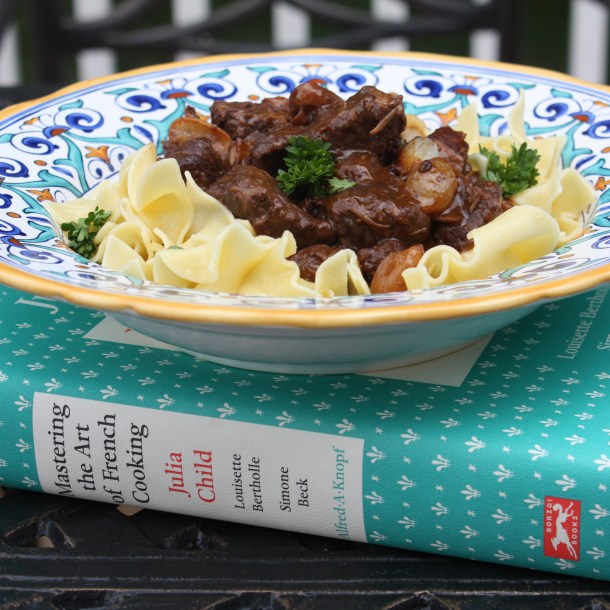
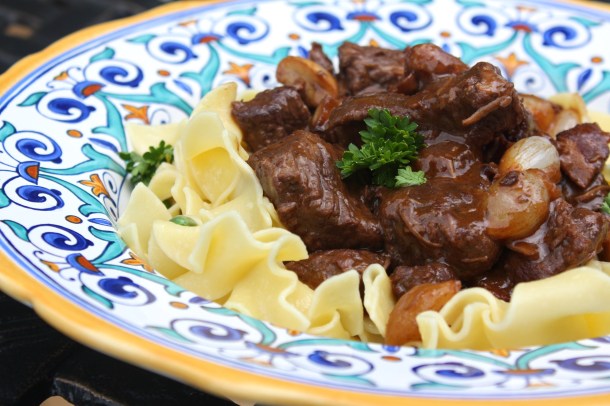
Julia understood what really mattered. She knew that good food needn’t be complicated with elaborate presentation. She would say, “You don’t have to cook fancy or complicated masterpieces – just good food from fresh ingredients.” That’s all it really takes, isn’t it? It’s like this beef bourguignon, perhaps her most famous recipe and the subject of her very first televised episode of The French Chef on PBS. It’s a stew (with a fancy name that’s fun to say). But it’s a stew all the same, certainly not something most would consider fine dining. And yet, it’s probably one of the most delicious dishes you’ll ever eat.

I started making beef bourguignon a few years ago as our Christmas dinner. I suppose it’s become our tradition at this point. We entertain a large crowd on Christmas and for a few years, I experimented with various menus, all delicious, but the beef bourguignon stuck. It’s enjoyed by everyone at the table and best yet, can be fully prepared the day before. In fact, it’s even better after sitting in the fridge overnight!

In honor of what would have been Julia’s 100th birthday (August 15), I prepared her infamous beef bourguignon. (I certainly wasn’t going to cook the roast suckling pig.) Beef Bourguignon is normally a recipe I would save for the colder months when it’s lovely to have the house warmed with the slow-cooking oven and flooded with the rich aromas of the dish. But when I think of Julia, I think of beef bourguignon, and so it had to be.

The original recipe can be found in Julia’s first book, Mastering the Art of French Cooking. She was a wise woman who fully recognized that some of the recipes contained in the book may require stretching one’s budget, waistline, time, and schedule, but such are the sacrifices we make in the name of something wonderful to eat. Like many of the dishes in her book, this dish takes some time, but there’s no step too complicated for even the most novice chef. Heed Julia’s advice and cook with abandon. As with many of the world’s greatest pleasures, anything worth having is worth the work it takes to get there.
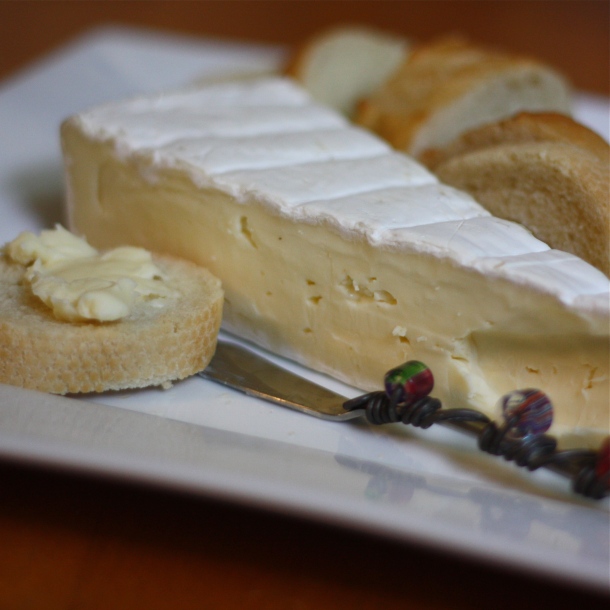
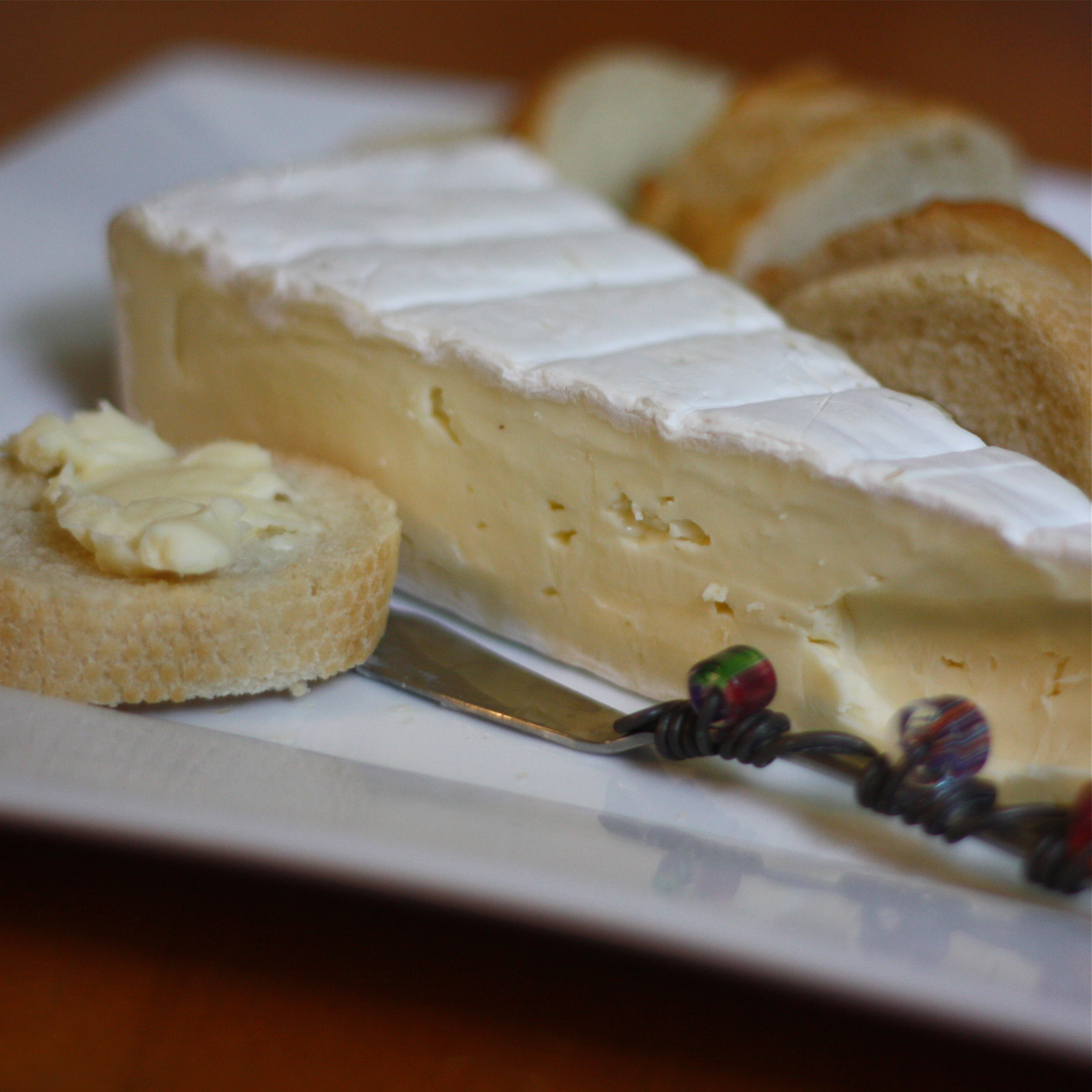
While I waited for my beef bourguignon to finish cooking, I turned on some music and danced in the kitchen with my boys. Then I poured myself a glass of wine and spread some creamy brie onto slices of French baguette. I’m pretty sure Julia would have approved.

Happy 100th, Julia and Bon Appétit!!

Julia Child’s Beef Bourguignon
Boeuf a la Bourguignonne

(In my own words. Very slightly modified from the original.)

Ingredients

  • 1/2 pound bacon, chopped
  • 1 tablespoon olive oil
  • 3 pounds lean stewing beef (cut into approximately 2″ chunks)
  • 1 carrot, sliced (or 10-15 baby carrots, coarse chopped)
  • 1 onion, chopped
  • 1 teaspoon salt
  • 1/4 teaspoon pepper
  • 2 tablespoons flour
  • 3 cups full-bodied red wine
  • 2 – 3 cups beef stock
  • 1 tablespoon tomato paste
  • 2 cloves garlic, smashed
  • 1/2 teaspoon thyme
  • 1 crumbled bay leaf (optional)

For the brown-braised onions (Oignons Glacés à Brun)

  • 1/2 bag frozen white pearl onions, defrosted and patted dry
  • 1 1/2 tablespoons butter
  • 1 tablespoon olive oil
  • 1/2 cup beef stock or beef broth
  • Salt and pepper

For the sautéed mushrooms (Champignons Sautés au Beurre)

  • 1 pound mushrooms, quartered
  • 4 tablespoons butter
  • Salt and pepper

Directions

Gather and prepare your ingredients prior to cooking. Chop the bacon, chop the beef, chop the veggies, smash the garlic… Preparing your ‘mise en place’ will help things go smoothly once you’ve fired up the stove.

Preheat oven to 450 degrees.
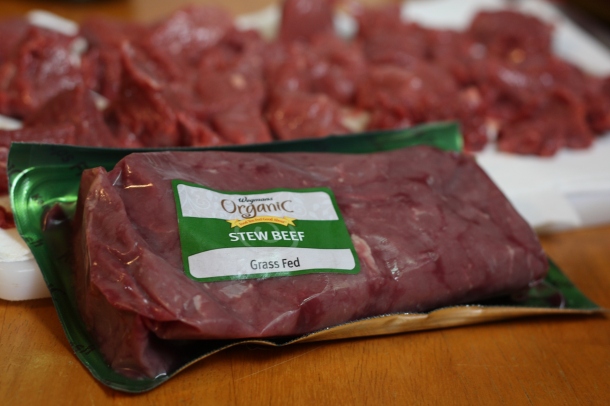
Arrange the beef chunks in a single layer on a tray lined with paper towels. Use additional paper towels to thoroughly pat the beef dry.

*Damp beef will not brown properly.

*Julia recommends chuck beef for stew meat. I usually use the precut ‘stew beef’ from my grocery store. It saves me a few minutes of prep time, which is invaluable when you’re cooking while three young boys threaten to tear the house (or each other) apart.

In a large dutch oven pan, heat the olive oil over medium heat. Add the bacon and cook for several minutes, until the bacon is browned and has released most of its fat. Use a slotted spoon to remove the bacon, leaving the fat in the pan.

*Julia’s recipe calls for a 6 ounce piece of chunk bacon, cut into lardons. Regular sliced bacon will work just fine!

*Any large, stove and oven-safe pan with a tight fitting lid will do the job. I use a 9-quart Le Creuset enameled  cast iron french oven pan.

Over medium/medium-high heat, brown the beef in the bacon fat for a minute or two on each side. Do not overcrowd the pan. The beef should quickly develop a nice caramelized brown on the surface. Turn the beef to brown on all sides, then remove with a slotted spoon and set aside. Repeat until all of the beef has been browned.

*You do not want to steam or boil the beef. If your beef is not browning properly, it is either due to the heat not being high enough, the pan being over-crowded (which lowers the heat of the bacon fat), or the beef being too damp. Try adjusting each of these conditions.

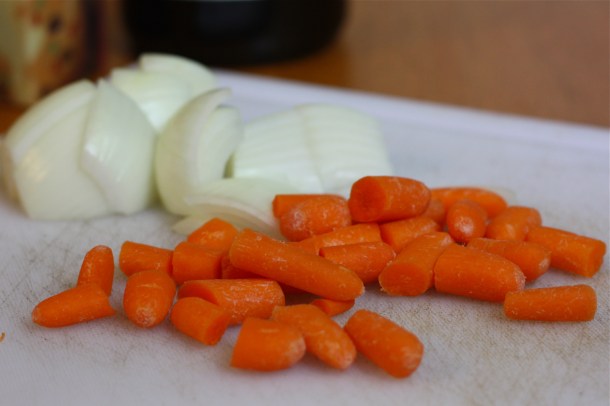
Once all of the beef has been browned, add the carrots and onions to the pan. Cook for a few minutes until they develop a golden brown color. Then, carefully pour out the excess bacon fat, leaving the veggies in the pan.
Add the beef and bacon back into the pan. Toss with salt and pepper. Then, sprinkle the flour over the mixture and toss again. Place the pan, uncovered, on the middle rack of the preheated oven for 4 minutes. Toss the mixture, then cook for 4 more minutes.

Remove the pan from the oven and reduce the heat to 325 degrees.

Add the wine*, beef stock, tomato paste, garlic, and thyme. Add just enough beef stock to barely cover the beef.

*Julia recommends Beaujolais, Cotes du Rhone or Burgundy. I use whatever dry red I have on hand, usually Merlot, Cabernet Sauvignon, or Pinot Noir. Use something you enjoy drinking. While you’re at it, go ahead and pour a glass. Julia wouldn’t mind. In fact, I think she would have encouraged it. Cheers!

Bring to a simmer on top of the stove. Then, cover the pan, and place it in the oven. Cook, covered, for about 3 hours. Adjust the temperature slightly, if necessary, so that the liquid maintains a gentle simmer throughout the cooking time.

While the beef is cooking, prepare the onions and mushrooms.
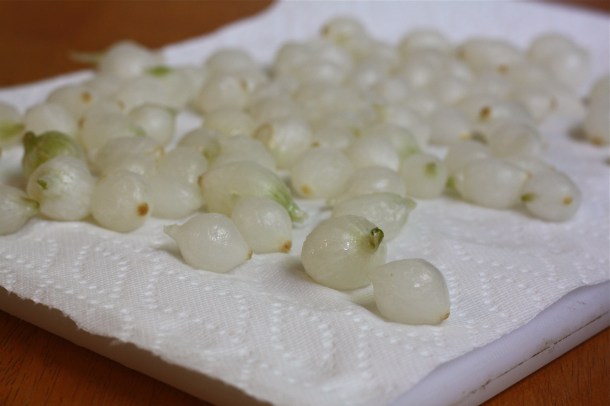
For the onions:

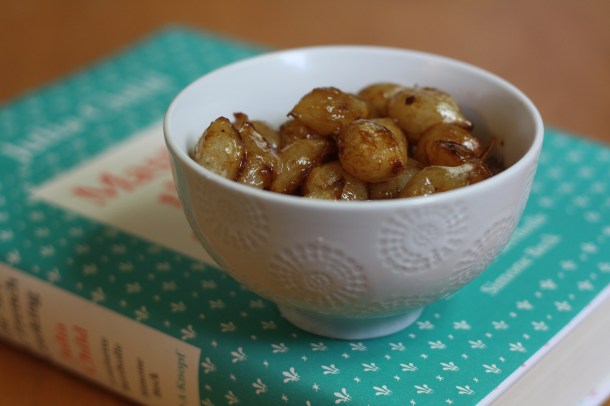
Heat the butter and oil in a sauté pan over medium heat. Add the onions and cook for about 10 minutes, occasionally shaking the pan to allow the onions to roll around in the pan and brown on all sides. Then, add the beef stock. Bring to a simmer, then lower the heat. Cover and simmer slowly for about 15-20 minutes. Check the pan towards the end of the cooking time. Most of the liquid should have evaporated and formed a brown glaze around the onions. Season with salt and pepper. Set aside.

*Julia’s recipe calls for fresh, peeled white onions, about 1″ in diameter. Since my grocery store does not regularly carry the small onions, I use about 1/2 a bag of frozen white pearl onions. The added convenience is that they’re already peeled! Just be sure to defrost completely and pat dry before sauteeing. Fresh onions will require longer cooking time, about 40-50 minutes.
For the mushrooms:

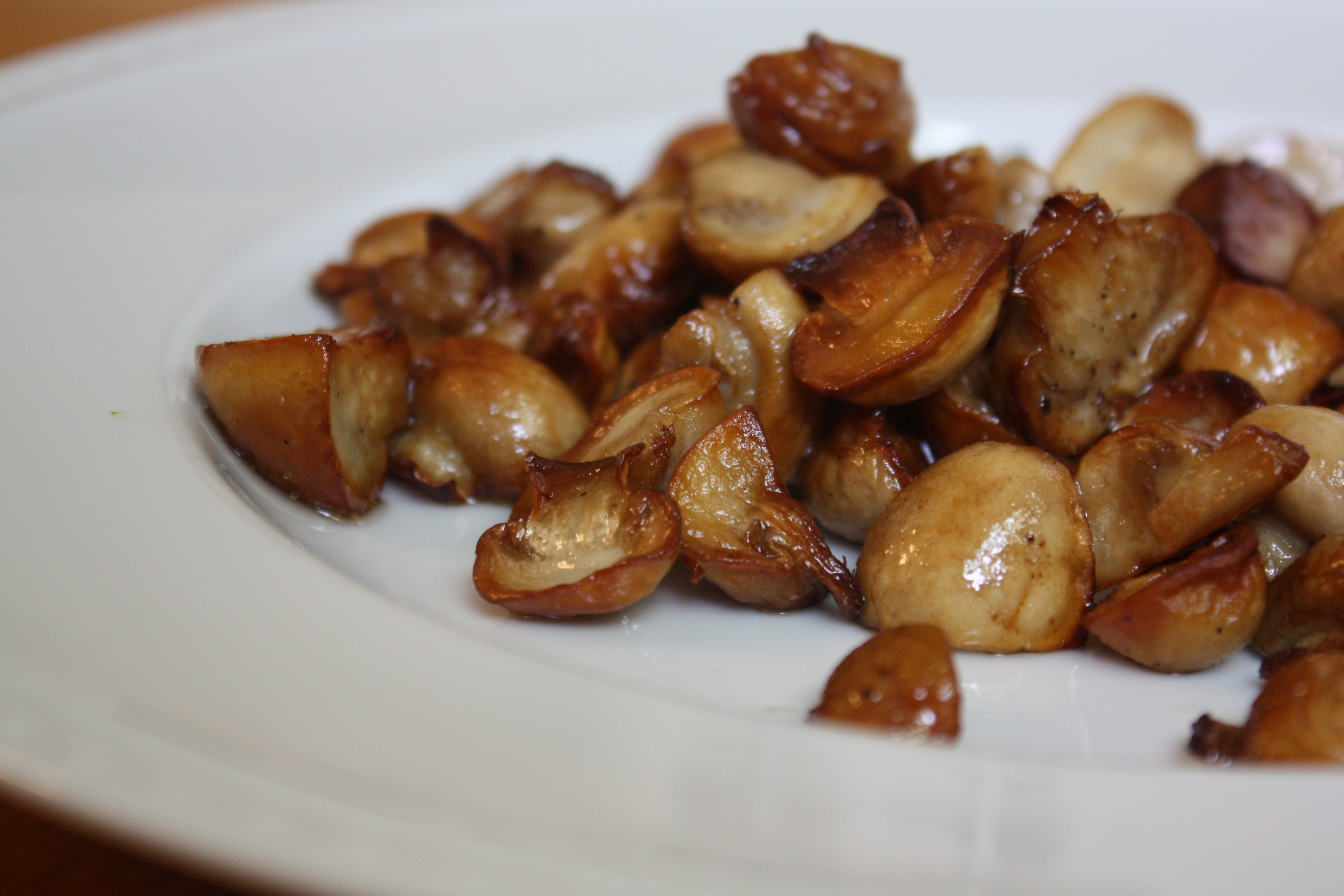
Heat the butter in a sauté pan over medium-high heat. Add the mushrooms. Cook for  about 10 minutes, stirring frequently.

*The mushrooms will at first appear to absorb the melted butter, but will eventually release the butter and their own liquid. As the liquid evaporates, the mushrooms will acquire a golden brown color.

Season with salt and pepper, then set aside.

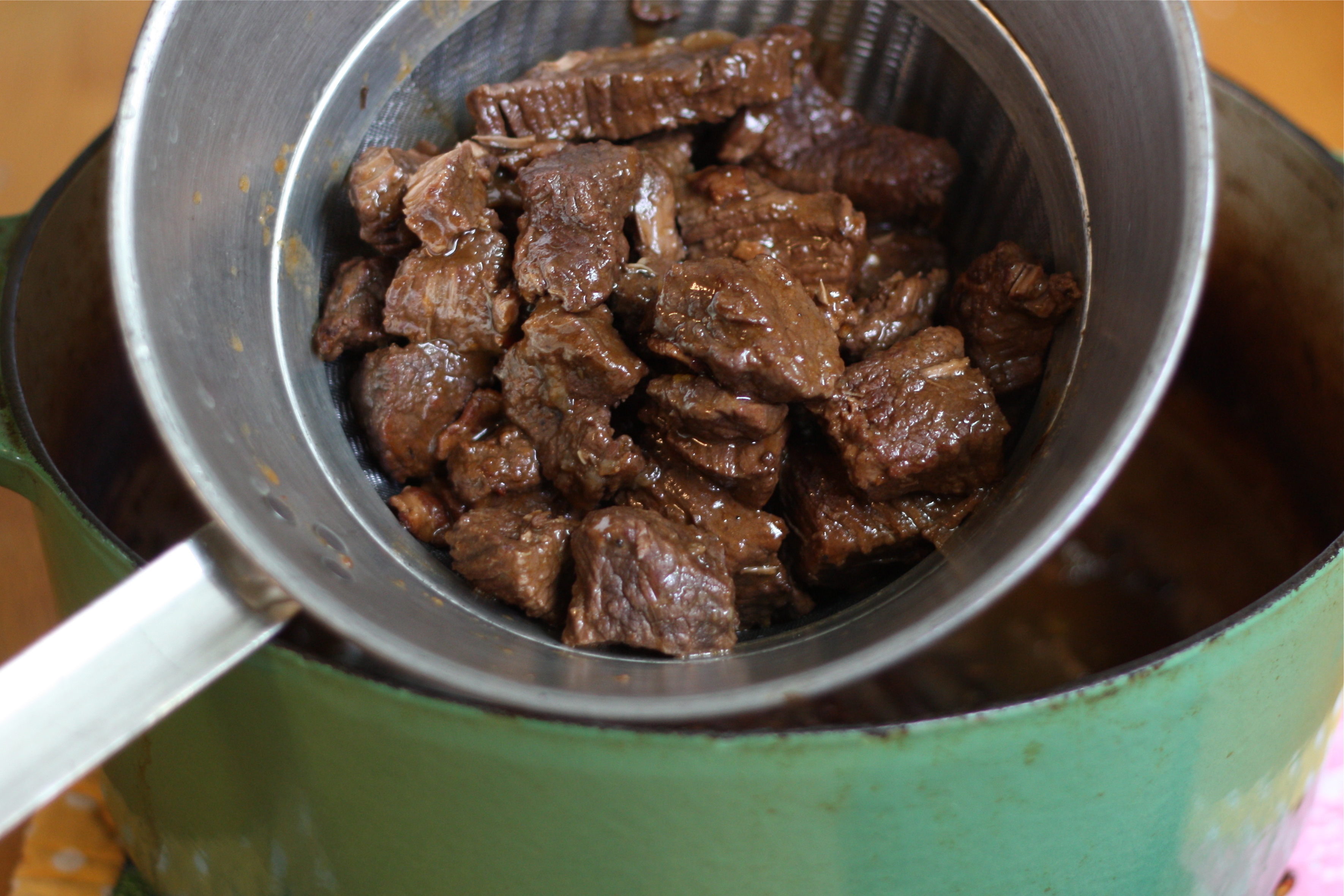
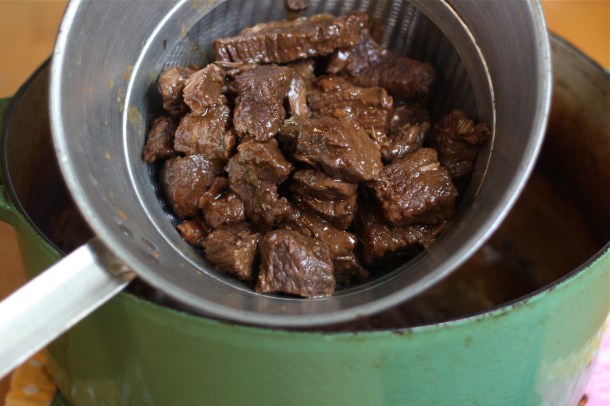
Once the beef has finished cooking, carefully pour the mixture through a sieve or strainer. Allow the sauce to collect in a large measuring cup (the 4-cup kind) or glass bowl. Return the beef and bacon to the dutch oven pan. Discard the carrot and onion pieces.
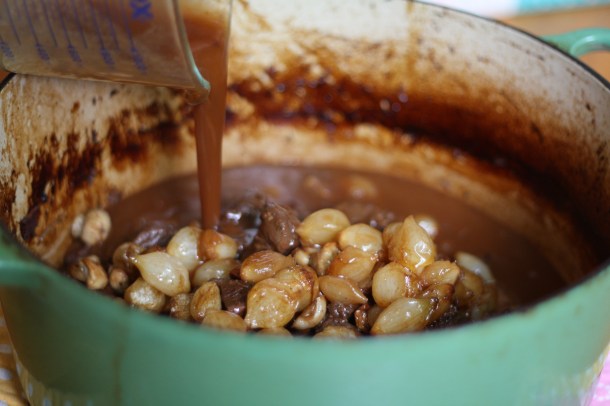
Arrange the brown-braised onions and sauteed mushrooms over the beef.

Allow the sauce to rest for a few minutes. The excess fat will rise to the surface as it rests. Use a spoon to collect and discard the excess fat. Repeat until much of the excess fat has been discarded.
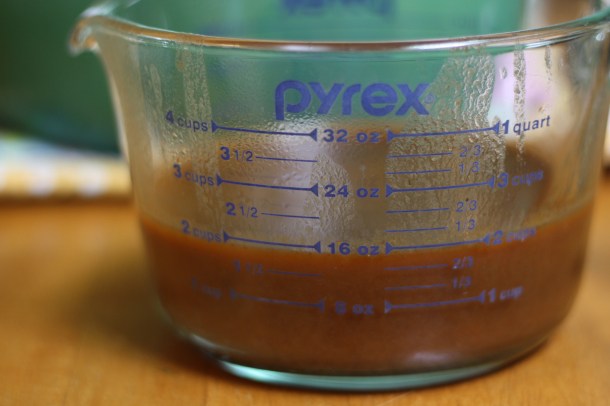
You should have about 2 – 2 1/2 cups of sauce. If you have much more than this, pour the sauce into a small saucepan and simmer uncovered until it’s reduced a bit. It should be quite flavorful and thick enough to lightly coat the back of a spoon. Taste and adjust the seasoning with salt and pepper, as desired. Pour the sauce over the beef, mushrooms, and onions.
Serve over boiled potatoes or hot-buttered noodles. Julia recommends a side of buttered peas as an appropriate veggie side.

This dish reheats exceptionally well. Simply bring to a gentle simmer on the stovetop for a few minutes, until all components are heated through.
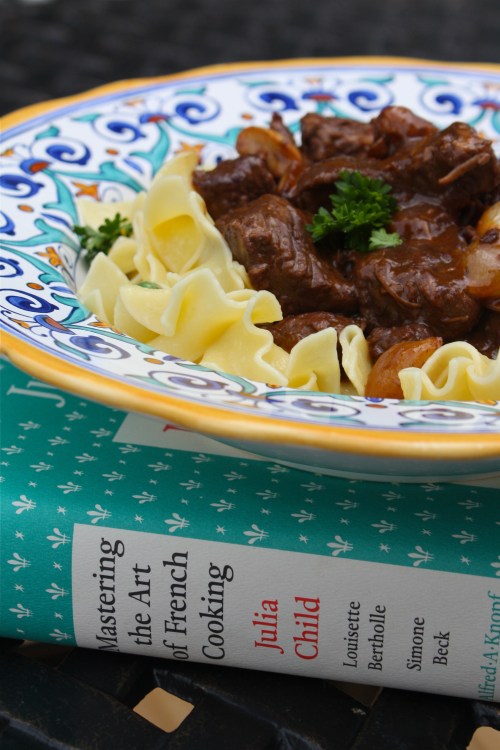
If you’ve got 30 minutes to spare, you can watch Julia cooking her beef bourguignon during the first episode of The French Chef  HERE.
Barbecue Bacon Mango Pizza

Posted on

The sun is barely risen. I’m lying in bed and I can feel sweet warm breath rhythmically hitting my face. I slowly open my eyes and find myself nose to nose with Lucas, my three-year-old, who climbs into bed with me each morning. I put my arms around him, then close my eyes and pretend to be asleep. He plays with one of my earrings, trying to remove the small silver leaf from my ear. After a moment, he abandons the earring and begins running his tiny fingers over my eyebrows. Behind me, I can feel my five-year-old, Liam, trying to braid my excessively long hair. Lucas becomes bored with my eyebrows and begins trying to forcefully push my eyelids open. I roll over to face my Liam. Liam pushes his nose closer to mine and whispers, I love you, Mommy. I kiss his nose. The baby begins to peep through the monitor, wordlessly begging to join the family snuggle time. My husband rolls out of bed to grab the baby. Once in our bedroom, our sweet baby James crawls over his brothers to get on top of me. He puts his wide open mouth onto my cheek. I think it’s a kiss. A very sloppy kiss. Then he tries to jam his finger into my mouth to touch my teeth. I rouse myself then, to bring the boys downstairs for breakfast before my little amateur dentist gets too aggressive.

I’ve come to realize that I belong to my children as much as they belong to me. We belong to each other. It’s a thoroughly symbiotic relationship.

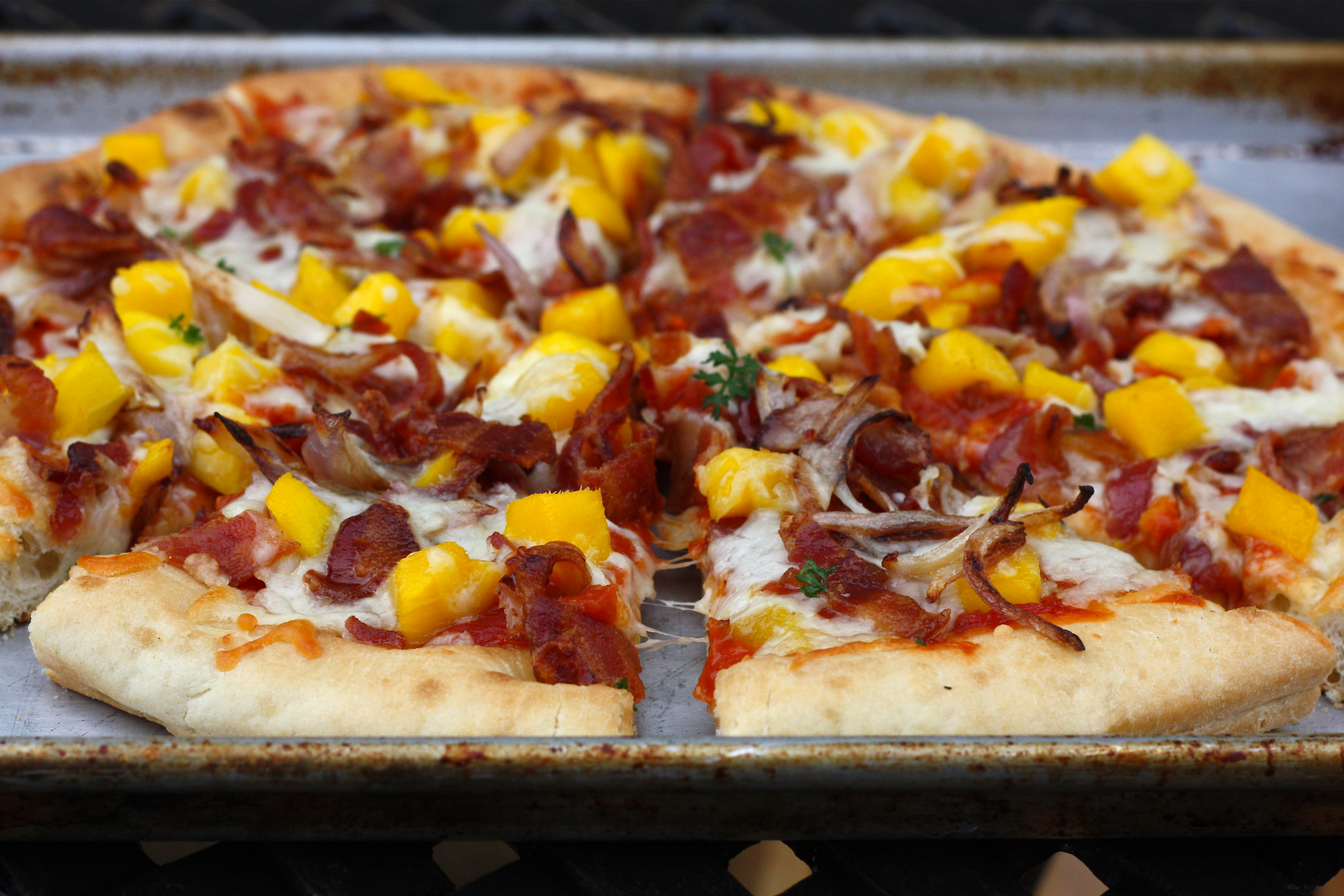
More than anything, I want my family to feel loved in the same way they so generously give their love to me. And one of the ways that I show my love is through fresh and delicious food, carefully crafted into delicious meals we can enjoy as a family, like this barbecue bacon mango pizza. This pizza is inspired by one of the recipes provided by The National Mango Board in a booklet they sent along with a shipment of beautiful ripe mangos. It instantly reminded me of a sweet and savory Hawaiian pizza, only substituting the ham for bacon and the pineapple for mango. Genius. Only I took that idea a little further by coming up with a homemade mango barbecue sauce, rather than slathering on something store-bought.

Though unplanned, the preparation of this pizza became a family affair. Small noses came running at the scent of bacon. Small hands stole said bacon. Small mouths gobbled up an entire mango before I had a moment to protest. We dubbed the afternoon Mangofest. There were tears when the last of the mango had been devoured, but smiles returned once this pizza was presented. Definitely a family pleaser! Best yet, the recipe for the barbecue sauce will make more than you need for the pizza…perfect for grilled mango barbecue chicken breasts the next day!!

Barbecue Bacon Mango Pizza

Ingredients

For the mango barbecue sauce

  • 1 tablespoon olive oil
  • 1/2 small red onion, chopped
  • 1 1/2 teaspoons garlic, minced
  • 1 (15-ounce) can tomato sauce
  • 1 1/2 cups fresh mango puree (2 medium mangos should do the trick)
  • 4 tablespoons tomato paste
  • 2 tablespoons brown sugar
  • 2 tablespoons apple cider vinegar
  • 1 tablespoon worcestershire sauce
  • 1 teaspoon dry mustard
  • 1/2 teaspoon cayenne pepper (plus more, if desired)
  • Salt (optional), as desired

For the pizza

  • 1 12″ pizza crust
  • 1/2 red onion, thinly sliced
  • 1 tablespoon olive oil
  • 1 mango, chopped*
  • 6-8 slices bacon, cooked and chopped
  • 3/4 cup mozzarella cheese, shredded
  • Fresh parsley, chopped

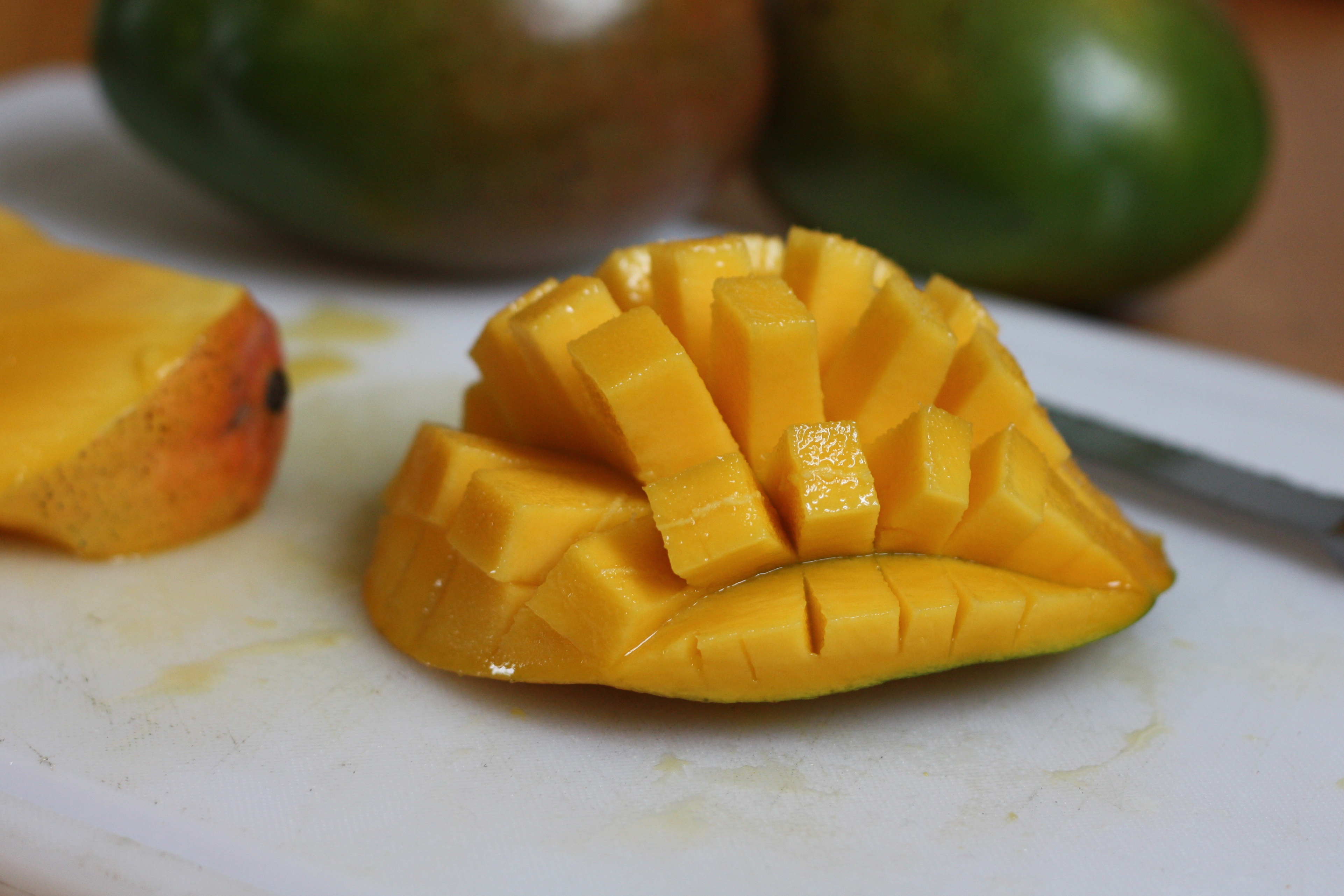
* Click HERE to see my photo guide on how to chop a mango.

Directions

To prepare the mango barbecue sauce: Heat the olive oil in a large pan over medium/medium-low heat. Add the onion and cook for 5-7 minutes until tender and translucent. Add the garlic and cook for another minute or two. Add all other barbecue sauce ingredients and stir to combine. Bring to a very gentle simmer, then reduce the heat to low and simmer for about 25 minutes, stirring occasionally to prevent burning. Allow the sauce to cool, then use a food processor or blender to puree until smooth. Taste the sauce and adjust seasoning as desired. Refrigerate until using.*

To prepare the pizza: Heat the oil in a small pan over medium/medium-low heat. Add the onion. Cook for about 15 minutes, stirring frequently to prevent burning, until the onions are tender, sweet, and lightly golden. Spread a thin layer of the sauce (approximately 1/2 cup) over the pizza crust. Scatter most of the bacon, mango, and onions over the sauce. Top with the shredded cheese. Scatter the remaining bacon, mango, onions, and parsley on top. Bake in a 400 degrees oven for about 12-15 minutes, until hot and melty.

*The barbecue sauce recipe will produce more sauce than is necessary for the pizza. You can use the sauce as you might use any barbecue sauce on grilled chicken, ribs, shrimp… It would also freeze nicely for later use.

The Gourmand Mom

Good food, seasoned with a dash of life